
The American Ambulance of 1870-71
- Creator
- AA
- When
- Roots
- Where
- France
The American Ambulance of 1870-71
The history of improvised hospitals is linked directly to the history of military medicine: it was due to the initiative of one of the most illustrious members of the officers corps of the French Military Medical Service that tents and barracks were made use of for hospitals, during wartime.
It is true to say that in the various major wars of this century, due to overcrowding of hospital buildings, military surgeons had to resort to hospitalizing the sick and wounded in tents; but this was done only out of extreme necessity, as an exceptional measure and, despite the good results obtained, the use of these kinds of hospitals was never generalized until the advent of the Crimean War.
__ Les ambulances de la Presse pendant le Siège et sous la Commune, 1870-1871, Marc, Paris 1872, p. 202.
In 1867, an international convention of the Societies for Assistance to the War Wounded was held in Paris, in conjunction with the World Trade Exhibition. Among the displays at the Exhibition was a complete American tent "ambulance", the fruit of Civil War battlefield experience. Dr. Thomas W. Evans was the organizer.
"As early as the year 1865, I decided to assemble in a collection and at my own expense," Evans said, "the inventions which had enabled the Sanitary Commission to obtain its wonderful results." His calculation was that the progress made by the United States sanitarians during the Civil War had saved the lives of a hundred thousand men. Dr. Evans approached inventors and manufacturers in the United States and sent his friend Dr. Crane to America to select and supervise. The result was an important collection of medical books, documents, photographs, apparatus, and equipment illustrating the work of the Sanitary Commission.
The commission had planned to send an exhibit to Napoleon III's great Paris fair of 1867. But the American government refused to cooperate. Dr. Evans, with his own collection as the nucleus, now came forward to fill the vacuum. France gave him space on the fairground, and Evans paid the cost of transporting exhibits from the United States and constructing a building on the grounds of the Champs-de-Mars.
__ Gerald Carson, The Dentist and the Empress, Boston: Houghton Mifflin, 1983.
1870-1871: France's "année terrible"
- 13 July 1870 France declares war on Prussia
- 1 Sept 1870 Surrender of Sedan
- 4 Sept 1870 Fall of the Second Empire
- 20 Sep 1870 Prussian encirclement of Paris completed
- 27 Dec 1870 Prussian bombardement of Paris
- 27 Jan 1871 Armistice
- 30 Jan to 6 March Prussian occupation of Paris
- 18 Mar 1871 Paris rebels seize power, Thiers flees to Versailles
- 26 Mar 1871 Paris elections
- 28 Mar 1871 The Commune installs itself in the Hôtel de Ville
- 15 Apr 1871 Thiers bombards Paris
- 21 May 1871 Government forces enter Paris ("semaine sanglante")
- 28 May 1871 Shooting of 147 Communards in retaliation for the murder of the Archbishop of Paris
July, 1870
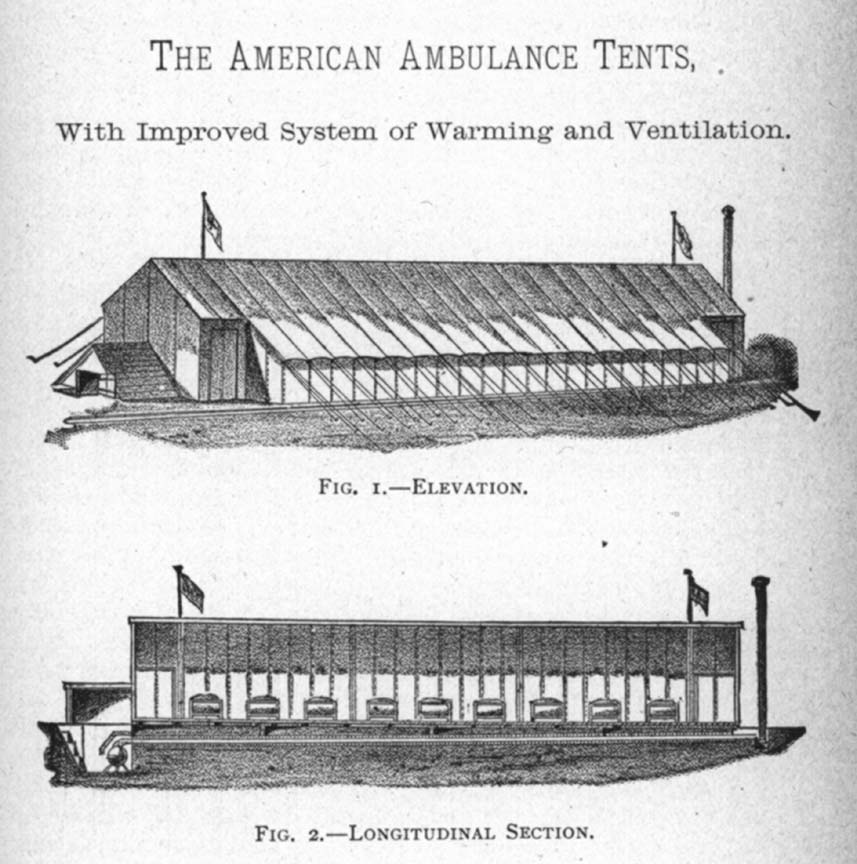
The day before the declaration of war Dr. Evans called a meeting of representative men of the American colony in Paris. Twenty-five gathered at his office and established a committee called the American International Sanitary Committee. Dr. Evans was named president, with his faithful colleague, Dr. Crane, as secretary. The doctor at once ordered ten U.S. Army regulation tents through his friend and New York lawyer, Horace Ely. What Evans had in mind was to set up a field hospital under canvas, instead of crowding the sick and wounded into churches and public buildings, as was customarily done in Europe. It was decided that the best place to establish the ambulance was in Paris, since the Germans might advance rapidly as indeed they did.
__ Gerald Carson. The Dentist and the Empress. The Adventures of Dr. Tom Evans in Gas-Lit Paris. Boston: Houghton-Mifflin. 1983.
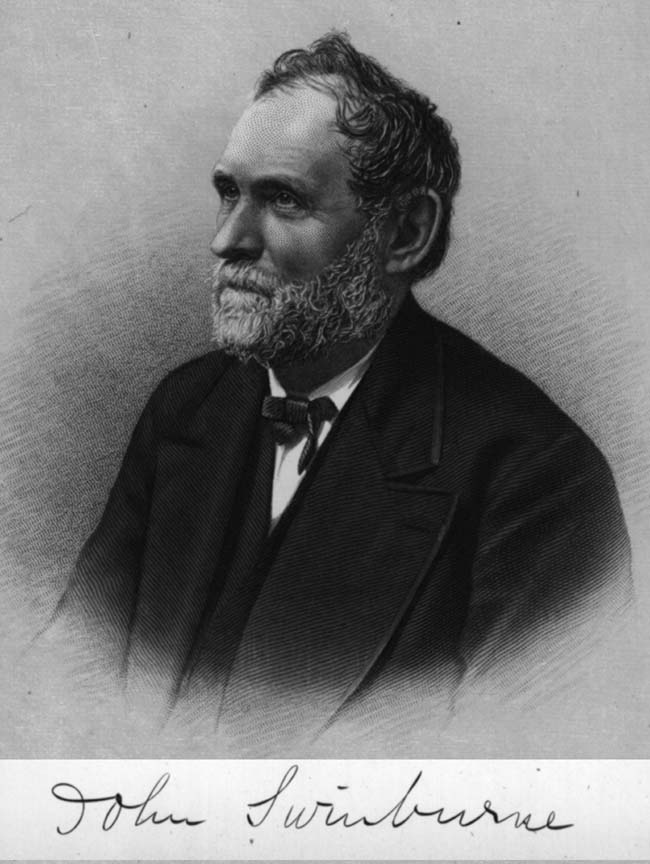
When the clouds of war were gathering, and the murmurs were portentous of what followed, a large meeting of American citizens residing in Paris was held in that city on July 18, 1870, when it was decided that they as non-combatants would organize a system of "Help for the Wounded of All Nations" on strictly humanitarian grounds, and elected as an executive committee Thomas W. Evans, M.D.(president), Edward A. Crane (secretary), Col. James McKaye, Albert Lee Ward, and Thomas Pratt, M.D. As late as the 26th of August neither the French minister of war nor the representatives of foreign governments would guarantee to recognize the proposed American ambulance at any headquarters, asserting no special passports could be accorded it, and adding that all movements made by the ambulance must be at its own risk and that of its personnel. Besides these obstacles, there was a feeling among the French soldiery that all foreigners not attached to some branch of the French army were Prussian spies. This was the condition of affairs when three members of the committee, indorsed by Minister Washburn, visited London, and solicited Dr. Swinburne to accompany them to Paris and voluntarily take charge of the American ambulance, and introduce, for the sake of humanity, his system of conservative surgery which had proven so great a boon during our civil war. It must, in this connection, be remembered, that every service to be rendered was to be voluntary, each person attached to the ambulance bearing all his individual expenses.
__ The Citizen's Association. A Typical American. Incidents in the Life of Dr. John Swinburne. Albany: The Citizen's Office, 1885.
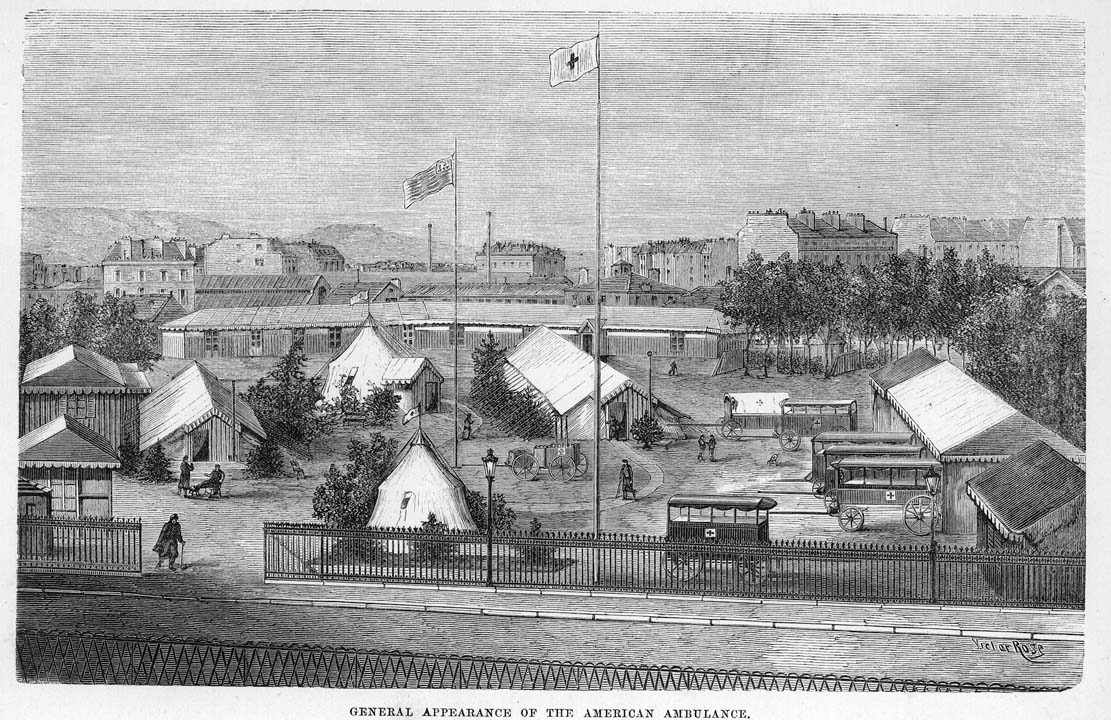
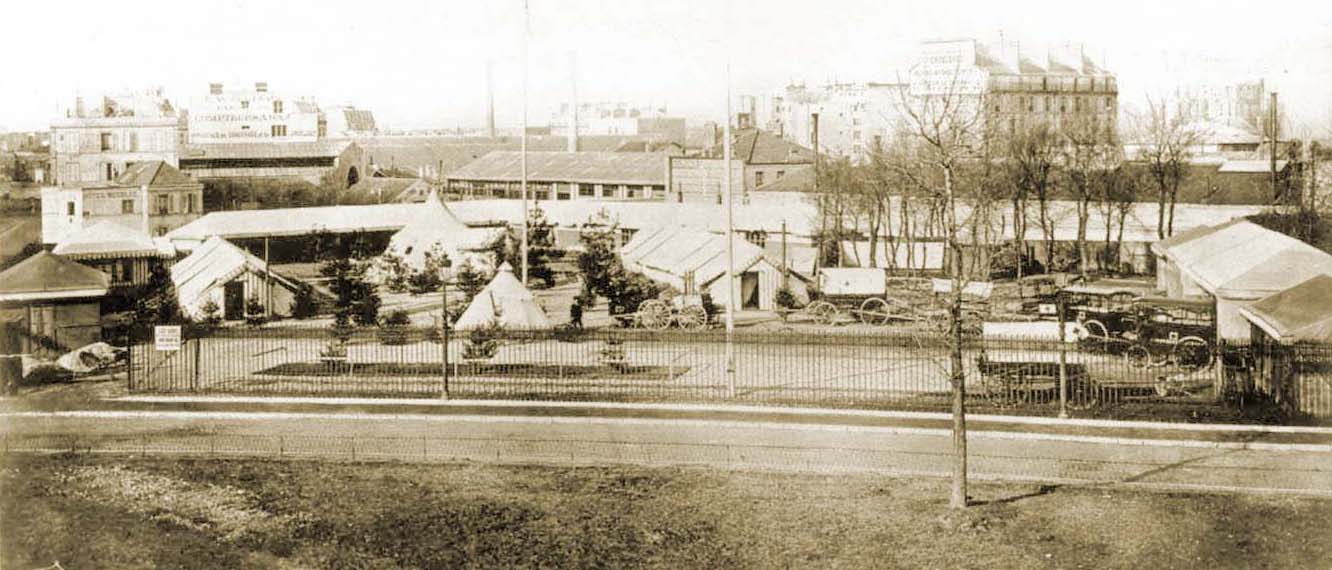
The American Ambulance was set up on the northern side of what is now Avenue Foch, opposite Dr. Evans' residence, about half way between the Arc of Triumph and the Bois de Boulogne.
"About halfway down the Avenue de l'Impératrice, on the right, you perceive a number of tents ---not a large number, a veritable little city of canvas: it is the American ambulance. You are at first surprised that the wounded can be treated almost in the open air; but if you enter, you will very quickly change your first impression . . . . Let no one fear that bronchitis and other diseases of the respiratory organs have been occasioned by this practice. Facts have settled this question . . .
__ The Citizen's Association. A Typical American. Incidents in the Life of Dr. John Swinburne. Albany: The Citizen's Office, 1885.
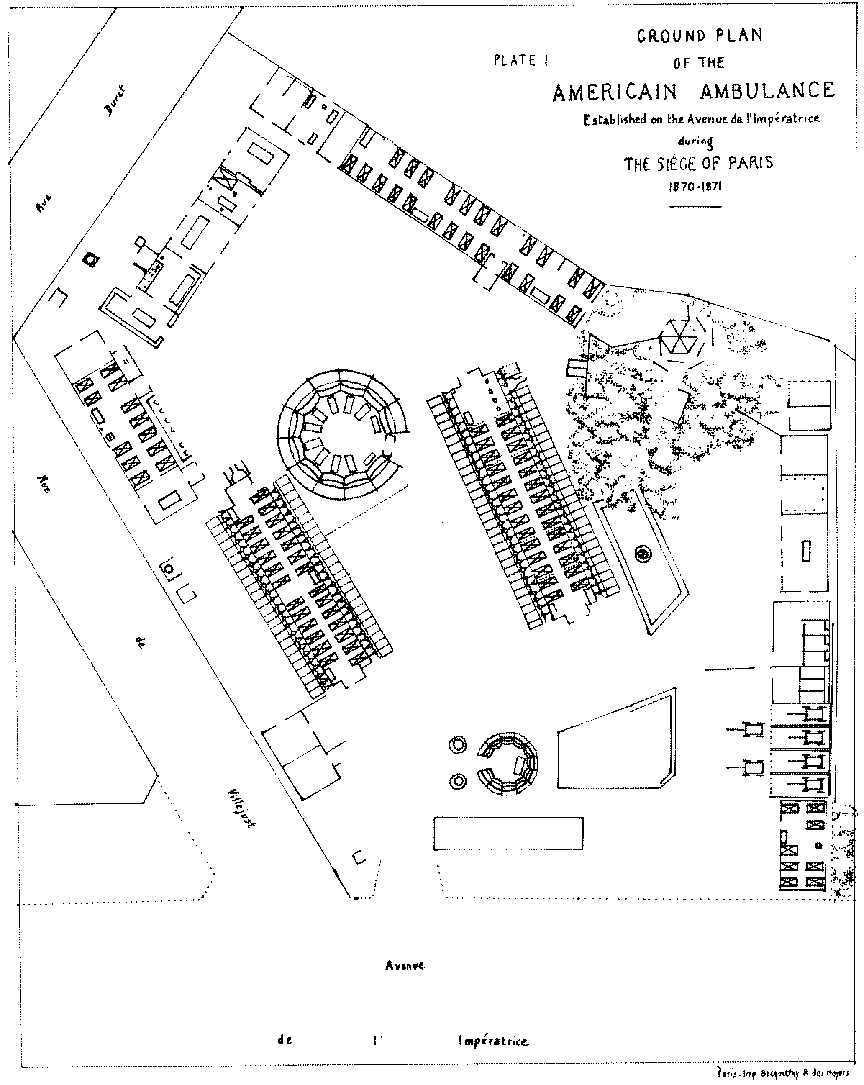
A plot of ground, about an acre and a half in extent, covered with weeds and poorly drained, was obtained from the Prince de Bauffremont, one of Dr. Evans's patients and a friend of the Empress. The site was across the street from Bella Rosa, with its entrance on the Avenue de l'Impératrice, where the great avenue sloped gently down toward the fortifications. The first tents went up on September 1. A big American flag was borrowed from Bowles Brothers and Company, an American banking house, and in the bright sunlit days of early September the volunteers drove tent pegs and greased the ambulance wagon wheels. American ladies, wearing the brassard of Geneva strapped on an arm, ranged the principal streets, carrying sticks with a sack attached at the end to receive contributions for the wounded: napoleons worth about twenty francs from persons in easy circumstances, sous from working men and grisettes. But most of the money was provided by Dr. Evans himself. He estimated that during the period of the operation of the ambulance he drew on his personal account with the Rothschilds for approximately 1.25 million francs, or $250,000 as he calculated his expenditures in 1873.
The borders of the encampment were set with young spruce and fir trees for "purifying the air," with a grove of evergreens also in the central portion of the grounds. A bright and cheerful atmosphere was created with the white tents, bright-colored awnings, graveled walks, flower beds, orange and pomegranate bushes set in green tubs. There were two tall flagstaffs. One carried the Red Cross flag, the other the American flag. The amenities included a piano, several singing birds, a tortoiseshell cat, a yellow dog, and four cows.
Supporting facilities included a barracks, kitchen, washhouse, storehouse, offices for the surgeon, the committee, the volunteer aides, and the ladies who did the nursing and cooking, read to the patients, wrote letters for them, entertained them with a game of checkers or backgammon. The ambulance wagons were manned by high-spirited young Americans who formed, Evans noted, 'a sort of connecting wire between it (the field hospital) and the whole of the American colony in Paris.' Sometimes they accompanied their work with songs, including a lusty rendition of "Marching Through Georgia" in times of greatest danger. This caused a considerable degree of astonishment among the French and German soldiers, whose immediate task was to disembowel each other.
__ Gerald Carson, The Dentist and the Empress, Boston: Houghton Mifflin, 1983. P. 107-109
False Start
In the general eagerness to defend the French cause there were no patriots more ardent than the members of the numerous and well-to-do American colony. The best way for them to show their devotion to their beloved France, they decided, was to organize an American ambulance corps for service in the field; and the best way to ensure their ambulance corps' quality and prestige was to ask the renowned Marion Sims to serve as its leader.
Prompted partly by disturbing recollections of his much-criticized aloofness from his native land's own recent war, Sims, though he was fifty-seven years of age, was quite as anxious as any of his fellow expatriates to do his share for the country which had been his home for nearly a decade, but inasmuch as he had made definite commitments to return soon to New York he demurred at first when a committee of American residents presented their request. His wife, however, was insistent in reminding him that the hospitality he had received from France was so great as to deserve repayment at any cost, and, as so often happened, her good counsels prevailed.
No sooner had he agreed to serve than he began to find that organizing an ambulance corps of Americans was not so easy as it sounded. The trouble lay not in any lack of physicians and others eager to serve, but rather in the fact that at the moment France was in a mood to feel suspicious of all foreigners. At the war's outset the French Society for Aid to the Wounded announced that all foreign surgeons would be banned. Next the Emperor proclaimed that any British and American surgeons who cared to offer their aid would be welcomed, provided they would serve under French leadership in France's own military hospitals. The few outlanders who assented to these conditions, however, soon found their activities so uncomfortably restricted by French suspicions of espionage that they were forced to withdraw. Even when at last the French authorities agreed to accept the American offer to provide an ambulance corps the road was still not clear, for by then dissension had arisen between the American colony's committee and the group of physicians and aides whom Sims had enlisted. The committee maintained that the doctors should set up their tents in Paris and await the coming of the Prussians. Sims and his associates were shocked at this suggestion, insisting that their organization had been formed for the purpose of succoring the wounded on or near the field of battle, and therefore it was their duty to proceed at once to the front.
In the midst of this impasse there arrived in Paris a representative of the English National Society for Aid to the Sick and Wounded in War, armed with plenty of money and supplies, and quite as anxious as Sims and his young followers to reach the seat of war. Almost overnight a new line-up emerged. The American surgeons promptly decided to break away from the sponsorship of the hesitant American committee with which they had been bickering and to unite themselves instead with the doctors whom the British organization was supporting. Thus there was born the Anglo-American Ambulance Corps, composed of eight Americans and eight Englishmen, with Marion Sims as surgeon-in-chief and with Sims's son-in-law, Tom Pratt, and two young British physicians, Drs. Frank and MacCormac, as its other executives. (MacCormac later became one of England's most eminent surgeons.) Included among the eight Americans was young Harry Sims, now graduated from college and planning soon to embark on medical studies at the College of Physicians and Surgeons in New York.
__ Seale Harris. Woman's Surgeon. New York: MacMillan, 1950.
On the 26th of August the question of "going" or "staying" was once more thoroughly and anxiously discussed. Those who were desirous of making an immediate dash to the front, set forth their view of the case, and urged an immediate decision in its favour. More than ever convinced of the impolicy of moving at the moment when the German armies were rapidly converging upon Paris, when "the mountain" in fact "was coming to us," the president was, nevertheless, willing to let the question be decided, then and there by a vote of the majority.
The question was accordingly put to the vote ; but the result was a tie, half the members voting for an immediate move, the other half voting not to move, but to await in Paris until events should have more clearly revealed the course to be pursued. The question was, therefore, undecided. [...]
The divergence of opinion which existed within the Committee was destined, however, to be definitively settled by the incidents of the meeting referred to. One member of the Committee, and the whole of its surgical staff withdrew. [...]
The three gentlemen who were now left to represent the Committee, having very soon decided to remain in Paris, and to proceed immediately to the organization of an ambulance in that city, addressed a letter to Dr. John Swinburne, then in London, inviting him to come over to Paris, and take charge of its surgical department.
__ Thomas W. Evans. History of the American Ambulance Established in Paris during the Siege of 1870-71, London: Low, Low and Searle, 1873.
The Ambulance in action
"Here I am, within a few rods of the inner fortifications of Paris. I had been in England, Ireland, and Scotland, visiting hospitals and other places of interest, until last week, when I received notice that I was wanted here. With Louis (my son), I immediately left for this place, where the Americans have established a hospital and ambulance corps out of American manufactures, including tents and about two hundred American patent beds, stretchers, etc. You would not blush for America, could you see these arrangements, and compare them with the English, or even the French. In truth, they are the admiration of the place. The soldiers say, if such accommodations were provided them, they would not mind being wounded.
__ The Citizen's Association. A Typical American. Incidents in the Life of Dr. John Swinburne. Albany: The Citizen's Office, 1885.
During this period of which Dr. Gordon writes, there were in and around Paris six hundred and thirty-four ambulances, in addition to ten hospitals, and at least three thousand surgeons from all the nations of Europe, many of them holding the leading places among their professional brethren as physicians and surgeons. It is a remarkable feature in his work, that, out of this multitude of ambulances, he selected the American as the model one in its installation, on which to treat at length; but a still more remarkable feature was his selection of numerous cases treated by Dr. Swinburne, out of the thousands, and the minutiæ with which he described their treatment and results as of the most vital interest to science. In his book he devotes more space to the work of the American surgeon, and cites more of the cases treated by him, than by any other individual, or, indeed, the whole of the other surgeons combined.
__ The Citizen's Association. A Typical American. Incidents in the Life of Dr. John Swinburne. Albany: The Citizen's Office, 1885.
Fancy a beaming, grizzle-bearded, sure-handed master surgeon working for pure philanthropy, with a heart as soft as his language is strong; a spruce Quakeress, scandalized at the slightest impropriety; two ladies of the opera; an extremely Evangelical parson, believing in the efficacy of texts printed in French; a number of bankers and idle young men, believing in nothing at all; a stray Englishman or two; and finally, a rich woman of colour, who has left her luxury in order to perform the most menial offices for the wounded men, and to be snubbed by the rest of the ambulance.
__ Thomas G. Bowles, The Defence of Paris; London: A. Low, 1871, pp 172-3.
I am writing you amid the sound of heavy cannonading ---hundreds of iron mouths belching fire against and from the city for three parts of its perimeter, the other portion being held by the Germans. All around our own fine quarter of the Champs Elysées we are daily visited by a shower of shells bursting upon the avenues that radiate from the Arc de Triomphe, breaking into fine houses, or striking them with the flying fragments.
__ W.O. Lamson [The Episcopal parson referred to above],"The American Church in Paris", The Church Journal (N.Y.), v. 19, p. 188, 14 June 1871.
On entering the grounds, our visitors glanced round at the throng of volunteers sauntering about, and asked curiously: 'But who are these gentlemen, messieurs?' Kent explained that they were members of the volunteer staff, which was divided into two squads doing duty on alternate days, and pointed out several of the more prominent. 'But they are men of wealth and high standing in society,' said the little gentleman in surprise;'Certainly, sir; but that consideration doesn't seem to make any difference with their picking up a wounded man or dressing an injured limb on the field.'
__ Louis Judson Swinburne, "Chapter Two", Paris Sketches, Joel Mursell, Albany NY, 1875.
Orders had been received at headquarters to be in readiness to move, and the whole camp was consequently in commotion. The volunteer service was larger than it had ever been before, and more completely equipped. Each aid wore the usual navy cap with its shield bearing the red Geneva-cross, and the regulation brassard about his arm.
__ Louis Judson Swinburne, "Chapter Four", Paris Sketches, Joel Mursell, Albany NY, 1875.
It was at first impossible for us to proceed, the road being so jammed with ambulance trains; but when the facts of our situation were made known at headquarters, a speedy answer came, in the person of Dr. Sarrazin, who dashing up on his famous bay, shouted in a stentorian voice: 'L'ambulance américaine en avant!' And to the front we went, passing by scores of great, lumbering omnibuses, and out upon the unobstructed avenue. This little incident established a precedence for us, for ever afterward we had the honor of holding the van of the French army trains.
__ Louis Judson Swinburne, "Chapter Four", Paris Sketches, Joel Mursell, Albany NY, 1875.
Our carriage was filled with wounded before we reached the Mairie, whither we had been directed to go, and accordingly we turned about and drove home to the ambulance as quickly as consistent with our load. Returning we found all the ambulance trains drawn up on the outskirts of the village, their drivers, aids, and hangers-on standing round on foot; and we were driving on without stopping to inquire the cause, when one of our own wagons came up on its trip to the city.
"You'd better not go on," halloed one of the gentlemen as we passed, " the shells are falling like hail."
"Pshaw!" we replied, "all nonsense"; and we went on.
__ Louis Judson Swinburne, "Chapter Eleven", Paris Sketches, Joel Mursell, Albany NY, 1875.
Here a part of our corps left us and moved down the slope to Rueil. They were evidently excited by the scene, for we could hear them singing as they tramped on ---"Marching through Georgia!"--- at the top of their voices, ---Will Dryer's high tenor and the gruff basso of Captain Bowles being easily distinguishable. Cheer after cheer rose from the French reserve, and all along the line.'What's that for?' called out Frank to a returning squad.'Les Américains!' a voice replied. Our friends' enthusiasm had aroused their admiration. But we had seen all there was to be seen, and Frank and I started with the first carriage-load. We drove carefully, for the poor fellows were suffering severely, and the slightest jolt made them cry out with pain. It was far into the night when they thundered across the draw-bridge of the Porte Maillot.'Hola! de quelle ambulance êtes-vous?' By the glare of the torches we saw the gleam of an armed guard.'L'ambulance américaine!' -'Passez.'- Inside the walls were assembled an anxious crowd. With some difficulty we got through the press, and at last drove into the ambulance grounds with our wagon-load of sufferers."
__ Louis Judson Swinburne, "Chapter Four", Paris Sketches, Joel Mursell, Albany NY, 1875.
All in all, the state of the Parisian 'ambulances' showed little advance over what Lord Raglan's men had suffered in the Crimea. And the nearest resemblance to any Florence Nightingale upon the scene lay in the presence of the American Ambulance, which owed its existence to Dr. Thomas Evans, the handsome and enterprising dentist who had assisted the Empress Eugénie to flee from Paris. After the Great Exhibition of 1867, Evans had (for no very clear reason) bought up the whole collection of up-to-date medical equipment of the American Civil War exhibited in Paris, and when the war broke out, he had organized an ambulance and presented all this equipment to it, plus 10,000 francs. In charge of the American Ambulance was Dr. Swinburne, as Chief Surgeon, who based his work on Civil War experiences. There it had been proved that the most effective way of combating septicaemia was by ensuring perfect ventilation. To the astonishment of the French with their native horror of courants d'air, the American Ambulance housed its two hundred wounded in draughty tents, kept warm only by a stove placed in a hole in the ground which dried and heated the earth beneath the tent. The results were miraculous: whereas four out of five died in the purulent confines of the Grand Hôtel, four out of five of Swinburne's cases survived.
The British correspondents were constantly singing Swinburne's praises, and even Dr. Alan Hebert, working in Wallace's British Ambulance, had to admit that its American counterpart was 'one of the shows of today'. On any battlefield the American Ambulance was always (according to Terry Bowles) the first to arrive; at the Great Sortie it brought in eighty wounded men, one of them dying in the arms of Washburne's son; and at a later engagement its field clearing-station was actually hit by Prussian shells. Its fame spread fast. Labouchère said: 'It is the dream of every French soldier, if he is wounded, to be taken to this ambulance. They appear to be under the impression that, even if their legs are shot off, the skill of the Aesculapi of the United States will make them grow again.' It may have been a mild exaggeration, but certainly there was no mistaking the efficacy of Evans' and Swinburne's team; nor the Parisian gratitude which their work of mercy gained for the United States.
__ Alistaire Horne, The Fall of Paris, St Martin's, NY 1966, pp. 174-175.