
The Geneva Convention of 1864
- Creator
- AA
- When
- Roots
- Where
- Switzerland
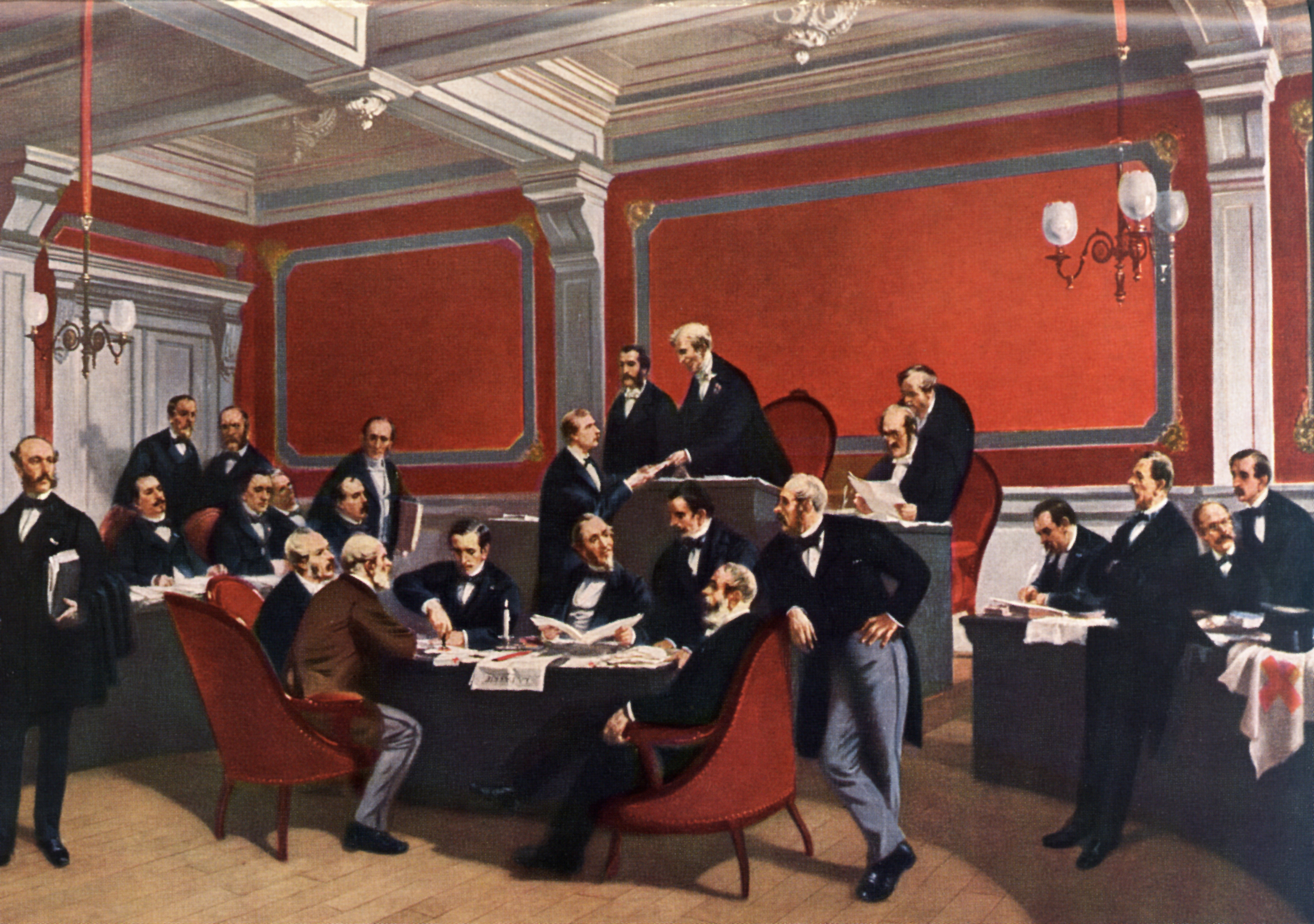
The Geneva Convention of 1864
Mabel Boardman. Under the Red Cross Flag at Home and Abroad. Philadelphia: J.B. Lippincott, 1915.
For many years there had existed in Geneva a Society of Public Utility, whose efforts were devoted to the furtherance of philanthropic and humane work. This Society of which Monsieur Gustave Moynier was president, appointed a special committee, which sent out a general invitation for a conference to be held at Geneva in October, 1863, to consider the question of volunteer aid for the medical service of armies in time of war and also the neutralization of its personnel. Occasionally special temporary agreements had been arranged between nations at war whereby hospital formations and their personnel were neutralized and protected, but there was no international agreement to this effect.
In the letter of invitation for the conference sent to a large number of public-spirited men the Committee for the Relief of Wounded Soldiers said:
"The Geneva Society of Public Utility, complying with the desire expressed by Mr. Henri Dunant in a book entitled 'A Souvenir of Solferino, ' organized among its members a committee charged with working towards its realization.
"This committee in turn thought that the best course to pursue in order to carry the ideas of Mr. Dunant from the domain of theory to that of practice, would be to bring about a meeting of those persons who in the various countries have at heart the philanthropic work in question, in order to examine within what limits his suggestion is practicable, and to devise measures for carrying it out if possible. "
With this letter was sent a proposed draft of a proposed agreement for discussion. The somewhat lengthy name suggested for the conference was, "An International Conference for Investigating the Means to Supplement the Inadequacy of Medical Services of Armies in Campaigns. "
[...]
The deliberations of this conference at Geneva were expressed in resolutions to the following effect:
That in each country adhering to the proposed agreement a committee should be formed to co-operate in time of war with the military medical service, each committee being organized as its members deemed expedient; in time of peace a trained personnel should be organized and supplies collected;the aid of the societies of neutral nations might be invited; the volunteer societies irrespective of the country to which they belong should wear distinctive badge-a red cross on a white ground. The conference also recommended the neutralization of hospital formations and their personnel.
Because of the success of this conference, the Swiss Government in 1864 addressed an invitation to twenty-five sovereign States to send representatives to a diplomatic convention to be held that year in August at Geneva. At this convention the United States was represented informally by our Minister to Switzerland, Mr. George C. Fogg, and associated with him was Mr. Charles S. P. Bowles, European agent of the Sanitary Commission.
In the letter authorizing Mr. Fogg to attend the convention, the Secretary of State said:
"The object of the proposed congress is certainly laudable and important, and the Department sees no objection to your being present on the occasion. You are, therefore, authorized to attend the meeting in an informal manner, for the purpose of giving or receiving such suggestions as you may think likely to promote the humane ends which have prompted it. It is hardly necessary to add that your presence at the congress would be improper if any of the insurgent emissaries of the United States in Europe should be permitted to take part in its proceedings. "Many of the military representatives at this convention were incredulous as to the possibility of securing the adoption of a treaty based on the recommendations of the conference of the year before. Fortunate it was for this great project that a representative of the Sanitary Commission was present
Mr. Bowles in his report, says:
"But I was able to prove that this same 'mythical' institution-the United States Sanitary Commission had long since met with and overcome the difficulties which some delegates were now predicting and recoiling before; had long since solved, and practically, too, the very problems which they now were delving over. Moreover, I had just arrived from the scene of these labors in the United States, and with the battlefield, hospital and burying ground freshly pictured in my mind, could speak to them but too earnestly of war, the disease of all nations, and its known or proposed remedies. I had brought with me from the United States the latest reports and most valuable publications of the Commission, and a number of photographs from life of the field relief corps with its men, wagons, horses, tents, and their arrangements and action. These life pictures, books and practical proofs, produced an effect as great as it was valuable. To many of them, earnest men seeking for light, with their whole hearts in the interest of a long suffering humanity it was like the sight of the promised land. They had been working in the dark, and this was the opening of a window, letting in a flood of light and putting an end to all darkness and doubt. "
A remarkable spirit of harmony characterized the convention, for, although discussions were often intense and opinions differed widely, one of the delegates reports: "Yet the charm was never broken by an unkind word or feeling between any two of its members. " The treaty which was eventually adopted is generally called the Geneva Treaty, but sometimes the Red Cross Treaty. It provides for protection for hospital formations and their personnel in time of war. Out of compliment to Switzerland the Swiss flag with its colors reversed-a red cross on a white ground-was adopted as the worldwide insignia of humanity and neutrality.
More
William H. Taft (ed.) Service with Fighting Men, New York, 1922.
"The result of his strenuous labors was the Convention of Geneva in 1864, called by the Swiss Government. Its aim was to bring the governments of Europe to an agreement which would make possible more humane treatment of the sick and wounded in war. The civilian appeared in a new rôle---the framer of rules of war that would permit workers unmolested to serve the wounded on the field of battle and that would guarantee some security for hospitals and ambulances."
Caroline Moorehead, Dunant's Dream. War, Switzerland and the History of the Red Cross, New York: Carroll and Graf. 1998.
"At one o'clock on 8 August 1864, the Diplomatic Conference opened at last in Geneva. [...]
"Two weeks later, on 22 August, the first international legal instrument to regulate certain aspects of warfare was ready for signature. Formally known as the Convention for the Amelioration of the Condition of the Wounded in Armies in the Field, it covered care and respect for wounded soldiers regardless of their nationality (Article 6); and it enshrined the principle of neutrality for ambulances, military hospitals and hospital personnel (Articles 1 and 2). Anyone helping the wounded was to be 'respected and remain free' (Article 5). And since neutrality clearly depended on being able to recognize them, a red cross against a white background --- conveniently the Swiss flag reversed --was to be accepted as the universal emblem for all medical people and places, whether on a flag or as an armband. From now on the words 'Red Cross' were increasingly used when referring to the new movement"