
Henry Dunant at Solferino
- Creator
- AA
- When
- Roots
- Where
- Europe
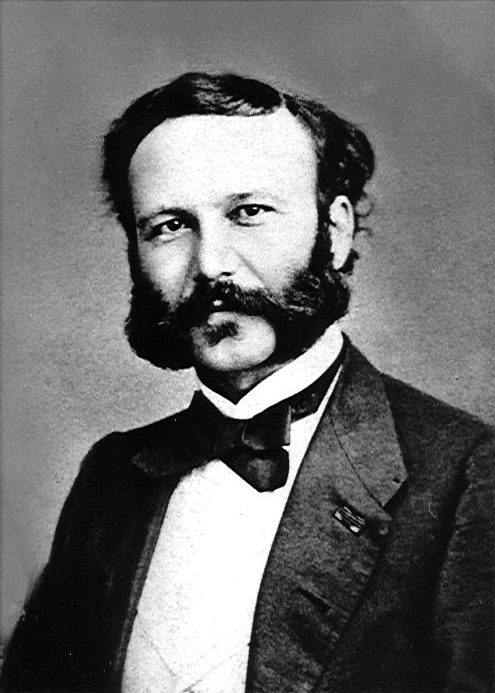

Dunant at Solferino
Jean-Henri Dunant, known as the father of the Red Cross, was born on May 8, 1828, in Geneva, Switzerland. His father, a successful businessman and a citizen of some prominence, was a man of means. His mother was a gentle and pious woman. She, more than anyone else, was responsible for her first-born child's early education. Her influence had much to do with molding his character.
As Dunant grew to manhood he enjoyed all the privileges accruing to him by virtue of his family's social and economic position. At the same time, he experienced the disciplines usual to the son of a responsible Swiss citizen. The atmosphere of Calvinist Geneva also influenced his growth and development. He early developed deep religious convictions and high moral principles.
In the first years of his maturity he found outlet for his energies by allying himself with various movements or causes and by engaging in charitable and religious activities. For a time he was active in a movement---then quite strong in many parts of Europe---for the union of Christians and Jews. He became a member of an organization in Geneva known as the League of Alms, whose purpose was to bring spiritual and material comfort and aid to the poor, sick, and afflicted. He was also a regular visitor to the city prison, where he labored to help reform transgressors of the law.
Until he was nearly 30 years of age, however, Dunant's keenest interest was in a group of organizations in Switzerland, France, and Belgium operating under the name of "The Young Men's Christian Union." These were European counterparts of the newly formed Young Men's Christian Association in England. In early 1853 a movement was begun to federate the "Unions" into one organization. Dunant steadfastly opposed the plan as too limited, making the counterproposal that a "World Union" to include the YMCA should be organized. Largely as a result of Dunant's persistence, this was done at the first world conference of the YMCA, held in Paris in 1855.
Despite Dunant's dedication to causes of this sort, he did not limit his activities to them. He was engaged also in laying the foundation for, and embarking upon, a business career as well. In 1849 he was apprenticed to a banking house in Geneva to learn the banking business. So well did he progress that, in 1853, he was given a temporary appointment as general manager of a subsidiary enterprise of his firm in Algeria, known as "Colonies Suisse de Setif." Later he severed his connections with the company and went into business for himself. The energetic young man seemed headed for a successful business career and the acquiring of a substantial fortune.
It was while journeying on a business mission in Italy that Dunant chanced to arrive in Castiglione della Pieve on the same day in June 1859 that the Battle of Solferino was fought nearby. When the town filled with casualties and the army medical services available it that point proved to be inadequate, it was wholly natural for Dunant to try to help relieve the pain and suffering of the wounded. By temperament, tradition, and training, he could do no less. This experience completely changed the course of his life. From that time forward Dunant's business activities and other interests became secondary as he sought to find a way in which such suffering could somehow be prevented, or at least ameliorated, in future wars.
__ Henri Dunant. A Memory of Solferino. Washington, DC: American National Red Cross, 1959.
On the evening of 23 June, the Allied commanders learnt that the Austrians were camped on the edge of the vast plain that stretches from Brescia to Mantua, near a village called Solferino, whose eleventh-century tower, known to the soldiers as 'Italy's spy', could be seen for many miles in every direction.
The order to attack came at dawn on 24 June. Three hundred thousand soldiers, the Austrians under their yellow and black flags emblazoned with the Imperial Eagle, the French to the sound of drums and bugles, faced each other across a sixteen-kilometre front. The men were, for the most part, exhausted by many days of forced marches, hungry, thirsty and hot in their thick uniforms. They had had very little to eat. The two armies were on the whole evenly matched; the Austrians had fewer men, but more horses and cannon. Both had emperors at their head; Napoleon III as commander-in-chief of the Allied forces and the twenty-eight-year-old Franz Joseph leading the Austrians. It would be the last major European battle directed by reigning monarchs.
All day long, while the heat and the sunshine lasted, the soldiers advanced and retreated across the plain and up and down the hills, pushing their way through the rows of vines that had been strung between mulberry trees, with dust kicked up by the squadrons of cavalry and shells from the artillery on the heights raining down on them. The tower of Solferino, taken, lost, retaken, became the symbol of victory. At 4 o'clock a storm blew up, and the exhausted soldiers were drenched by heavy rain. Squalls of wind carried dust into their faces. Hail followed, then thunder and lightning. Visibility became extremely poor but when it cleared towards nightfall, it was obvious that the Austrians were in flight. Napoleon sent a telegram to Empress Eugénie: 'Great battle! Great victory!'
Among the vines, in the ditches, under the mulberry trees and around the battlements of Solferino lay more than 6,000 bodies. Well over 30,000 soldiers, equally divided between the Austrians and the Allies, had been wounded. One man in every five who had joined battle that morning was now either dead or injured. The living were agonizingly thirsty. The heavy rain had turned the few dusty tracks that criss-crossed the plain into impassable rivers of mud. There was little question of moving the wounded from where they lay to the surrounding villages. In any case, the retreating Austrians had taken every cart and horse they could find.
All battlefields have visitors; some come to loot, others to stare, a few to help the wounded. On the evening of 24 June a young Genevan businessman in a light tropical suit arrived at Solferino; later, people would talk of him as the 'man in white'. Henri Jean Dunant was thirty-one, a pious, sentimental, serious, somewhat stout young man, but full of energy. He had never seen a battlefield before. 'The stillness of the night was broken by groans, by stifled sighs of anguish and suffering,' he would later write. 'Heart-rending voices kept calling for help. Who could ever describe the agonies of that fearful night!'
__ Caroline Moorehead. Dunant's Dream. War, Switzerland and the History of the Red Cross. New York: Carrol and Graf. 1998.