
Section Three (SSU 3) – Part III
In the Orient
- When
- WWI
- Where
- Balkans (The Orient), Greece, Serbia, Albania
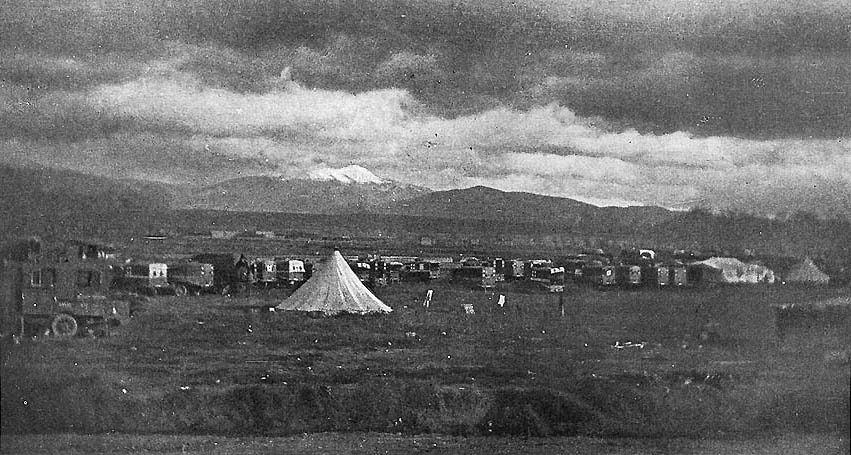
SectionThree was organized in Paris in April, 1915, and sent to the French Seventh Army for trial. Within a fortnight it was assigned to duty in reconquered Alsace.
...
With the beginning of the autumn of 1916, it was decided, owing to the request of the French Government for a section such as had been able to work in the mountains of Alsace, to send SECTION THREE to the Balkans with the French Army of the Orient. Consequently it was ordered to Marseilles, sailing for Salonica October 20, and arriving in that city the 28th. In November the Section was assigned to the Monastir sector. Several times cars were detached and sent over into the wild, mountainous country of Albania to serve French troops there, and on one occasion the whole Section was sent to Greece with the French force ordered there to maintain Greece's neutrality. The Section remained in the Balkans until October, 1917, when the United States Army took over the Field Service work. The United States, not being at war at that time with Austria, Bulgaria, or Turkey, the War Department was unwilling to take over the Field Service work in this region. The personnel of the Section was obliged to return to France, but the material was turned over to the French Army of the Orient in order that this much-needed work might continue. It is interesting to note that the cars of the two Balkan sections were still in service during the last great advance which ended the Balkan campaign.
'The Ambulance Sections', History of the American Field Service in France, "Friends of France" 1914-1917, Told by Its Members, Volume I (Boston and New York: Houghton and Mifflin Company, 1920)
SECTION THREE
II. IN THE ORIENT
Tout vient vers elle et tout en part;
Elle est le progrès, elle est l'art,
Sol qui produit, peuple qui pense.
Gloire à la France!
PAUL DÉROULÈDE
I
EN ROUTE TO THE ORIENT
October 25, 1916
To-day will be our fifth day at sea. We left Marseilles on Saturday in a strong mistral, and packed our bags and blanket-rolls in our bunks down in the hold along with a great number of Indo-Chinamen. We were on the lowest deck. The bunks were in tiers of two and squares of eight, merely steel or tin braces like those of a strawberry crate. We stayed there till five o'clock when Lovering Hill made arrangements to move us up a deck nearer the open air. We moved. The Chinamen moved down at the same time. Such confusion! These Chinese are so small and yellow that you cannot tell them from their khaki packs. They bumped us and jabbered like monkeys. We bumped them and cursed. They continued jabbering. Their talk is a funny, monkeyish twang. At about 6.30 that night we were fed on the deck, although we looked longingly at the officers' mess-room. It got dark early, and we retired early. Luckily Hill gave me a chance to sleep on the floor of his cabin, so I did n't have to go below. Some of the fellows slept on the floor of what was once the smoking room on this ship. I saw George Hollister that night tuck himself away in an upper bunk way back in the dark against the side of the boat. Hill made arrangements to have us eat in the officers' mess twice a day, which is enough. Then he arranged to have us all sleep in the smoking-room. Since then we have been comfortable.
If you never have travelled on a real transport, I may tell you in passing that you are better off where you are. First of all, every one is packed in as we were the first night; the deck space is filled with cargo, and men occupy the upper deck in great numbers. Rancid smells come up from below, for the sewerage system is not working. The sanitary arrangements aft, where most of the Indo-Chinks are, were put out of commission the first night; so nobody with a keen sense of smell can go near there. Food is being cooked all the time; and a stuffy breeze comes up from the kitchen, which is on the main deck amidships. The calf and the pig aboard are dirty, and their companions, some horses and cows, are not things of beauty either.
October 27
Yesterday we were developed into mariners. The commander of the ship got us all to stand watch, as we were in dangerous waters all day and night. We had posts during the day at the bow, on deck below the bridge, amidships on the same deck, on the bridge, and at the stern. From 1.40 until 5.40 Fenton and I were on duty up at the bow, when I looked so hard for periscopes or mines that I saw all sorts of things. Finally at four o'clock we saw land way off in the distance. Due to our zigzagging, it was on the port side one minute, straight ahead the next, and on the starboard side the next. Then we saw islands across our bow --- low-lying objects hardly distinguishable from clouds. We were finally relieved by some Frenchmen.
At eight o'clock I went on watch at the stern till 11 P.M., when George Hollister replaced me, and he stayed on till 2 A.M., when he was relieved. All this time, up to eight this morning, our Section was on watch along with the regular crew. It was strange, to say the least, to see an ambulancier pacing the bridge along with the captain.
At night we passed many lights, on shore no doubt. There was a boat, however, which passed, that flashed "phoney" signals, which we did n't answer. The captain was excited and did not breathe easy for a long time. During my watch from eight to eleven a dead "Chink" was heaved overboard in a box. That makes two.
October 28
I went on watch at two last night on the bridge with George Hollister. We were relieved at five o'clock. We followed along a mountainous shore all night. Warships signalled us at times, and a torpedo boat came up behind us. It looked for all the world like a submarine, but no one on the bridge got excited about it. The morning star came up about 3.30. It looked like a fusée éclairante at the front. I never saw a bigger or more beautiful star. It was still dark when we were relieved. George went to bed, but I stayed up on the bridge to watch the dawn come. Off to the right the sky brightened and turned a very brilliant red. Low land was silhouetted against it. On our left two snow-tipped mountain-peaks glistened in the light. The lower sides of the mountains were purplish and brown. A few white houses showed themselves.
CHARLES BAIRD, JR.*
*Of New York City; Harvard, '11 ; entered the Service in July, 1916, and served in Sections Two and Three; subsequently became a First Lieutenant and later a Captain in the United States Field Artillery. The above are extracts from Mr. Baird's home letters.
II
SALONICA
En route to the Balkans, we arrived in the harbor of Salonica on the morning of October 28, 1916, and disembarked on the evening of the following day. The port and town were the scene of great activity, and were very picturesque with the presence of natives from almost every country under the sun, and the streets packed with strange costumes. The town, I noted, has its walls still standing, with a sort of fortress above it; a Turkish quarter, which looks very pretty from the sea, with its heaps of little wooden houses painted blue, rising one above the other; and plenty of minarets, very white in the early sunshine, and very lovely to our ocean-weary eyes.
There were a few cases of spinal meningitis among the native troops on board our ship, and at first it was a question of being quarantined with said fellow travellers. So the Lieutenant in command of the troops and I immediately began trying to arrange our cantonment in the Camp des Orientaux, where the proposed internment was to take place. Fortunately, however, at lunch-time the decree was revoked, and we were ordered to join our service at the Parc de Réserve, where we would be quartered.
Arrived there, we found that no one had ever heard of us, that there was no place to lodge us, and that it was impossible to feed us. So I let every one shift for himself for dinner, and those of us who could n't find room, slept out in an open lot. Fortunately the weather continued fine, and the next morning we got three Marabout tents which we pitched at once; just in time, in fact, for it started to pour as the last one went up. In this matter of weather, by the way, we had the most astounding good luck. Even the sea was as smooth as a pond during the whole voyage. I don't know what we should have done on board if it had been otherwise, for living between decks was out of the question on account of the native troops.
LOVERING HILL*
*Of New York City; Harvard, '10; entered the Field Service in November, 1914, where he became Section Commander, and in 1917 a Captain in the United States Field Artillery.
III
INTO THE BALKANS
The first flicker of dawn was showing as we wound our way down through the outlying parts of Salonica, a sinuous line of ambulances and auxiliary cars. On the water front the convoy halted for final adjustment. The foreglow, coming across the harbor, filtered through the spars of the shipping and gave promise of a clear day. A few early porters and rugged stevedores paused to gaze wonderingly upon us. The C.O. passed down the line to see if all were ready; the whistle sounded and we were off.
Passing through the already livening streets we paralleled the quay, turned toward the northwest and then, as the muezzins in the minarets were calling upon the faithful to greet the rising sun, entered upon the great caravan trail which runs back into the mountains, and Allah knows where. Past trains of little mountain ponies, laden with hides; past lumbering, solid-wheeled wagons, drawn by water buffaloes and piled high with roughly baled tobacco, tobacco from which are made some of the choicest Turkish cigarettes in the world; past other wagons with towering piles of coarse native matting; past the herdsman and his flock, his ballet skirt blowing in the morning breeze; past the solemn Turk, mounted athwart his drooping burro, his veiled woman trudging behind. The city lay behind us now; the passers-by became fewer, until only an occasional wayfarer and his burro were sighted. The road, pitted and gutted, stretched away through a barren, dreary country. The sun's early promise had not been fulfilled and a gray, slaty day emphasized the dreariness of the landscape. To our right bleak mountains rose to meet a slaty sky --- nowhere appeared tree or shrub, not even a fence broke the monotony of the landscape, never a house, not even a road, though occasionally a muddy track wandered aimlessly through the waste. We rounded the mountains and crossed a sluggish stream, the Galiko. Once we saw a village far away, its white minarets rising above the dull gray of the ensemble. Then the desolation closed down. Farther on, over a shaky wooden bridge, we crossed the Vardar, the Axius of Virgil. Hereabouts the country was flat and swampy, but suddenly it changed; scattered trees began to appear, here and there rocks jutted out. The trail began to mount and presently as we twisted our way through the first settlement, the village of Yenidze, mountains came into view to the northeast and then moved toward the south and west. About eleven we sighted some whitewashed houses clinging to the side of a cliff, the overflow of the town of Vodena through which we presently passed over a winding road of mountainous steepness; up we went, three hundred, four hundred metres, finally stopping where a fountain gushed from the roadside, a kilometre or so beyond the town.
We were in the heart of the hills now. On three sides of us the mountains rose to a height of six thousand feet or more. Their tops were covered with snow, and from this time on we were never to lose sight of it.
Some biscuits, ham, and chocolate found a good home and there was time for a couple of pipes before the whistle blew and we again cast off. And now our troubles began. Up to this time our way could at least lay claim to the name "road," but now even an attorney, working on a percentage basis, could establish no such identity for the straggling gully through which we struggled --- sometimes a heap of boulders, sometimes a mire, but always it climbed. The cars coughed and grunted and often we were forced to halt while the motors cooled. In mid-afternoon the rain, which had been threatening for some hours, set in and the ground quickly assumed the consistency of sticky paste, through which we sloughed our way. About four we spoke the Lake of Ostrovo and shortly afterwards passed through the straggling village of the same name.
Deep sand here made the going hard, but we soon left the shores of the lake and again headed straight into the mountains. So far as possible the trail held to the passes, but even so, the ascent was very great. As night fell we came to an especially steep stretch slanting up between snow-covered mountains. From a little distance it looked as though some one, tiring of road-building, had leaned the unfinished product up against a mountain-side. Time and again we charged, but without avail; no engine built could take that grade. Physics books tell us, "that which causes or tends to cause a body to pass from a state of rest to one of motion is known as Force." With twenty men to a car, pulling, pushing and dragging, we assumed the function of "force" and " caused a "body" --- the cars ---to "pass from a state of rest to one of motion," hoisting them by main strength over the crest.
Night had shut down for some hours when the last car had topped the rise. A bone-chilling wind had swept down from the snow, the rain still fell. The lights were switched on, and over a trail, flanked on one side by a towering cliff and on the other by a black chasm of nothingness, we kept on. Once we rounded a sharp curve, there was a sudden dip in the trail and in the darkness we almost shot off into the space below.
It still lacked some two hours of midnight when ahead we discerned a few flickering lights. The Lieutenant gave the signal and we came to a stop at the fringe of a miserable village. We had been sixteen hours at the wheel but had covered no more than one hundred and fifty kilometres. We were all cold and hungry, but the soup battery was mired somewhere miles in the rear. Our lanterns showed us but a few stone hovels. Had we known more of the Balkans, we should not even have thought of finding a shop. We gave up thoughts of dinner, crawled within our cars, and, wrapping our great coats about us, sought to dream of "a cleaner, greener land."
The tramping of many feet and the sobbing of a man woke me next morning. I looked out to see a column of Russian infantry passing. One big fellow was crying as though his heart would break. Banica or Banitza, the village at which we had halted, proved to be a miserable collection of huts, constructed of rounded stones, with which the surrounding hills were covered. Like most Turkish villages, it clung to the side of a hill, sprawling there with no attempt at system or a view to streets. The buildings were of one story; a few had glass, but in by far the most part straw was employed to block the windows. The twisting paths which wandered about between the houses were knee-deep in black mud. There were no shops, not even a café.
Other and higher hills rose above the one on which the village was situated. These hills were barren and covered with loose stones, their tops were crested with rough breastworks behind which were empty cartridge cases, torn clothing, ponchos, and scattered bodies in faded uniforms, for here the Bulgar and Serb had opposed each other. To the north of the village stood a few trees, and here within a barbed-wire corral a few armed Serbs guarded several hundred Bulgar prisoners. The villagers were as unattractive as their surroundings, the men dull, dirty-looking specimens, the women cleaner, but far from comely. The latter were dressed in skirts and blouses of many colors. Their heads were covered with shawls, the ends of which were wound about their necks. From beneath these straggled their hair, invariably woven into two plaits into which was interwoven hair from cow's tails dyed a bright orange. Upon their feet they wore wooden, heelless sandals which, when they walked, flapped about like shutters in a gale of wind. The little girls were miniature replicas of their mothers, save their faces were brighter --- some almost pretty. They wore their many petticoats like their mothers, at mid-leg length, tiny head-shawls and striped wool stockings. The endless occupation, both of the women and children, was the carrying of water in clay jars. They must have been building a river somewhere and judging from the amount of water they were transporting, it was to be no small-sized stream either.
Not all of the cars had come through to Banitza and so we awaited their arrival. Several had broken axles and the big atelier car and the soup battery had mired in crossing the Ostrovo flats. Meanwhile, perched on the side of a hill with the snow above us and a falling temperature, we, of the advance squad, were reminded that winter was almost upon us. The days were gray, and as there was nothing to do while awaiting the stragglers, save gaze across the valley which stretched southward below us, the time dragged. The boom of heavy guns came to us from the northwest and occasionally, when the wind was right, we could hear the crackle of infantry fire. Some couriers riding back from the front brought word that Monastir had fallen after fierce fighting and the French were advancing northward.
By evening of the third day all the cars had come up, and, with the kitchen wagons once more in our midst, we were again able to have a hot meal. Our spirits rose, and that night, clustered round a small fire, we sang some mighty choruses. At nine on the morning of the 24th of November --- a cold, drizzly morning --- we wormed our way down through the village and out upon the transport road northeast toward the Serbian frontier. Though hundreds of German, Bulgar, and Turkish prisoners were at work upon the road, it was scarcely passable. Everywhere we passed mired couriers and camions; dead horses and abandoned wagons were scattered about. The way led across a level valley floor. On the flat, muddy plains bordering the road were camps of French, English, Italians, and Russians. Several aviator groups were squatted in the miry desolation.
As we advanced, the road accomplished something we had deemed impossible --- it grew worse. The transport of five armies struggled along, or rather through it, and contributed everything from huge tractors to little spool-wheeled, cow-drawn Serbian carts. We passed through one squalid, war-festered village where the road reached the sublimity of awfulness and then about midday spoke the village of Sakulevo. Several demolished buildings, pocked walls, and shelled houses showed the place had been recently under fire. Passing through, we crossed a sluggish stream, from which the village takes its name, and on a shell-scarred flat on the north bank halted and pitched our tents.
"VALLEYS DREADLY DESOLATE"
The road at this point bends to the east before again turning northward, and enters the long valley at the farther end of which lies the city of Monastir. About a mile northward from our camp was a stone which marked the border between Macedonia and Serbia. High ranges of mountains stretched along the side of the lonesome valley. No words of mine can describe the landscape as do the words of Service:
The lonely sunsets flare forlorn
Down valleys dreadly desolate,
The lordly mountains soar in scorn
As still as death, as stern as fate.The lonely sunsets flame and die,
The giant valleys gulp the night,
The monster mountains scrape the sky
Where eager stars are diamond bright.
"WHERE THE BEST IS LIKE THE WORST"
We had reached Sakulevo on the afternoon of the 24th of November. On the morning of the 25th we started to work. On the other side of the river was a cluster of tents. It was a field dressing-station and, appropriate to its name, was located in a muddy field. Since Sakulevo was at this time some thirty kilometres from the fighting, our work consisted of evacuations; that is, back of the line work, the most uninteresting an ambulancier is called upon to do, since it wholly lacks excitement. Here it was made more trying because of the fearful roads over which our route lay. At this time the village of Eksisu, some forty kilometres southeast of Sakulevo was railhead, and to this point we evacuated our wounded. It was a matter of three and a half hours of the most trying sort of driving. Perhaps a better idea of our work at Sakulevo may be had if we go together on a "run." It's seven-thirty in the morning, a cold raw morning with ice on the pools and a skim of ice on the inside of the tent. The sun has not long appeared over the snow-clad mountains and there is little warmth in its rays. We have just had breakfast ---Heaven save the name! some black coffee and army bread --- so it's time to be off. We crank-up ---a none too easy performance, since the motors are as stiff with cold as we are --- and then toss and bump our way across the little bridge disregarding a sign which, in five languages, bids us "go slowly." A couple of hundred metres farther on in a field at the left of the road is a group of tents, before which whips a sheet of canvas displaying a red cross. It is the field dressing-station. We turn the car, put on all power and plough through a mire, and then out upon more solid ground, stopping in front of the tents.
The tent flap opens and two brancardiers appear, bearing between them a stretcher upon which lies a limp figure covered with a dirty blanket. A gray-green sleeve dangles from the stretcher and shows your first passenger is a German. He is slid into place and by this time your second passenger is ready. He is a giant Senegalese with a punctured lung. Your third man is a sous-officier whose right leg has just been amputated. He has been given a shot of morphine and his eyes are glazed in stupor. The third stretcher is shot home, the tail-board put up, and the rear curtain clamped down. Over these roads we can take no more, so we are ready for the start.
Through the slough and then out upon the road, which is little more, we go. Through war's traffic we pick our way, beside shell-laden camions, pack-trains, carts, past stolid lines of Russians, dodging huge English lorries whose crews of Tommies sing out a friendly "Are we down-hearted?" Between rows of Bulgar and Boche prisoners your way is made, the hooter sounding out its demand for the rights of a loaded ambulance. Along the roadside, out there in the fields, sprinkled everywhere, we see the little wooden crosses, war's aftermath. Everywhere war's material wastage is apparent. Wrecked wagons and motors, dead mules, hopelessly mired carts, military equipment, smashed helmets, dented douilles. Your way is lined with these. The road from there on becomes freer, but is still too rough to permit much quickening of speed. As we turn a bend, a frenzied Italian comes charging across the fields. He seems greatly excited about something and unwinds reels of vowels, not one word of which we understand. We try him in English and French, not one word of which he understands, so finally we give it up and go on, leaving him to his "que dises."
Through two passes, in which the white, low-hanging clouds close down, through several deserted villages over a road which, save in the Balkans, would be considered impassable, we carry our load. It is impossible to prevent lurching, and the black within groans and cries aloud in his pain. The Boche, too, when there is an exceptionally bad bit, moans a little, but the sous-officier makes not a sound throughout the voyage. At one point the road passes near the railroad, and, dangling over a ravine, we can see the remains of a fine iron bridge dynamited during the great retreat. At last, rounding the jutting point of a hill, we see far below us the blue waters and barren shores of Lake Petersko. Squatted beside the lake is a little village, Sorovicevo. Railhead and our destination, the station of Eksisu, lies a mile or so to the west. Down the hill we brake our way, then over a kilometre of wavelike road into a slough, where for a time it seems we are destined to stick, and at last the tossed and moaning load is brought to a stop at the hôpital d'évacuation, a large cluster of tents. We assist in removing the wounded --- the Senegalese is gray now, with the shadow of death upon him, and his breath gushes with great sobs through his torn lung. The Frenchman and Boche seem to have come through all right.
It is now eleven-thirty o'clock, and we are probably becoming conscious that we could use a little food, but it will be at least two hours before we can reach camp, so we get out a spark-plug wrench and break up several army biscuits to munch on the way home. En route we are hailed by three Tommies who have been left behind and are seeking to join their detachment. They desire a lift, so we take them aboard and are repaid by hearing their whimsical comments on the "filthy country." It is nearly two o'clock --- a blowout has delayed us --- when we reach camp and the motor has barely stopped churning before we are in the mess-tent clamoring for our "dum-dums" --- beans --- and singe, tinned beef. You will find your appetite has not suffered because of the "run."
TENTING IN SERBIA
The days were rapidly growing colder. Our tents were sheathed with ice and the snow foot crept far down the mountains each night. We got our sheepskin coats and inserted an extra blanket in our sleeping-bags. Each night we drained our radiators to prevent damage from freezing. The few sweets we had brought with us had now given out. In the French army, save for a little sugar --- very little --- and occasionally --- very occasionally --- and a small amount of apple preserve, no sweets are issued. It was impossible to purchase any, so presently there set in that craving for sugar which was to stay with us through the long winter. The arrival of Thanksgiving, with its memories of the laden tables at home, did not help matters. Dinner consisted of lentils --- my own particular aversion --- boiled beef, bread, red wine, and black coffee. However, the day was made happy by the arrival of our first mail and we feasted on letters.
It's wonderful what a cheering effect the arrival of the post had on us. Throughout the winter it was about our only comfort. In France it had been welcome, but down in the Orient we seemed so cut off from the world that letters were a luxury, the link with the outside. When they came, it did n't so much matter that a man was cold or hungry and caked with mud, that the quarters leaked and the snow drifted in on his blankets. The probability of its arrival was an unfailing source of pleasurable conjecture; its arrival the signal for whoops and yowls; its failure, the occasion for gloom and pessimism.
Some fifteen kilometres to the north and west of Sakulevo was the large town of Florina, the northernmost town of Macedonia. Here was located a large field hospital. At the hospital, for a time, we maintained a poste of two cars on five-day shifts.
AT FLORINA
We found Florina one of the most interesting towns in the Balkans. Long under the rule of the Turk, it possessed a distinctly Oriental aspect which gave it charm. It nestled at the foot of some high hills which had been the scene of heavy fighting in the dispute for its possession. The town itself had suffered little, if any, in the fighting. Its long main street followed a valley, turning and twisting. Booths and bazaars lined the thoroughfare and in places vines had been trained to cover it. There were innumerable tiny Turkish cafés, yogart shops, little shops where beaten copperware was hammered out, other booths where old men worked on wooden pack-saddles for burros. There were artisans in silver and vendors of goat's-wool rugs. The streets were always alive with "the passing show," for the normal population of fifteen thousand souls had been greatly augmented by the influx of refugees from Monastir. There was an air of unreality about the place, an indefinable theatricalism which gave one the sense of being part of a play, a character, and of expecting, on rounding a corner, to see an audience and then to hear the playing of the orchestra.
It was while on duty at the hospital at Florina that I made the first run into Monastir. My journal for December 2 reads:
"At one o'clock this afternoon received orders to proceed to Monastir en raison de service. My passengers were two corporals. It has been a cold, overcast day, the clouds hanging low over the snow-capped mountains. A cold, penetrating wind hit us in the face as we drew away from the hospital.
"Where the Florina road joins the main caravan road to Monastir, we passed from Macedonia into Serbia. Here we turned sharply toward the north. The flat fields on either side were cut up with trenches, well made, deep ones, from which the enemy was driven less than a fortnight before, and shallow rifle pits which the French and Serbs had used in the advance. Even now, so soon after their evacuation, they were half filled with water. Everywhere there was evidence of big gun-fire and in one place where we crossed a bridge the ground for yards about was an uninterrupted series of craters. For the first time in the war I saw piles of enemy shells and shell cases showing that his retreat had been unpremeditated and hasty. In one place stood a dismantled field piece.
NEGOCANI --- MONASTIR
"About a quarter of an hour after leaving Florina, we reached the village of Negocani. There had been heavy fighting here and many of the houses had been reduced to piles of 'dobe bricks. Two miles away on the road, we could discern the remains of another village, Kenali, where the enemy made his last stand before falling back upon Monastir the other day. The sound of the guns had all the while been growing louder, and not far beyond Negocani I caught my first glimpse of the minarets of Monastir. It had been two months since I was under fire and I had some curiosity as to how it would affect me. Before reaching the environs of the city, it became apparent that this curiosity would not long remain unsatisfied, for ahead we could see the smoke and dust from bursting shells. Approaching the city, the way becomes a regular road, quite the best I have yet seen in the Balkans. I was speculating on this marvel when, perhaps five hundred yards ahead, a columnar mass of earth spouted into the air. The whirring of speeding éclat had scarcely ceased when another came in slightly nearer. The road was under fire and that same old prickly feeling shot up my spine, the same 'gone' sensation moved in and took possession of my insides. Suddenly the familiar sound pervaded the air. There was the crash as though of colliding trains and not forty metres away the earth by the roadside vomited into the air. In another second the débris and éclat rained all about us, showering the car. The shell was a good-sized one --- at least a '150,' and we owed our lives to the fact that, striking in soft ground, the éclat did not radiate. Meanwhile, I had not waited for the freedom of the city to be presented. The machine was doing all that was in her, and in a few seconds more we shot by the outlying buildings. The fire zone seemed to be restricted to the entering road and the extreme fringe of the city, and when we reached the main street, though we could hear the shells passing over, none struck near. Within the city our batteries, planted all about, were in action and the whirring of our own shells was continuously sounding overhead.
"We parked in a filth-strewn little square lined with queer exotic buildings. While I waited for the corporals to perform their mission, I talked with an Algerian zouave who lounged in the doorway. He pointed out where a shell had struck this morning, killing three men, two civilians and a soldier. He further informed me that the streets of the city were in full view of the enemy, who occupied the hills just beyond its outskirts. This revelation was most disconcerting to me, for I had no desire to work up a 'firing acquaintance.' A number of officers of high rank passed --- among them a three-star general. A colonel of infantry stopped, shook hands with me, and spoke appreciatively of the work of the Corps in France, saying he was glad to welcome a car in the Orient.
"By three o'clock we were ready. My passenger list was augmented by a lieutenant, médecin, who wished to reach Florina. He cautioned me with much earnestness to allez vite when we should reach this shelled zone, a caution wholly unnecessary, as I had every intention of going as fast as Providence and gasoline would let me. The firing now --- praise to Allah --- had slackened and only an occasional shell was coming in. So, making sure the engine was functioning properly, I tuned up, and a second later we were going down the road as though 'all hell and a policeman' were after us.
"We reached Florina without mishaps. To-night there is a full moon. Don and I strolled down into the town. It was singularly beautiful, the white minarets standing out against the sombre mountains, the silvery light flooding the deserted streets. We strayed into one of the tiny little cafés. It was a cosy place. Divans covered with rugs and sheepskins lined the walls. A few befezzed old men sat cross-legged on these --- sat there silently smoking giant hookahs and sipping their syrupy coffee. We, too, ordered coffee, and then sat in the silence helping in the thinking. After a while the door opened and a short, hairy man entered. He was clad in long white wool drawers, around which below the knee were wound black thongs. On his feet were queer-shaped shoes which turned sharply up at the end and were adorned with black pompoms. He wore a short jacket embroidered with tape, and thrown back from his shoulders was a rough wool cape. Around his waist was wound a broad sash, into which was thrust a revolver and a long-bladed dirk. About his neck and across his breast were hung many silver chains, which jingled when he moved. His head was surmounted by a white brimless hat. He talked in an unknown tongue to the patron, and then, bowing low to us, was gone amid a clinking of metal. This strange-looking individual was --- so we learned from the café's proprietor --- an Albanian, a man learned in the ways of the mountains, a scout in the employ of the French.
"We sipped another coffee, smoked a cigarette, and then, bowing to the old men, went out into the moonlit street, leaving them to their meditations. As I write this from the tent, the sky is darkening, a chill wind sweeps down from the snow and gutters the candle. I am glad that our blankets are many."
As the days went by, our camp-site, where we were the first comers, began to assume the aspect of a boom mining town. Several camion sections appeared. Numerous ravitaillement groups moved in. Tents and nondescript structures of earth and ammunition boxes sprang up. Across the river ten thousand Russians were encamped, and all night their singing came to us beautifully across the water. All day and all night, war's traffic ground and creaked by us. The lines had shaken down; the two forces were now entrenched, facing each other just beyond Monastir, and the transport was accumulating munitions for an offensive. In the first camp opposite struggled long lines of Serbian carts --- carts such as Adam used to bring the hay in. The sad-faced burros plodded by, loaded with everything from bread to bodies. Soldiers --- French, Italian, Serb, and Russian---slogged by. But this activity was confined to the narrow zone of the roads. Beyond, the grim, desolate country preserved its lonesomeness and impressed upon the soul of man the bleakness and harshness of a land forlorn. For the most part the days were gray and sombre, with low-hanging clouds which frequently gave out rain and sleet and caused the river to rise so that more than once we were in danger of being flooded out. But occasionally there would be a clear morning, when the clouds were driven back and the rising sun would light the mountains, turning the snow to rose and orange. We were growing very tired of the evacuation work, of the long, weary runs. There was no excitement to tinge the monotony. We were becoming "fed up." The Squad, therefore, hailed with joy the news that the Section was to move up to Monastir and there take up the front-line work.
Though the exact date of our departure was not announced, we knew it would be soon and we commenced at once to make ready. Helmets once more became items of interest and motors were tested with an interest born of empirical knowledge that the fire zone was no place to make repairs. Everybody brightened up; interest and optimism pervaded the camp. And then the word came that we should leave on the 17th of December.
MONASTIR
Men stumbled about in the darkness falling over tent pegs or pulling at icy ropes. Now and then a motor in response to frantic cranking, coughed, sputtered and then "died." Down near the cook-tent some one was swearing earnestly and fervently at the mud. It was three o'clock in the morning, and the only light was that given off by the stars. The Squad was breaking camp, and we were to be in Monastir, twenty-five kilometres distant, before daybreak. Somehow, in spite of the darkness, the tents were struck and packed, and the cars rolled out on the bumpy roads.
With the assistance of our lights we were able to hold a good pace until we reached the dip in the road which had been designated as the point where the convoy should halt. Here we extinguished all our lights and made sure that everything was right. Ahead we could see flashes, but whether from our own guns or bursting shells we could not determine. The sound of firing came plainly to our ears. The cars now got away at fifteen seconds' intervals. A faint, gray light was showing in the east, just permitting a dim vision of the car ahead. At the entrance to the city, in a particularly exposed spot, there was some confusion while the leading machine circled about in an endeavor to pick the right street; then we were off again, heading for the northeast quarter of the city. Crossing a small, wall-confined stream by a fragile wooden bridge, we wound and twisted through a maze of crooked streets, and finally, just as the first glow lightened the minarets, came to a halt in a narrow street. Where my car stopped was a shattered house and the street was carpeted with débris, the freshness of which testified to the fact that the shells causing the damage must have come in not long before. Even as I clambered out of the machine, two shells crashed in somewhere over in another street.
Our cantonment consisted of two five-roomed, two-storied Turkish houses which stood within a small walled compound. The top floors, or attics, of these houses were free from partitions and gave just sufficient space for our beds, ranged around the walls. The place was clean and dry, and though, of course, there was no heat and no glass in the windows, it was infinitely better than the tents. The rooms below were used for the mess, the galley, and for the French staff, and one room which had windows and a stove was set aside for a lounge. The C.O. occupied a small stone building which formed part of the compound wall, a sort of porter's lodge. Beneath the houses were semi-cellars, and in one of these were stored the spare gas and oil. The cars were at first parked along a narrow, blind street which extended a short distance directly in front of quarters. As it was ascertained, however, that here they were in plain view of the enemy, they were moved back on another street and sheltered from sight by intervening buildings. The atelier was established in a half-demolished shed about two hundred yards up the street from the compound.
A BIZARRE POST
Our quarters were situated about midway between two mosques. In front of one of these mosques which faced on a tiny square hung a tattered Red Cross flag, betokening a field dressing-station. Here we got our wounded. The lines at this time were just beyond the outskirts of the city, and the wounded were brought directly from the trenches to this mosque, from whence it was our work to carry them back to the field hospitals out of range of the guns. I doubt if there ever was a more bizarre poste than this of the mosque. The trappings and gear of Mohammedanism remained intact. The muezzin's pulpit draped with its chain of wooden beads looked down on the wounded men lying on the straw-carpeted floor. On the walls, strange Turkish characters proclaimed the truths of the Koran. The little railed enclosure, wherein the faithful were wont to remove their sandals before treading the sacred ground, now served as a bureau. All was the same, save that now the walls echoed, not the muezzin's nasal chant, but the groans of wounded men who called not on Allah, but on God.
At first we found the twisted streets very confusing. They rarely held their direction for more than a hundred yards and their narrowness prevented any "observation for position." There seemed no names or identifications either for streets or quarters, and did one inquire the way of some befezzed old Turk, the reply would be "Kim bilir Allah" --- Who knows? God. But gradually we grew to know these ways until on the darkest of nights we could make our way through the mazy blackness.
The city sprawled about on a more or less level plain at one end of the long valley which extended southward to the Macedonian frontier. Some of its houses straggled up the hills which rose immediately back of the city proper. Beyond these hills rose the mountains from which at a distance of two kilometres the enemy hurled down his hate. The normal population of Monastir was perhaps fifty thousand souls, a population of that bastard complexity found only in the Balkans. When we reached the city, a month after its capture and occupation by the French, something like forty thousand of this civilian population yet remained, the others having fled to Florina or gone even farther south. Conditions were still unsettled. Daily, spies were led out to be shot, and we were warned not to wander unarmed in the remote sections. Snipers, from the protection of covered houses, shot at passing soldiers and at night it was unsalubrious to go about. Lines were drawn about the town and none but military transport permitted to pass. Famine prices prevailed. In the bazaars, captured dogs were butchered and offered for sale. A few stores remained open. Above their doors were signs in the queer, jumpy characters of the Serbian alphabet, signs which it would take a piccolo artist to decipher. Within, matches were sold for half a drachmi (10 cents) a box, eggs, 7 drachmi a dozen, and sugar at 6 drachmi a kilo. All moneys, save Bulgar, were accepted; the drachmi, the piastre, the franc, the lepta, the para, but the exchange was as complicated as a machine gun, and no man not of the Tribe of Shylock could hope to solve its mysteries.
THE GUNS THAT COMMAND MONASTIR
Though most of the houses were closed and shuttered as protection against shell splinters, life seemed to go on much as usual. There was no traffic in the streets, save at night when the army transports came through, or when our machines went by with their loads, but the populace passed and repassed, bartered and ordered its life with the phlegmatic fatalism of the Easterner. The enemy from his point of vantage saw every move in the city. His guns commanded its every corner. His surveys gave him the range to an inch. Daily he raked it with shrapnel and pounded it with high-explosive. No man in Monastir, seeing the morning's sun, but knew that, ere it set, his own might sink. At any time of the day or night the screeching death might come, did come. Old men, old women, little children, were blown to bits, houses were demolished, and yet, because it was decreed by Allah, it was inexorable. The civil population went its way. Of course, when shells came in there was terror, panic, a wailing and gnashing of teeth, for not even the fatalism of Mohammed could be proof against such sights. And horrible sights these were. It was nothing to go through the streets after a bombardment and see mangled and torn bodies; a man with his head blown off; a little girl dead, her face staring upward, her body pierced by a dozen wounds; a group in grotesque attitudes, with, perhaps, an arm or a leg torn off and thrown fifty feet away. These in Monastir were daily sights.
One afternoon I remember as typical. It was within a few days of Christmas, though there was little of Yuletide in the atmosphere. At home, the cars were bearing the signs, "Do Your Christmas Shopping Early," but here in Monastir, where, as "Doc" says, "a chap was liable to start out full of peace and good will and come back full of shrapnel and shell splinters," there was little inducement to do Christmas shopping. Nevertheless, we started on one of those prowling strolls in which we both delighted. We rambled through the tangled streets, poked into various odd little shops in quest of the curious, dropped into a hot milk booth where we talked with some English-speaking Montenegrins, and then finally crossed one of the rickety wooden bridges which span the city's bisecting stream. By easy stages, stopping often to probe for curios, we reached the main street of the city. Here at a queer little bakery, where the proprietor shoved his products into a yawning stove-oven with a twelve-foot wooden shovel, we got, for an outrageous price, some sad little cakes. As we munched these, we stood on a corner and watched the scene about us. It was a fine day, the first sunny one we had experienced in a long time. Many people were in the streets, a crowd such as only war and the Orient could produce: a sprinkling of soldiers, mostly French, although occasionally a Russian or an Italian was noticed; a meditative old Turk, stolid Serbian women, little children --- a lively, varied picture. Our cakes consumed, "Doc" and I crossed the street and, a short way along a transverse street, stopped to watch the bread line. There were possibly three hundred people, mostly women, gathered here waiting for the distribution of the farina issued by the military to the civil population. For a while we watched them, and then, as the street ahead looked as if it might yield something interesting in booths, we continued along it. In another fifty yards, however, its character changed; it became residential, and so we turned to retrace our steps. Fortunate for us it was that we made the decision. We had gone back perhaps a dekametre, when we heard the screech. We sprang to the left-hand wall and flattened ourselves against it as the crash came. It was a "155" H.E.. Just beyond, at the point toward which we had been making our way, the whole street rose into the air. We sped around the corner to the main street. It was a mass of screaming, terror-stricken people. In quick succession three more shells came in, one knocking "Doc" off his feet with its concussion. The wall by which we had stood and an iron shutter close by were rent and torn with éclats. One of these shells had struck near the bread line. How many were killed I never knew. "Doc" for the moment had disappeared, and I was greatly worried until I saw him emerge from an archway. There was now a lull in the shelling. All our desire for wandering about the city had ceased. We started back toward quarters. Before we were halfway there, more shells came in, scattered about the city, though the region about the main street seemed to be suffering most. Crossing the stream, we saw the body of a man hanging half over the wall and near by, the shattered paving where the shell had struck.
In such an atmosphere we lived. Each day brought its messages of death. On December 19, I saw a spy taken out to be shot. On the 20th, a house next our quarters was hit. Two days later, when evacuating under shrapnel fire, I saw two men killed. Constantly we had to change our route through the city because of buildings blown into the street.
ROBERT WHITNEY IMBRIE*
*From Behind the Wheel of a War Ambulance. Courtesy of Robert M. McBride & Company of New York.
IV
ALBANIAN POSTES
Soon after our arrival at Monastir, the Albanian work was also got under way and two cars were sent over there --- one to Koritza, the other to Sulim, on the west shore of Lake Presba. They went over on December 30, crossing the pass with great difficulty. In the middle of January I got back from there with Fenton from a two-day rescue trip, one of the cars having a broken wheel. The col is so bad that we got over it in the supply car stripped of its body for the trip. If dry, the road is just possible; otherwise you are cut off. Hence the cars stayed over there. Supplies for the men had to be sent by ox or mule, a two days' journey; oil and gas going also by mule. It was very interesting over there, where nothing moved out of the villages without a military escort, and the fellows were all armed to the teeth.
Officers at Koritza did n't dare ride out of town except on the road toward Florina and then only for the first four or five kilometres, which were patrolled. No soldier went out in the street without a gun. They all said they were living, too, on a political volcano, and in fact, in the midst of it all, along in December, a Republic of Albania was founded! But to us it seemed all very quiet, with excellent cake-shops open. We slept in a hotel with an English-speaking proprietor where there were no fleas, and were shaved in the latest "scream" in American barber chairs, the barber having been ten years in New Haven. He installed this splendor on the main corner and, getting only three clients a day, declared the Albanians to be "a lot of cheap guys."
THE FIRST AUTO TRIP INTO ALBANIA
This is an account of the trip of the first auto into Albania.
At Florina, we loaded up with food, gas, and oil, enough for two days' continual travelling and started out with an infirmier to help take care of the blessés on the way back. We got over the Pisoderi grade this time without pushing, for I knew the grade better. From there on it was the most interesting trip I ever have made. For twenty kilometres we went along a valley and had to ford the river ten or eleven times. The people may have seen autos before, but they had n't seen them enough to satisfy their curiosity; so they would drop everything as they worked in near-by fields and rush to the road to watch us pass. When we got about twenty kilometres from the second poste, both man and beast were afraid of the machines. They would see us coming, and by the time we got to them they were well across a ditch, where I suppose they imagined they were safe. Even the old, sleepy oxen showed a lot of "pep" when we came along, and backed and twisted around so in their yokes that the drivers had a hard time untangling them.
At one village we were stopped by a doctor who said that a blessé was en route in a wagon that had been sent for him the night before. So we went on to meet him, but found that the wagon did not have the wounded man after all. We decided, therefore, to go on as long as the Ford would run, and soon crossed the line into Albania, passing through several towns that had been pretty well shot up by both the Bulgars and the Allies as the former retreated two months before.
The roads were almost impassable, as the old brancardier had told us would be the case, and nothing but a Ford could have got over them. At length we arrived at Koritza, our destination, and waited for the doctor to make inquiries. The surprise was on us when several Albanians speaking English crowded around the machines. They had been in Worcester, Massachusetts, and had accumulated a roll of bills large enough to retire on over here. You find a lot like that.. Finally we found the poste de secours. Imagine our further surprise when the blessé greeted us in perfect English, saying, "I am glad you have come." When he heard we were Americans, he added: "So am I ---an American volunteer, born and raised in New York City."
Eleven days before our arrival this poor devil had been shot four times, and after lying out in front of the trenches all day, he was picked up by brancardiers and brought down from the mountains on a mule. The lines were only fifteen kilometres away, but it took eleven hours to accomplish this. We carried him twenty-five kilometres that afternoon, and stopped all night in a little town.
We left Albania the following morning and crept back at a snail's pace --- about ninety out of the hundred kilometres in low. On the way we picked up other blessés, less grave cases, and would take turns going ahead, with the grave case in the second machine. If the front car got an awful jolt, the second one would stop, while we took our American blessé out and ran the machine over the ditch or bump. Then we would put him back again, and go on.
We got to the second poste about noon, and had our Thanksgiving dinner of the supplies we had brought along. Probably it was the lightest turkey dinner either of us ever had, for it consisted of singe, or canned beef, biscuits, cooking-chocolate, and some wine. But it went down with much satisfaction.
We arrived at the Florina Hospital about five o'clock, and there received many congratulations from the Médecin Chef and several doctors, who thought we had done something wonderful, for it took a wagon train four days to make one way of this trip.
DONALD C. ARMOUR*
*Of Evanston, Illinois; Yale, '17; entered the Field Service in April, 1916, and served in Sections Three and Eight; subsequently a Second Lieutenant, U.S. Field Artillery.
ALBANIAN ADVENTURES
January 1, 1917
It is now New Year's Day and I am more than a hundred kilometres from where I was when I first started this letter --- away over two mountain ranges. I don't know when I shall get back to the Section, as I am now attached to a regiment of infantry. I have arranged to have oil, gas, and carbide sent to me by pack-mules, and I shall stay here probably until my car gives out. Then I shall have to go back on horseback --- a four or five days' trip.
Talk about Richard Harding Davis or Anthony Hope adventure stories! If I were a writer I would beat any of theirs. For instance, I am now armed with a carbine, a revolver, and one hundred and twenty rounds of ammunition, to protect myself from brigands along the road. Can you imagine anything more dime-novelly? The Colonel of the regiment was quite upset when he found that I was not armed and immediately gave orders to arm me to the teeth.
Imbrie and Winant have gone off to find their Colonel and I stay here for another day or two before we all go to hunt up the regiment --- over another mountain range. I understand it is an almost impossible route, over which no autos have ever gone before. In the meanwhile I am comfortably billeted here at the house of a man who lived for years in St. Louis and speaks English.
Later
I am over another mountain range and "busted down." I am living in a little mountain village with the Colonel, who has just become a general, and his staff. Until I get some spare parts, which will probably be a week at least, I shall have to stay here, for I am about a hundred miles from anywhere.
For the first day the General did n't have any food with him, so I found a chicken and some beans and cooked them, thus managing to provide a pretty good dinner.
The next day I walked over to my car and extricated the canned goods which I had in it, and we ate with relish. At last a limited amount of food arrived and we are fixed. The whole situation is really most amusing.
I am at the farthermost part of the lines, way up in the mountains between two lakes. The inhabitants of the country are wilder than the ancient American Indians and live in about the same way, although they have mud houses instead of tents. They speak a mixture of Greek, Albanian, and Serbian, which even the interpreter can't understand. The country is full of wolves which come down to the edge of town at night looking for stray dogs or donkeys. I saw two yesterday, but was too far away to get a shot.
J. MARQUAND WALKER*
*Of New York City; Harvard, '11; entered the Service in September, 1915, and later became a Section leader; received a commission in U.S. Artillery and was promoted to Captain. The above are extracts from home letters and letters addressed to the Paris Headquarters of the Field Service.
ON THE SERBIAN FRONTIER
Negocani, January 3, 1917
For over two weeks we have been up at the very front, but have now been ordered back a few kilometres to a village right on the frontier. We're very loath to go, but now that we are settled here, I think every one realizes that staying up there was an unnecessary risk to incur, for the daily, even hourly, bombardments from the enemy positions on the hills looking straight down into town had been getting more and more frequent and the inhabitants were either leaving or lying low in their cellars. Finally, a shell landed in a little courtyard, perhaps seventy yards away from us, and more or less damaged six of our cars. I had thirteen pieces in mine, damage done to two tires, a spoke and a radius rod, while a large hole was made in the crank case which necessitated taking down the entire motor. Roddy Montgomery, who was standing between two machines, perhaps five yards off, was knocked over and his car battered up; but he escaped unhurt. The worst feature was that a little girl of seven, who used to play around and talk to us while we were oiling and greasing, was literally blown to pieces and fragments of her burned flesh were spattered all over. Half of her head landed on the top of my car and had to be scraped off with essence. It was pretty sickening. After this, the Divisionnaire decided it was no use having the Section "shot up" little by little; so we moved our quarters. The work is still the same, however, as the cars go up from here at 6 A.M., and evacuate back to Florina, seventy kilometres in all, while some of us are even busier than before.
We are installed in a large mud farmhouse with a huge yard, a well, and half-dozen outbuildings, used as kitchen, dining-room, and bureau. This yard, when we came here, was two feet deep in straw, rubbish, and filth of all sorts, and it took two days of shovelling, burning, disinfecting, and whitewashing, to make it habitable; but we are now well installed. The village is deserted save for troops, so any one wanting firewood calmly attacks a house with a pick-axe, smashes the mud walls, and walks off with the beams, rafters, or anything else he fancies. It is very convenient, and avoids paperasses. All around us are the trenches and boyaux of the famous Kenali lines, from which the Bulgars were driven just before the capture of Monastir last month. Some of them are marvellously constructed, and collectors of ironware are revelling in souvenirs of all sorts --- shells, fuses, grenades, bayonets, etc., most of which, however, I think will be found too heavy to lug around and will be discarded long before our return.