
Applewhite, Robert Metzler
- Who
- WWII driver, Staff member
- When
- WWII, Postwar, The Sixties, The Seventees, The Eighties
- Where
- Middle East, India-Burma
- Education
- Newport News H.S.; William & Mary '43
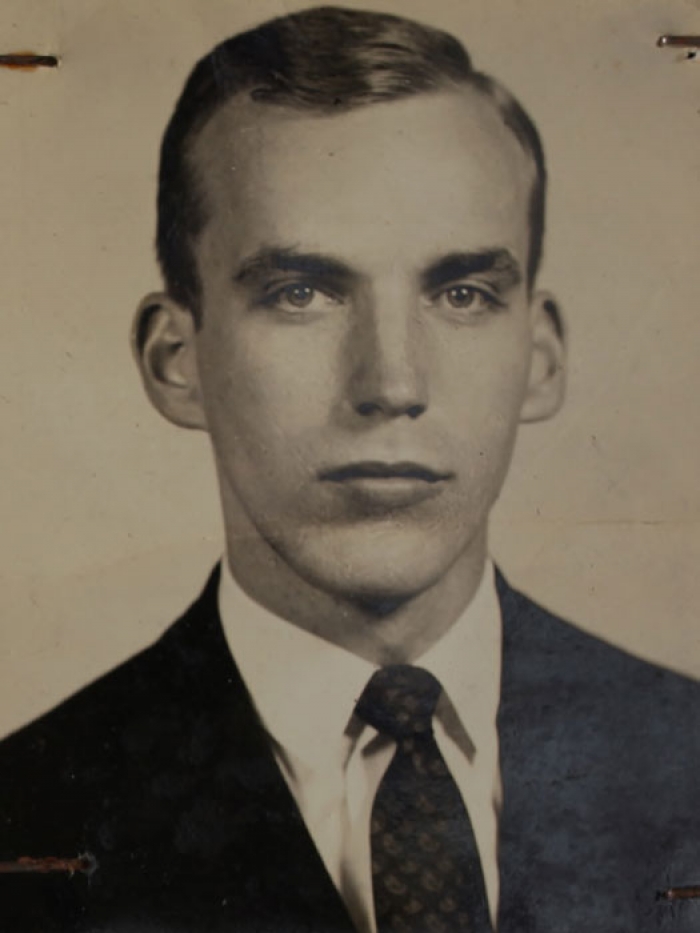
Robert Metzler Applewhite, affectionately referred to as "Apple," was born on June 21, 1921 in Newport News, Virginia to Moale Agnes Metzler and Dr. Edgar Jarrett Applewhite.
He entered the College of William and Mary in the fall of 1940 and in the spring of 1942 he volunteered for the American Field Service (AFS.) Applewhite served as an ambulance driver with AFS in Syria and with units attached to the Free French forces in the Western Desert and Tunisia. In the fall of 1943 he was attached to the D Platoon of 567 Company (Coy), and in 1944 he served with the 2nd Polish Armored Brigade during the Battle of Monte Cassino in Italy, service for which he was awarded The Bronze Cross of Merit with Swords by the Polish government. In the spring of 1945 Applewhite went to Germany and worked with AFS at the Bergen-Belsen concentration camp for two months after its liberation. He was transferred to India-Burma in July 1945 before being repatriated in October.
Following the war, Applewhite was hired by AFS to work with former ambulance driver records and accounts, and eventually became part of a small contingent of staff that operated the newly-founded international scholarships and exchange programs (AFSIS). Applewhite left AFS in 1948 to work in fundraising, and returned in June 1957 to assume responsibilities in fundraising and benefits. He served as Shipboard Director for the students on many crossings of the Seven Seas and became Acting Secretary of AFS in 1960. Upon George Rock's death in 1962 Applewhite was elected Corporate Secretary and served in this capacity until his retirement on January 1, 1990.
Robert M. Applewhite passed away on March 20, 1991, at age 70.
[Bio courtesy of AFS Archives, New York]
* * *
In those old days down in that building--I have to tell you a joke that to me absolutely epitomized the fun we had and how we used to work and under what conditions and the camaraderie that we had, and a lot of people didn't get paid at all. The young girls, I guess, got paid something. Nobody like me, who had somebody to support them, of course, got paid anything. One morning, on a terribly, terribly cold morning, I came in and came down the stairs. I was taking my coat off and sitting down at my desk and Apple's desk was just two desks away. And as I sat down, I saw this gigantic cockroach in my 'IN' basket on top of all my piled work. And I screamed. I'd never seen anything like that; so I screamed, 'Apple, there's a cockroach in my IN basket.' And he said, 'Put it in your OUT basket and get to work.'
__ Elaine Koehl, quoted in W.P. Orrick, The First Thirty Years, AFS International Scholarships, 1947-1976, New York, 1991.
ROBERT APPLEWHITE: A PROFILE
by Carla Rotolo
(From Our Little World)
June 21st is the longest day of the year. Robert Metzler Applewhite, Secretary of the AFS, who was born on that date is well aware of the fact---his mother has been reminding him of it for the past forty-one years. Your reporter attempted to interview Mr. Applewhite on June 19th but because of constant telephone calls and visitors came away with only one concrete fact---his date of birth. (Plans were already afoot to fete this proper Southern gentlemen, born in Newport News, Virginia, the youngest in a family of six.)
Mr. Applewhite's desk, a standard piece of office furniture, is unlike most others at AFS/NY. It has character. Among the hodgepodge of papers and folders, one notes an American flag mounted on an elegant gold stand, a begonia in a red pot (a gift from the Finance Department), a cactus in a white pot, a bank in the shape of the world, an assortment of lighters that never work, empty packs of cigarettes, and an "impressive" row of books. Mixed in with "Who's Who in America," and "Ford Foundation Reports," one comes upon "Lady Loverly's Chatter," "Non-Profit Organizations," and "Why You Lose at Bridge." Most disconcerting are a rubber Neanderthal club (a Christmas gift left over from last year) and the unblinking stare of a set of naked doll eyes which repose on "The World Almanac."
When questioned about his childhood, Mr. Applewhite toyed reflectively with the eyes and replied: "I went to the Marietta Johnson School of Organic Education in Fairhope, Alabama, for two years. I think it was a progressive school because all I can remember is making raffia belts and playing with snakes. Then I spent a year in Tahiti where my sister had a plantation, and somehow managed to get through the rest of the Thirties back in Virginia."
Your reporter decided to skip to college and was told: "I entered William and Mary in 1940 and I am sure it was as much of a challenge to the college as it certainly was to me. Then in the spring of 1942 I heard of the AFS volunteer ambulance corps. I wrote a letter asking for information and got a letter of acceptance by return mail.
Dodges, Ditches and Dogs
"In September of 1942, I sailed out of New York on a Norwegian freighter with a group of six other volunteers. We went around Cape Horn to Cape Town and eventually on up to Cairo. Then I was sent up to Syria for a training period as we were supposed to maintain our own Dodge ambulances. From Syria I was sent out to the Western Desert to join a unit of the Free French at Gambut West, which turned out to be nothing more than a map reference. We didn't have any ambulances at first, and then when we did get some, they were so dilapidated that they required as much if not more care that the wounded. That summer (1943) I was attached to General Leclerc's Rear Headquarters in Kairouan, Tunisia, and didn't see another American for three months. As North Africa had been liberated, there were no more wounded, and therefore no evacuations, so I acted as official interpreter and translator for the HQ, which was a type of calamity the French were by then used to.
"Then in the fall I went to Italy, and the chronology becomes rather confused. I remember being snowbound for six weeks with a small unit of the Carpathian Ski Patrol, which was absurd as I didn't speak any Polish and they didn't speak any English. I stayed on with the Polish corps throughout the Battle of Monte Cassino, which after this lapse of time is memorable chiefly for a night spent in a ditch with two Polish corporals and a dog, one of whose parents was at the least a Great Dane.
(The History of the American Field Service, 1920-1955 notes that Mr. Applewhite was decorated with the Polish Bronze Cross of Merit with Crossed Swords, and that his Section received a special commendation from General Rakowski, commanding officer of the 2nd Armored Brigade, which read in part: "Their work for wounded Polish soldiers has strengthened the friendliness of every Pole to the American nation ")
From Italy, Mr. Applewhite drove his ambulance up through France and the Low Countries, ending in Belsen where he worked until it was burned to the ground. Upon the end of the war in Europe, he was transferred to India, but the day his unit arrived in Bombay, Hiroshima was bombed, so there was no need for additional ambulance work.
"As our priority was nil," Mr. Applewhite stated, "and I knew it would be months before we could get home, I went to Calcutta and ran the Repatriated Allied Prisoners of War and Civilian Internees' Information Bureau, which we at once shortened to RAPWI. In a few weeks we processed some 20,000 repatriates and almost as many inquiries---it was my first and I trust last experience with a 20-hour working day."
Mr. Applewhite's work for the AFS did not cease, even with his return to the United States.
Brownstone Bedroom
"When I came back to work for the AFS after the war, the present scholarship program was just getting underway. There were only five of us in the office then, and the whole operation (including a lot of wartime clean-up work) was carried out from what had been a bedroom in a brownstone house on East 51st Street. At least by present standards, everything was rather informal. Although we did know where the students were going, we frequently had no idea how they were coming. We would write telling them to telephone us when they got to New York---and they did, or simply appeared at the door. About the only thing that hasn't changed is the need for money.
"During those first several years all of us felt that a goal of 100 students a year would be a commendable achievement. With the possible exception of Mr. Galatti, none of us could have envisioned the scope of the present program in our wildest flights of fancy. If anyone had told us the day would come when we would bring more than two thousand students to the United States, I think we would have just called Bellevue and let it go at that. And to foresee a six-story building with an annex was beyond anyone's imagination---and we had some pretty fertile ones there too, I assure you.
"It is especially gratifying, I think, when the students from those first years write letters or drop in for a visit. Although we couldn't have been aware of it, that spirit which has become the heart of the AFS today was being generated then.
"There should be a plaque in that room some day---if they don't tear the building down and put up one of those apartment houses."
In 1948 Mr. Applewhite left AFS to work for "Institutional Financing . . . a fancy title for fund raising." When he returned to AFS during the summer of 1957, the program had grown tremendously and was located on 30th Street. Because of his previous experience he was placed in charge of all fund raising, and this has been his special province ever since. When the decision was made to build the American Field Service Headquarters at 313 East 43rd Street, Mr. Applewhite's duties increased.
Cigaretttes, Coffee, and Currency
As AFS fund raiser, Mr. Applewhite has organized several benefits. Most recent was the performance given by the Bayanihan dance troupe of the Philippines last November 18 at the Metropolitan Opera House, which he co-ordinated almost single-handedly. As the performance date approached, the telephone at his desk rang incessantly. Mr. Applewhite had a "holder" placed on it so that his arm would be free to make notes and to shuffle through the stacks of cards on his desk. He still had difficulty smoking a cigarette while using the gadgeted telephone, making notes, and shuffling through the stacks of cards---the cigaret invariably dropped. He solved this problem by twisting an elastic band around two fingers. The cigaret was held firmly enough, but the blood in his fingers stopped circulating. Mr. Applewhite was forced to abandon his ingenious invention, but the telephone aid remained. It is still there, and every day your reporter gets the same despairing call from the switchboard: "Please tell Apple to hang up his phone." Your reporter duly relays the message and watches Mr. Applewhite unhook the telephone holder from a corner of his desk where it has kept the phone off the hook since the last call came in. Mr. Applewhite's penchant for leaving his telephone off the hook and his electric typewriter turned on (whether in use or not) has made him all the more endearing to his fellow workers; every morning without fail, he is the recipient of at least three cups of coffee and at times one even finds five on his desk.
Newer division girls, who haven't spent much time at Mr. Applewhite's desk, are often overawed by his proper Southern bearing. They are apt to catch a glimpse of him marching about his office looking most dignified, but fail to hear him humming little snatches of ribaldry learned during the war years or from his theatrical friends, of whom he has many.
Whimsy also characterizes external events in his life. Some time ago he was informed that he might expect an inheritance of several thousand dollars from an aged relative. The entire family was incensed until the relative died and it was found that the money was in Confederate currency. Episodes of this sort never seem to faze the nonchalant Mr. Applewhite, whose outlook on life might best be summed up in his favorite expression, "Why not!?"
Every evening he straightens his tie, places his hat squarely atop his balding head, dons his chesterfield or mackintosh (depending upon the season), saunters into the AFS elevator, and heads for home. Home for Mr Applewhite is a five-room apartment overlooking Gramercy Park. Mr. Applewhite reaches his apartment by "lift," one of the few of its type remaining in New York City; a lift man is required to haul on a rope, which slowly moves it from floor to floor. Although it may take five minutes to creak Mr. Applewhite up in the evenings, the lift makes excellent time coming down; Mr. Applewhite is rarely late for his morning coffee.
Upon the untimely death of George Rock, Mr. Applewhite was elected Secretary of the American Field Service. As Secretary, Mr. Applewhite has been called upon to assume added responsibilities, but your reporter doubts that this will effect any great change in his remarkable personality. Mr. Galatti seems to feel the same way: "I can't imagine a more effective man to be the AFS Secretary. When Apple walked into 30th Street to undertake fund raising, it seemed he just walked in and took hold, and the next day it felt as if he had always been there. This has been true even since. On anything new he undertakes there is no fuss no questions. He just goes ahead and does it. And we mustn't forget his charm at AFS parties. He can herd people here and there without their knowing that they are being pushed around, for that ever-present wit and caustic phrase brings only delight." Your reporter heartily agrees.
WWII File
- Unit(s)
- FFC, CM 94, ME 30, IB 60-T
- Home at time of enlistment
- Hilton Village, Va., USA
Decoration(s) received while a volunteer with the Field Service
- Bronze Cross of Merit with Swords (Poland)
- Decorated in WWII