
Aupperle, Harold Vincent
- Who
- WWI driver
- When
- WWI
- Where
- Balkans (The Orient), France
- Education
- Leland Stanford '17
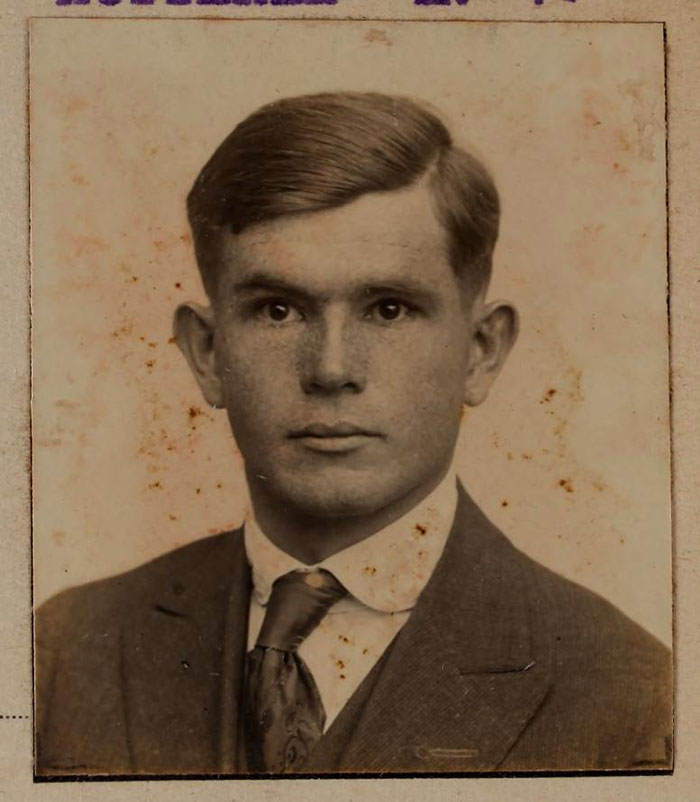
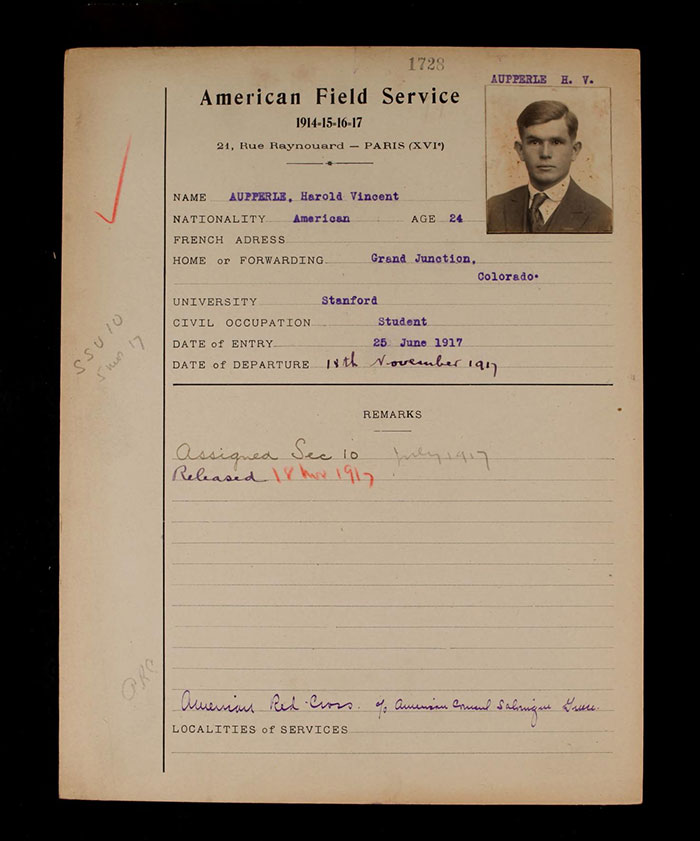
Born August 9, 1892, in Sioux City, Iowa. Son of D. W. and Nancy Gilman Aupperle. Home, Grand junction, Colorado. Educated Grand junction High School and Leland Stanford University, Class of 1917. Joined American Field Service, June 25, 1917; attached Section Ten in the Balkans to November 18, 1917. Rejected by U. S. Army and Navy. Enlisted American Red Cross. To Salonica and Belgrade. Serbian Order of the White Eagle. Died June 14, 1919, of typhus at Nova Varosh, Serbia. Buried Belgrade, Serbia. Body transferred to Masonic Cemetery, Grand Junction, Colorado.
LIKE Kim, "a friend to all the world,"---that was Harold Vincent Aupperle, of Section Ten. "Little Aup," as he was lovingly called by his pals, gave his life in the service of humanity. It was in the bleak and dingy little town of Nova Varosh, Serbia, that he fought his last battle --- with typhus. Weary, worn, and weak from the strain of unrelenting service, "Little Aup " lost.
Aupperle came from Grand Junction, Colorado, where by his eighteenth year he had finished school and had become city editor of a crusading daily paper. Three years later he began his college career at Stanford University, where he captained a winning track team and became a leader in student affairs. Chancellor David Starr Jordan took Aupperle as private secretary on a number of his extended tours.
Aupperle's story is not one of spectacular heroism. War's choice for him was a series of drudgeries, monotonous details, and steady duties. He accepted his lot with cheerful endurance and whimsical philosophy. When death took him all unexpectedly, Aupperle was on the last lap of a wearing, nerve-racking job, doing his bit long after he might have been repatriated, had he so wished.
Rejected for regular war service, in the spring of 1917, as underweight, Aupperle enlisted in the Field Service with the third Stanford unit. On reaching Paris he was assigned to the second Stanford Section, just starting for the Balkans. There he served with the French Armée d'Orient until his formation was recalled to France. When the Field Service was militarized Aupperle was rejected by the army and navy and as a last resort enlisted in the American Red Cross, returning, in December, 1917, to the unfortunate Balkans.
At Salonica Aupperle had charge of the Red Cross motor transport for nearly a year. Then he joined the first relief expedition for Northern Serbia. He was in a small party that left Salonica early in December. Two weeks of adventure brought the expedition to Fiume. To Aupperle was assigned the difficult task of getting supplies through to Belgrade. He took the first relief to the Serbian capital, and received the grateful thanks of its people.
In April, at Belgrade, Aupperle suggested that he might get relief to certain mountain regions along the Bosnian frontier where conditions were distressful. Transportation was the principal problem. Aupperle was given this strenuous and tremendous undertaking and eventually was able to lead a train of wagons loaded with miscellaneous supplies to the beleaguered region.
His letters tell of plodding ox-cart caravans, and of weary treks with trains of pack animals. From a land of desolation he wrote letters so cheerful that they were used as official propaganda to counteract lagging enthusiasm. Aupperle was just completing this last assignment when he succumbed to the malignant typhus. A letter received by a chum in the same service two weeks before Aupperle's death, had said, "Another week will see me out of here --- a country which would make Buddha himself lose his even temperament. Well, Pop, pray that I may have good luck and finish up quickly."
"A little more than two weeks later," writes this chum, "on the hills beside the Danube, the Prince's band stopped playing for a moment while a company of Serbian veterans fired a salute over an open grave. Over and over again I said, 'Goodbye, Little Aup,' as I thought in turn of the many friends, American, French, British, Greek, Serbian, Albanian, and Turkish, that loved him, too."
- Tribute from Memorial Volume of the American Field Service, 1921
WWI File
- Months of service
- 5, 1917
- Section(s)
- S.S.U. 10
- Home at time of enlistment
- Grand Junction, Colo., USA
- Subsequent Service
- A.R.C.