
Avard, Percy Leo
- Who
- WWI driver
- When
- WWI
- Where
- France
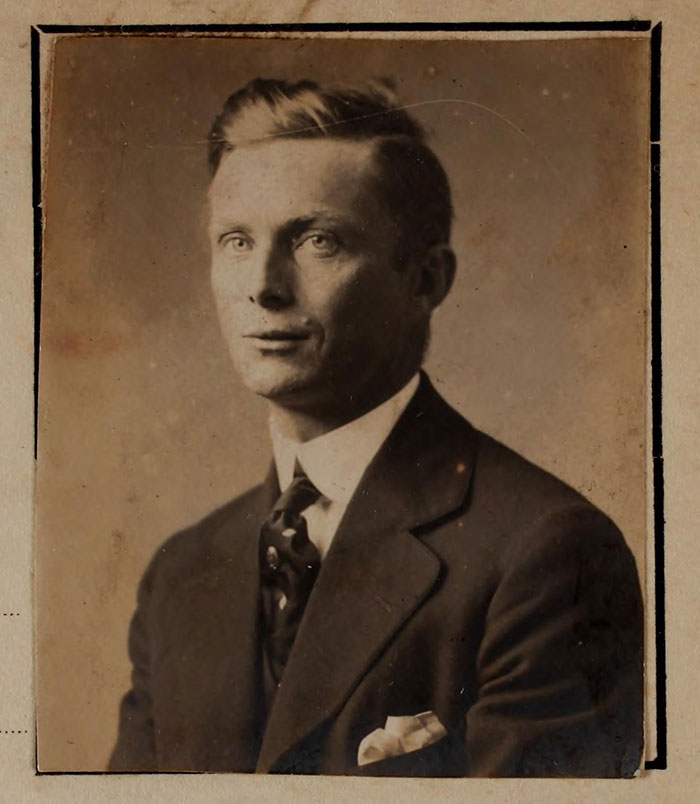
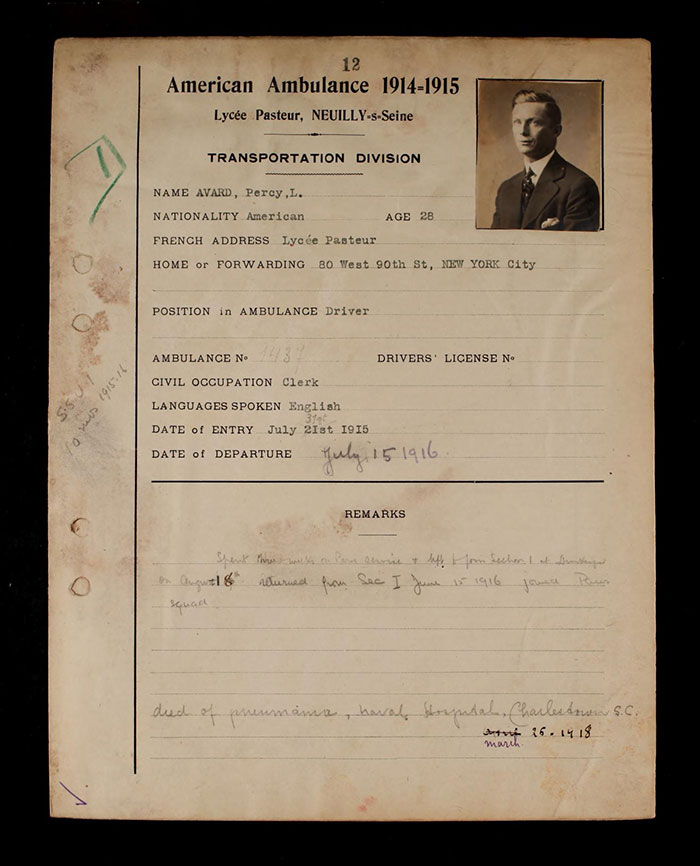
Born April 12, 1887, in London, England. Son of Alfred J. and Margaret O'Brien Avard. Home, New York City. Educated New York public and high schools. Clerk, New York Central Railroad to 1904. California and Arizona, mining. Came East, 1909. New York National Guard. Enlisted United States Army, September 26, 1910, Fort Slocum, New York; attached 5th Cavalry, Troop 1; served Honolulu, Hawaii, and Mexican Border. Promoted to corporal and sergeant. Honorably discharged, September 27, 1913, Fort Huachuca, Arizona. Credit Department, Grolier Society, New York. Joined American Field Service, July 31, 1915; attached Section One, to July 15, 1916. Returned to America. Mining with Chile Exploration Company, Chuquicamata Mine, nine months. Enlisted Naval Aviation, New York City. Naval Training Station, Charleston, South Carolina. Petty Officer. Died of pneumonia, March 26, 1918, Naval Hospital, Charleston. Buried in Calvary Cemetery, Long Island.
WITH spring of the first year of the World War, Percy Leo Avard felt he must share, however humbly, in that supreme effort which all France was making and he determined to join the American Ambulance Field Service. To the objections of his brother, Reverend A. J. Avard,, he responded: "You've given your life to the service of God, why should n't I give mine to help His people?" In June, 1915, his employer wrote in his excellent letter of recommendation: "Mr. Avard is not an adventurer looking for new thrills. . . . . I cannot understand his attitude in that he should give up his work and his family ties to spend an indefinite part of his life in this sacrifice." But those who knew "Pete" Avard best understood: his spirit was one of service, his fine ideals were of action as well as thought.
To "Pete" existence was an amazingly interesting thing, exhilarating, zestful. "We only live once," he said, and in that span he wished to see as much of the world and know as many of its human beings as he could. He traveled far, eager to know life, and always he was well liked and made staunch friends. "Pete" was, as another has described him, "the very salt of the earth."
Although born in England, "Pete" always considered himself entirely American for all his youth was passed in New York. Upon leaving high school he worked with The New York Central Railroad until 1904. Then, interested in mining, young Avard went west, returning in 1909 for his brother's ordination.
He was in the State National Guard, but his real military career began in September of 1910 at Fort Slocum, New York, when he enlisted as a private in the regular cavalry. With troop "I" of the 5th Regiment, he went to Honolulu, returning for further service on the Mexican Border. He was an excellent soldier and a crack shot, and in the troop he had a horse which he had "broken" himself, and which no one else could ride. At the expiration of his enlistment period in 1913, at Fort Huachuca, Arizona, he secured his honorable discharge with high commendation, although told he would be commissioned if he remained in the army.
For nearly two years in New York he was in the credit department of the Grolier Society, leaving it in June, 1915, to join the American Field Service in France. After several weeks of active work with the Paris Squad, "Pete" was with Section One in Flanders. From Crombeke to Beauvais and to the Somme, then in June, 1916, to Verdun, the Section labored, "Pete" setting an example by his tender care of his wounded.
After a year's service he returned to the United States, going almost at once to the Chuquicamata Copper Mine in South America under a three year contract with the Chile Exploration Company, but within the year America joined the Allies, and "Pete" gave up all his plans to return and enlist in naval aviation. At the training station because of his experience he was made a petty officer. Hardly a month later he was taken ill with pneumonia at Charleston, South Carolina. He knew he was sick but not how seriously, and to save his mother from anxiety at not hearing from him, "Pete" had a nurse write that he had hurt his finger playing baseball and would be unable to write home for some time. That was the day before he died.
Sincere, sympathetic, and unassuming, this boy had lived his life as a fine adventure in idealism. He sought no favors or advancements, he accepted the world as a friend, and seeking to serve it made his life a record of true sacrifice and faith. A gallant soldier, who joined to the strength of a man the gentle naturalness and enthusiasms of a child.
- Tribute from Memorial Volume of the American Field Service, 1921
WWI File
- Months of service
- 10, 1915-16
- Section(s)
- S.S.U. 1
- Home at time of enlistment
- New York City, USA
- Subsequent Service
- U.S. Navy