
Bacon, Charles
- Who
- WWI driver
- When
- WWI
- Where
- France
- Education
- Dartmouth
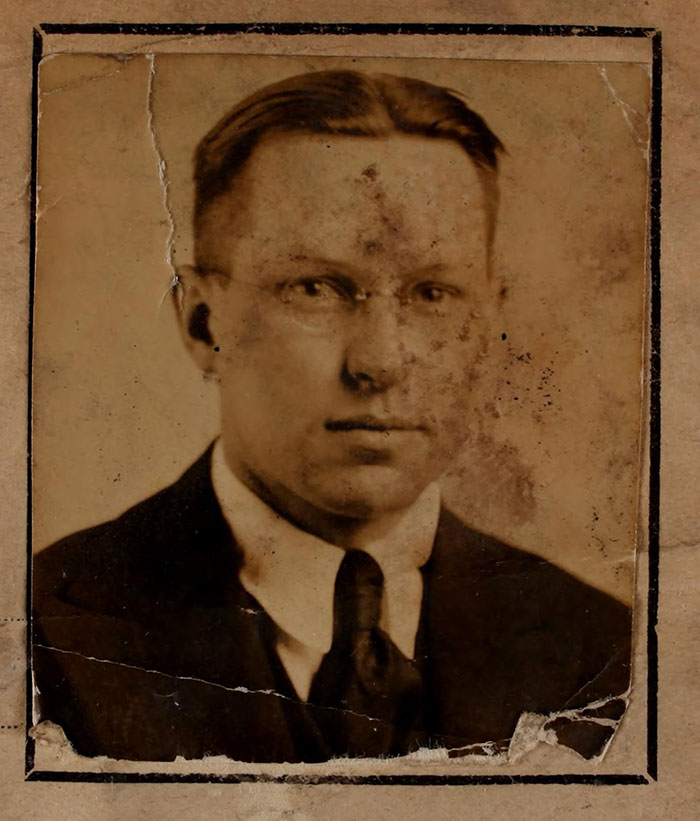

Born November 6, 1895, in Waltham, Massachusetts. Son of Clarence E. and Elizabeth Sheldrake Bacon. Educated Waltham High School and Dartmouth College, Class of 1919. Joined American Field Service, June 2, 1917; attached Transport Section 184 until November 16, 1917. Enlisted U. S. Field Artillery, December 5, 1917; attached 103d Regiment, 26th Division. Killed in action between Haumont and Samogneux, October 24, 1918. Recommended for heroism citation. Buried Samogneux, Meuse. Body transferred to Romagne-sous-Montfaucon, Meuse.
CHARLES BACON wrote to his family in October, 1917, while finishing out his term of enlistment with the Camion Service, a letter unconsciously filled with an intense longing for home. At the end, however, he assured his family that he was not homesick but on the contrary well and happy, and philosophically concludes, "I would give a good deal to be home for Christmas but I guess we cannot have everything we want." It was typical of his unflagging spirit that he would not admit his unhappiness and it was equally to be expected that he would not let the thing that he wanted to do, stand in the way of his duty. We are not surprised to learn that on the very day on which the letter arrived in America, he enlisted in the United States Army as a private in the 103d Field Artillery.
At the Waltham High School and during his short two years at Dartmouth College, "Dutch," as he was called, made many friends whose affection for him shines out from every page of the letters they wrote to his family on learning of his death. One schoolboy chum wrote with a feeling that was typical of them all, "He was the whitest man I've ever met, and every fellow that has known him thinks just that way. Believe me, he leaves a precious memory to us . . . . ...
Early in 1917, Bacon realized the nearness of the crisis and thought out his own duty in regard to it. In a letter to his mother, dated March 4th, he deplored the necessity of war with its attendant suffering, but stated calmly without affectation, "I will surely join wherever I can do the most good." June found him on his way to France in the American Field Service.
With his eagerness to see immediate action, he chose the camion branch and spent a happy and absorbing summer in T. M. U. 184 in a camp at Jouaignes, running up to the front near Vailly, on the Aisne. He wrote home long, ingenuous letters, full of the interest of his new work, striving conscientiously to reproduce for the benefit of those at home the atmosphere of the life he was leading. They are interwoven with bits of color and humor, and fairly breathe the affection and tenderness he always felt for his family. In describing his sensations the first time he was under fire, he said, "We all felt like lost dogs." In another letter he gives us a different and interesting impression of his character. There were just two things he wanted, he wrote,---a collection of Robert Service's poems and a tin of tobacco, and though he doubted whether the tobacco could be sent, he insisted on the poetry.
Like many Americans he at first wrote somewhat disparagingly of the French, but he was quick to recognize and acknowledge his mistake. Later we find him saying, "It is great to think you are doing something for France I only wish I had come over a year or two ago."
On December 5, 1917, "Dutch" transferred to the American Army, enlisted in Battery C, 103d Field Artillery, 26th Division, and soon went into action. Of the last months of his life, crowded as they must have been, we know but little. In the late afternoon of October 24th, 1918, as he stood by his gun in a little pit to the right of the road that runs from Samogneux to Haumont, northwest of Verdun, he was struck and instantly killed by a shell that exploded just above him. His body lies now in the cemetery of the Commune of Samogneux.
His captain described him as "fearless and reliable," and his lieutenant gave him high praise when he wrote "he was beloved by his comrades and always his work was of the best," but we know as certainly his worth when we hear the heart broken cry of his roommate of the old happy days at Dartmouth,--- "I loved him, I loved him ! "
- Tribute from Memorial Volume of the American Field Service, 1921
WWI File
- Months of service
- 5, 1917
- Section(s)
- T.M.U. 184
- Home at time of enlistment
- Waltham, Mass., USA
- Subsequent Service
- U.S.F.A.