
Baer, Carlos Willard
- Who
- WWI driver
- When
- WWI
- Where
- France
- Education
- Miami Univ.
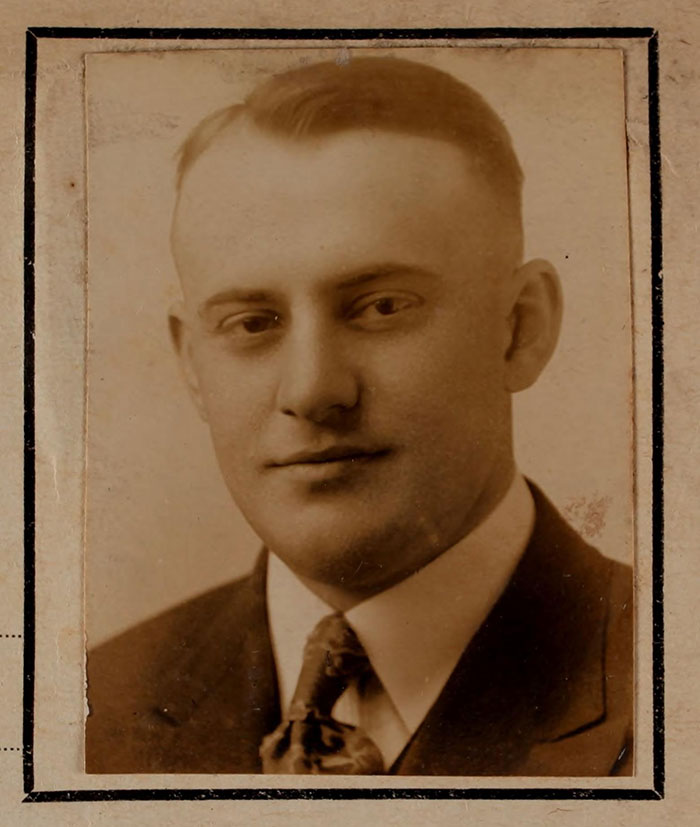
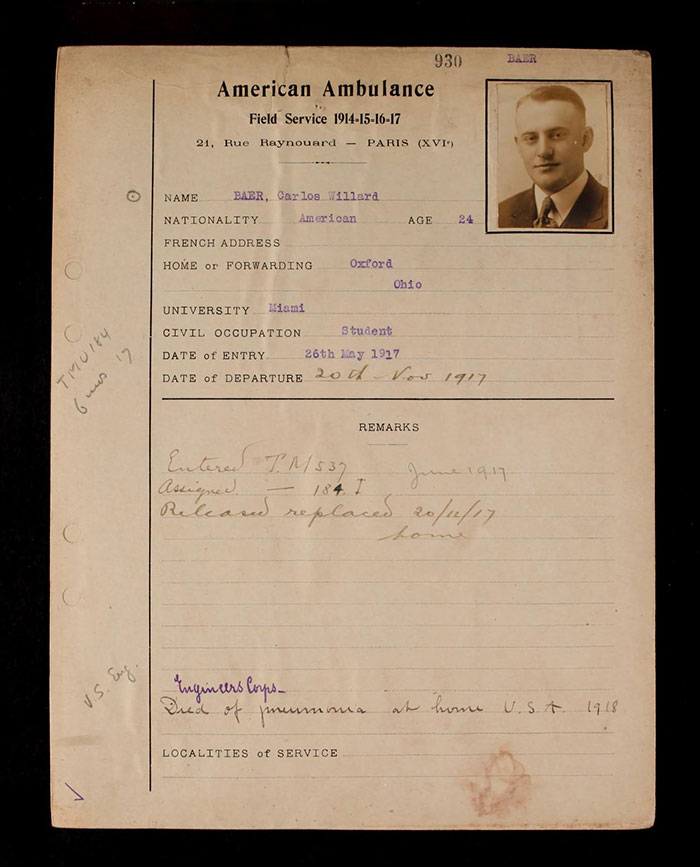
Born February 11, 1893, in Alexis, Illinois. Son of Reverend Michael R. and Henrietta Parcel Baer. Educated in Oxford, Ohio, schools and Miami University, Class of 1917. Joined American Field Service, May 26, 1917; attached Transport Section 184, to November 20, 1917. Returned to United States, December, 1917. Enlisted Engineers Corps as private, March, 1918. Died April 6, 1918, at Columbus Barracks, of pneumonia, following an operation for appendicitis. Buried Oxford, Ohio.
AT Miami University, which he left late in his senior year to join the Field Service, Carlos Willard Baer was "one of the best known athletes and one of the most popular university men in the community." A college professor, who knew him well, spoke of him as "one of the most modest athletes that I have ever known."
The fourth and youngest son of an Oxford, Ohio, clergyman, Baer was brought up in the university town and was therefore a familiar figure and a well-liked one before he graduated from high school. In the university life he quickly earned a place for himself, not merely because of his splendid athletic abilities, but because of the fine character and personality which went with them. His father said, "We could recite enough to fill a volume in the way of pleasing memories of his life and then not have done. He was a boy of exceptionally clean life --- with not one of the bad habits so usual in the lives of the youths of our day."
This clean living was remarked by all who knew him, yet he was so natural, in his simplicity and lack of affectation, that Carlos Baer secured their affection as well as their respect and admiration. He was a member of one of the stronger college fraternities, AKE, and elected in his senior year to the men's honorary society, the Red Cowl. Of him the Dean of the junior College wrote, "Mr. Baer had a remarkable physical development and was without question the most powerful man in college while he was here. He never at any time made use of his strength in a way which was a reflection upon him or his college. His conduct in every respect was above reproach. His habits were of the best and when he went from Miami, he left behind him the reputation of being one of her greatest football men, with the added distinction of playing a game which was of a character which met the full approval of those who believe in the cleanest kind of sports."
Soon after war was declared Baer, with that eagerness to be actively engaged in the actualities of it which so well suggests the college spirit in those days of 1917, enlisted in the American Field Service, sailing for France in May. There he joined the Camion branch in the field, and went out to Transport Section 184 of the Reserve Mallet near Soissons. Through the summer and fall he worked with the trucks, his strength being a great asset in the hard manual labors of carrying supplies and keeping his heavy truck in condition. Not wishing to enlist in this branch of service for the duration of the conflict, Baer did not sign up in the Motor Transport Corps when the Field Service was taken over by the army, but served out his enlistment period, then returned to America. In March of 1918 he enlisted in the Engineers' Corps and was temporarily stationed in Columbus. While there awaiting orders for transfer to Fort Meyer, Virginia, he suffered an acute attack of appendicitis. The hurried operation was successful but a few days later Baer contracted a severe case of pneumonia. And this man of fine physique, weakened by his operation and previous illness, died in the camp hospital on the sixth of April, just one year after our declaration of war.
The whole of Oxford mourned his death; the funeral services were held in the Miami auditorium, and the University battalion, comprising the whole student body, marched in procession to the cemetery. The number of his friends, the fineness of his life, the fidelity of his service, all identify the man. And nothing more fitting than the text which the pastor of his church used for his funeral discourse could be written down after the name of Carlos Willard Baer: "For he was faithful."
- Tribute from Memorial Volume of the American Field Service, 1921
WWI File
- Months of service
- 6, 1917
- Section(s)
- T.M.U. 184
- Home at time of enlistment
- Oxford, Ohio, USA
- Subsequent Service
- U.S. Eng.