
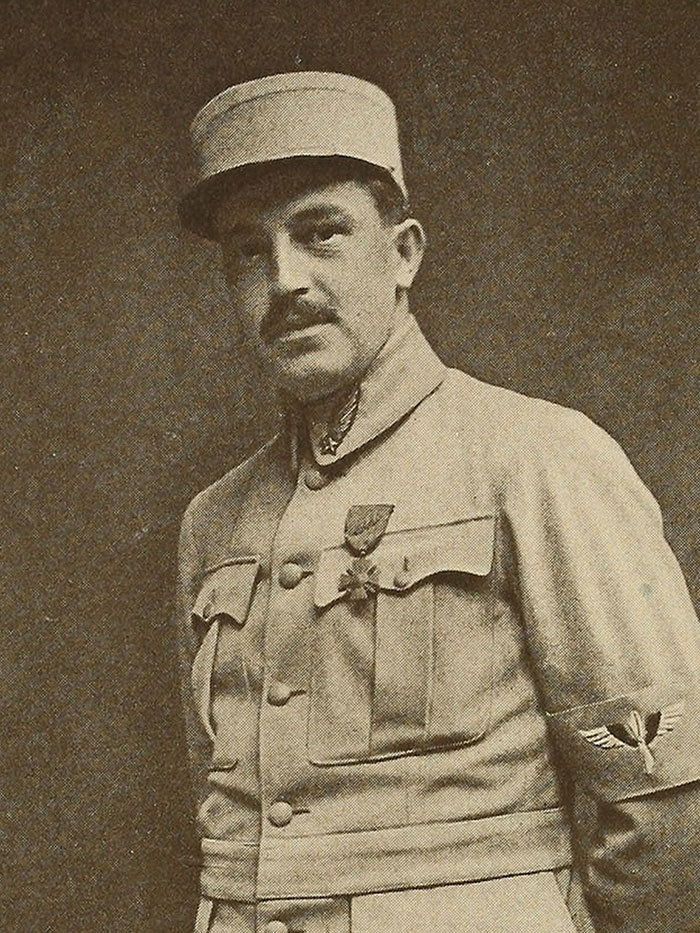
Balbiani, Roger Marie Louis
- Who
- WWI driver
- When
- WWI
- Where
- Western Front, France
CITATION AU 36ème CORPS D'ARMÉE
BALBIANI, Roger M. L., Conducteur, puis chef d'une section sanitaire étrangère: --
A déployé depuis plusieurs mois un grand dévouement; s'est particulièrement distingué du 22 Avril 1915 lors de l'attaque allemande au moyen de gazs asphyxiants et pendant les bombardements de Dunkerque.
Born April 8, 1887, in Paris, France. Son of Count and Countess Balbiani. Joined American Field Service, October 22, 1914; attached Section One. Commandant Adjoint, April 18, 1915, to December 10, 1915. Enlisted French Aviation, 1916. Trained Plessis-Belleville. Attached Escadrille Gaumont. Killed at Tours, May 21, 1918. Croix de Guerre, two stars and a palm. Buried at Paris, Seine.
ROGER BALBIANI was born in Paris some thirty years ago, and educated at a public school in England and on the continent. Coupled with his unusually genial nature was a certain savoir faire which made him at home in any gathering. He had in addition a care-free, joyous disposition that enabled him to be happy and gay, however trying the circumstances.
"Balbi's" history is that of Section One in the early days of 1914 and 1915: Merville and the British, then Dunkirk, finally the terrible days of the first gas attacks at Elverdinghe, at Popperinghe, and along the Yser. When it was all over an army citation and "Croix" came to "Balbi" as leader of the Section. It was quite typical of his generous nature that later on he tried every means of having his Cross transferred to another man.
After a year with the Field Service, Balbiani achieved his heart's desire, being admitted to the French aviation service. His dash and coolness made him an accomplished pursuit pilot. In 1917 he was sent back to an American flying center, where, he made many loyal friends, but was killed soon after in an accident.
The following are some of Henry Sydnor Harrison's impressions of the man:
"'Seniority' does not always bring the best to the top, but when Balbiani succeeded to the leadership of Section One, I think nobody doubted that the mantle had fallen where it rightfully belonged. His unusual education was of course an advantage: in his contact with the French officers, our superiors, "Balbi" was himself, in every essential, a fine French officer. As to speech alone, I am positive that he was more at home with French than many Frenchmen. It amused him to note the surprised looks of pedestrians to whom he, from his car, shouted some necessary warning or bit of casual repartee. They could not understand how such racy argot came to be issuing from the lips of an American chauffeur. But the gift for leadership in him was beyond these chance accomplishments. "Balbi" was blessed with the power of a personality at once decisive and humanly charming and persuasive. When need was, he could rule like another by the elementary method of the high hand, but his nature expressed itself most willingly through the kinder ---and with him no less effective--- means of suggestion. He abounded in tact and 'sweet reasonableness'; deeper than that, he was instinctively understanding, he had sensibilities of the heart.
"On our first excited day behind Ypres, some one was needed for a trivial duty at the gare of Popperinghe. The writer, a newcomer, was plainly indicated for the inglorious post, but when the chef came to break the unwelcome news to me, I remember that he was as reluctant and gentle as if my disappointment were his own. In fact, this young man had the gentleness which so often stirs the springs of a brave soul, and which, I am inclined to think, is the most endearing of the qualities possessed by the sons of men.
"Like many considerate and intuitive persons, 'Balbi' had also the continuing grace of humor. He loved to take and give a joke; he had himself a subtle wit and I always think of him as merry, and the memory now cannot separate him from his quick and understanding laugh. So he maintained under every circumstance, however difficult, that bearing of 'light humorous courage' which, in respect to a man's address and the manner of his attack upon life, is perhaps the last word of personal distinction.
"He saw me off at the Dunkirk station, the day I left the Service. We spoke and passed, and our courses did not recross; but I have not forgotten his gay hail. Ardent and debonair, he gladly lived, and it can not be doubted that when his 'black minute' came, he met it as freely and laid him down with a will."
- Tribute from Memorial Volume of the American Field Service, 1921
WWI File
- Rank
- Cdt. Adjt. / Section Commander
- Months of service
- 14, 1914-15
- Section(s)
- S.S.U. 1
- Home at time of enlistment
- Paris, France, France
- Subsequent Service
- French Aviation
Decoration(s) received while a volunteer with the Field Service
- Croix de Guerre (1914-1918)