
Baylies, Frank Leaman
- Who
- WWI driver
- When
- WWI
- Where
- Balkans (The Orient), France
- Education
- New Bedford H.S.; Moses Brown
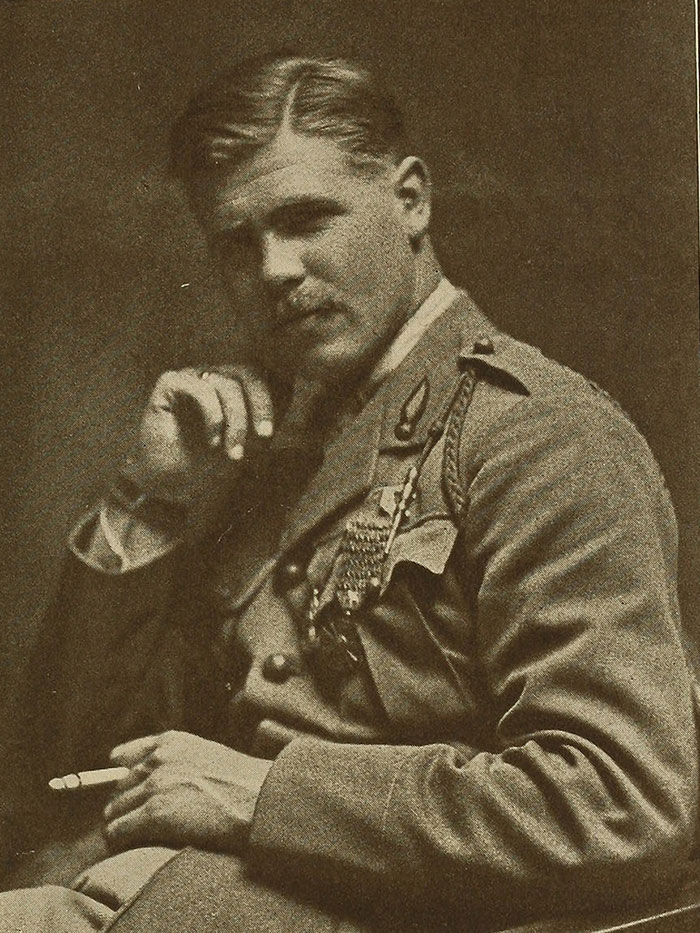
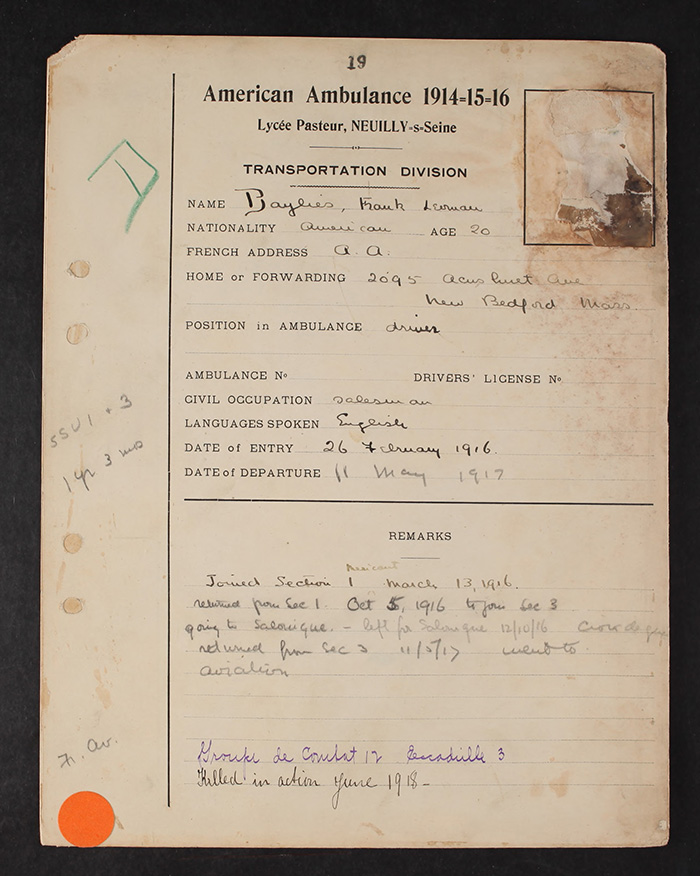
Born September 23, 1895 in New Bedford, Massachusetts. Son of Ex Lieutenant Charles S. Baylies, U. S. A., and Lydia T. Baylies. Educated New Bedford schools and Moses Brown School, Providence, Rhode Island. Business with father as salesman. Joined American Field Service, February 26, 1916 ; attached Section One, later Section Three in Balkans, October, 1916, to May 11, 1917. Croix de Guerre. Enlisted French Aviation, May 21, 1917. Trained Avord, Pau, Cazeaux. Breveted September 20, 1917 Attached Stork Escadrille, Spad 3, December 18, 1917. Promoted successively to Corporal, Sergeant, and proposed for Second Lieutenant. Offered commission in U. S. Aviation as Second Lieutenant, May 13, 1918. Twelve official victories. Légion d' Honneur, Croix de Guerre, seven palms, Médaille Militaire, Aero Club of America's Medal. Killed in action over the German lines, June 17, 1918, near Rollot, Oise, southeast of Montdidier. Buried Courcelles-Epayelles, Oise.
"PILOT BAYLIES killed. Was buried with honors befitting hero," was the message dropped over the French lines by a German plane.
Frank Leaman Baylies, the American "ace of aces," when he was brought down in flames over the German lines between Crèvecoeur and Lassigny in June, 1918, began his war career and won his first decorations with the Field Service. He joined Section One in February, 1916, and, after serving with distinction on the Somme and in the battle of Verdun on the French front, he was one of the men selected to go with Section Three in October, 1916, when it was offered the opportunity of serving with the French Army in the Balkans.
"To know Baylies was to like him," Paul Rockwell cabled the Chicago Daily News when his death was confirmed. "His outstanding qualities were those which real heroes possess. He was quiet, modest, and reticent on the ground. He was dashing, fearless, and indomitable in the air."
Baylies destroyed his first German aeroplane in February, 1918. Five months later, when he departed on his last mission, he had twelve official and five unofficial victories to his credit. No pilot in any army rose more quickly or deservedly to fame. "Baylies seems to add to the daring of a Guynemer the precision of a Dorme. He is a great ace who does honor to America and is a worthy rival of our most famous champions," wrote the aviation expert of Le Petit Journal when the young American's name began to appear almost daily in the communiqués.
Baylies enlisted in the French aviation corps when he returned with Section Three from the Balkans in May, 1917. He received his training in the schools of Avord, Pau, and Cazeaux, where his record foreshadowed his later victories and caused him to be selected for service at the front with the celebrated "Escadrille Cigogne," the squadron which Guynemer commanded until his death, and which included among its members many of the most noted flyers in the French army.
No one was allowed to wear the insignia of this famous squadron until he had brought down three German planes. Baylies lost no time in doing this. From the first his comrades spoke of him as a tireless flyer, who, in addition to his regular patrol work, spent many hours prowling the skies alone in search of aerial duels. "Baylies' fighting tactics," wrote a friend, "were extremely simple. When he saw enemy aeroplanes he immediately attacked regardless of the odds against him or the distance within the enemy lines."
But his was not the reckless fearlessness of a man who did not realize the risk he ran. The testimony of all of his comrades is that his daring was the well-considered , open-eyed courage of a remarkable flyer who counted the cost but never hesitated. In his many aerial duels his plane was not once struck by an opponent's bullet, although, when he first reached the front, he was brought down between the German and French lines by machine gun fire from the ground.
Baylies was awarded the Légion d'Honneur, the Médaille Militaire, and the Croix de Guerre with seven palms. The city of his birth has named a square after him with solemn services. He has a high place in all that has been written about the war in the air and those intrepid airmen "who took their toll" and then made the great sacrifice. Those who mourn him are consoled by the knowledge that he belongs to the noble company which will be remembered in two countries so long as there is any interest in the World War and any reverence for its heroes.
- Tribute from Memorial Volume of the American Field Service, 1921
WWI File
- Months of service
- 15, 1916-17
- Section(s)
- S.S.U. 1, S.S.U. 3
- Home at time of enlistment
- New Bedford, Mass., USA
- Subsequent Service
- Sgt. French Aviation - 2nd Lt. U.S. Aviation
Decoration(s) received while a volunteer with the Field Service
- Croix de Guerre (1914-1918)