
Beane, James Dudley
- Who
- WWI driver
- When
- WWI
- Where
- France
- Education
- Concord H.S.
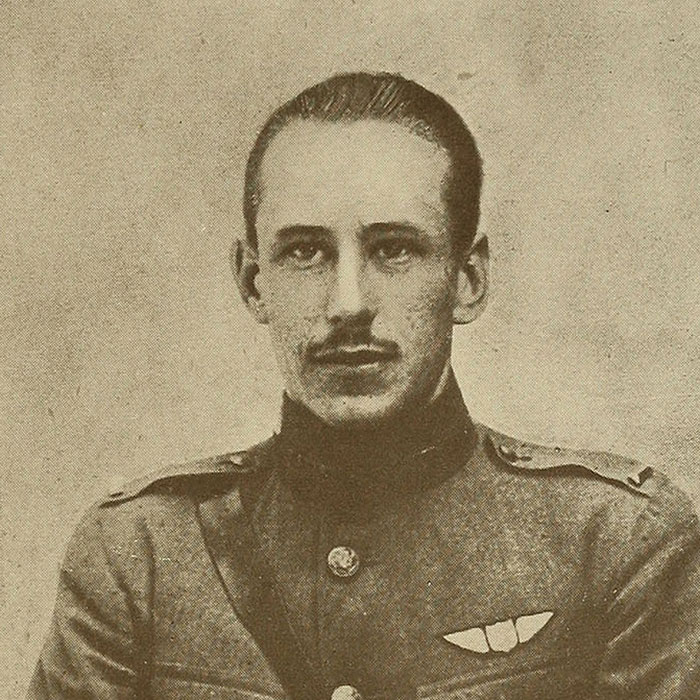
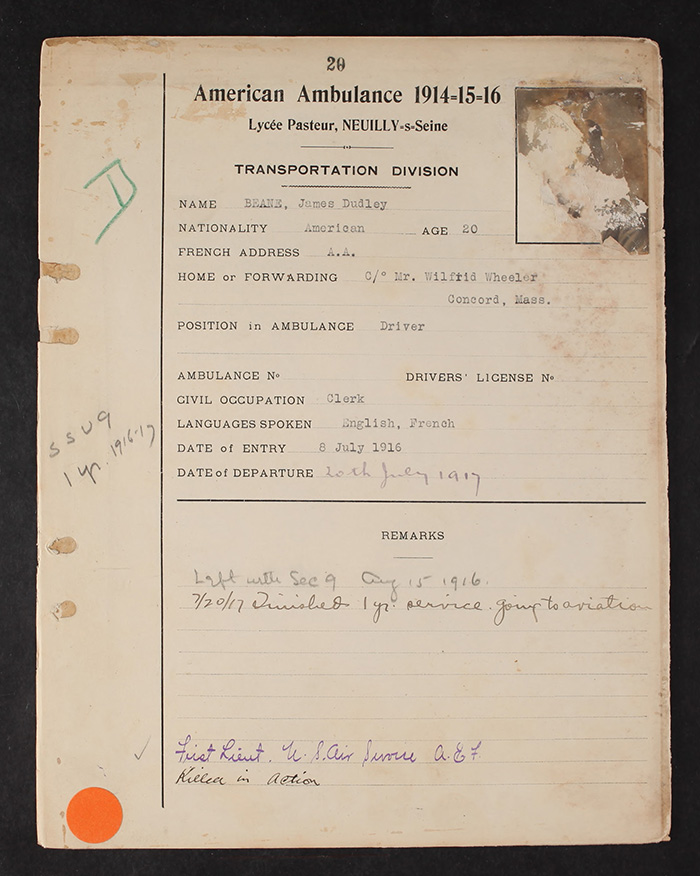
Born January 20, 1896, in New York City. Son of Edmund Murray and Kate Miles Beane. Educated Albany, New York, and Wellesley Hills, Massachusetts, schools, and Concord High School, Class of 1914. Employed State Department of Education. Joined American Field Service, July 8, 1916; attached Section Nine to July 20, 1917. Enlisted French Aviation, trained Tours and Issoudun. Attached 69th French Escadrille. Commissioned First Lieutenant, U. S. Air Service, January 8, 1918, detailed with the French. Wounded in action, June 18, 1918. Croix de Guerre and D. S. C. Transferred to 22d U. S. Aero Squadron, August 27, 1918. Killed in combat north of Grandpré, October 30, 1918. Buried near Brieulles-sur-Bar, Ardennes. Body transferred to American Cemetery, Romagne-sous-Montfaucon, Meuse.
AT the Concord High School, James Dudley Beane is remembered "rather for the variety and ingenuity of his pranks than for his learning His was a rest less young spirit, waiting for some interest outside of books that should seem real to him." It was undoubtedly this wild longing for adventure that drew him in the summer of 1916 from the dull routine of business life to France and the war. As an ambulance driver in Section Nine of the American Field Service, he had an opportunity to observe the war at first hand, and to find that it was in the main as prosaic and unromantic as studying Latin or adding up figures. But, though he lost illusions, he caught in their place a splendid fire of enthusiasm for France and for the greatness and sanctity of her cause. In 1917, he entered French Aviation, but was later transferred and eventually commissioned in the American Army, being among the first American pilots to reach the front. The service, with its dangers and its glory combining to make it the most chivalric branch of the Army, appealed to his romantic and adventurous spirit, and he showed great adaptability and proficiency as a flyer. He was soon taking an active part in aerial combat with the enemy, in which work he was, in the words of his squadron commander, "vigorous and clever."
On June 30, 1918, occurred his first exploit,---a fight against overwhelming odds, in the course of which his plane was completely riddled and two fingers of his left hand shot off---rewarded by the following citation for the Croix de Guerre to the Order of the Army: "In the course of patrol duty, James Dudley Beane was attacked by several enemy planes, and although seriously wounded he succeeded in extricating himself and in bringing back his damaged machine. He showed in this circumstance much skill and great coolness." His own version of the affair, contained in a letter from the hospital, was quite different, and very characteristic: "I lost two digits in a fight some time ago," he wrote briefly, "and have been laid up in the hospital ever since."
On his return to the front he set out upon the business of bringing down Huns with redoubled energy and skill. It was not long before he became an "ace," having destroyed five enemy planes upon which official confirmation was secured. "He was quiet and modest about his achievements," says his commander " . . . . and a braver or more skillful pilot would be hard to find." On October 29, 1918, he added two more Germans to his list in an inspired fight that is officially recorded in his citation for the Distinguished Service Cross: "When Lieutenant Beane's patrol was attacked by eight enemy planes, Fokker type, he dived into their midst in order to divert their attention from the other machines of his group, and shot down one of the Fokkers in flames. Four other Fokkers then joined in the battle, one of which was also destroyed by this officer."
The next day he flew out over the lines and engaged in his last "dog fight." In the course of the combat he disappeared from view, and was for some time listed among the missing. After the Armistice, however, his name was located in the official German records as killed in action, and later his grave was found close by the wreck of the machine that he had loved and in which he had made his glorious, imperishable record, in a little hollow off the road that runs from Brieulles to St. Pierrement, in the Ardennes.
- Tribute from Memorial Volume of the American Field Service, 1921
WWI File
- Months of service
- 12, 1916-17
- Section(s)
- S.S.U. 9
- Home at time of enlistment
- Concord, Mass., USA
- Subsequent Service
- 1st Lt. U.S. Av.