
Clark, Coleman Tileston
- Who
- WWI driver
- When
- WWI
- Where
- Balkans (The Orient), France
- Education
- Petit Lycée Condorcet, Paris; Kingsley; Yale
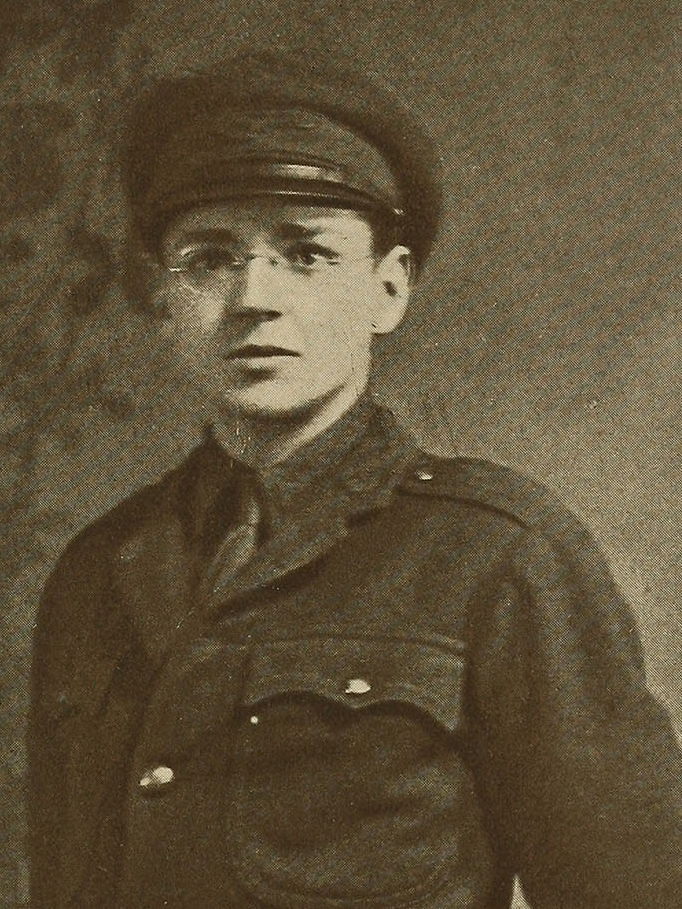
Born April 11, 1896, in Yonkers, New York. Son of Salter Storrs and Caroline Goddard Clark. Home, Westfield, New Jersey. Educated Westfield schools, Petit Lycée Condorcet, Paris; Kingsley School, New Jersey; Yale, University, Class of 1918. Joined American Field Service, April 29, 1916; attached Section Three, France, and nine months in Balkans, to August 24, 19 17. Croix de Guerre. Aspirant, French Artillery School, Fontainebleau, January 24, 1918. Attached 28th Regiment French Artillery. Mortally wounded in action, May 28th, Juvigny. Died May 29, 1918, field hospital, Fontenoy. Buried Ambleny. Removed to Ploisy, Aisne, near Soissons.
NONE of Coleman Clark's friends in the Field Service can recall when he was not tenderly known as "Brake Band," or " B. B.," just as none of us can remember when he was not dear to all who knew him. He was playfully given his nickname when he first went to the front in the late spring of 1916 with Section Three, then working in the hills of Lorraine, and when, as he wrote, "my car wore out three brake bands in three days, and it made me wild." To his companions in the army he was ever after known only as "B. B."
He was young, was "B. B.," and delightfully boyish in appearance and spirits, when he first came to the war. All his active service, too, was with one Section. And yet, boy though he was, and limited as was his actual personal contact with other Sections, he very quickly came to be one of the men who, with nothing to make them known except the transmitted force of a fine character and a quenchless enthusiasm for the cause of France, really stood for something in the eyes of the Service as a whole.
The fine record which he made in Lorraine, he repeated at Verdun, and in the Balkans. "I never knew a man who so completely won the respect and affection of every one," wrote Lovering Hill, his chief for the entire sixteen months of his service as a volunteer. "Always bright and cheerful, ever ready to do more than his share, gentle and kind, never out of temper, plucky and courageous, always a gentleman --- he rang true as steel." And another member of Section Three wrote to his parents at the time of his death: "You probably never knew from Coleman how fond we all were of him . . . . "
When America entered the war, "B. B." tried to enlist in his country's army, but he was rejected by every branch, on account of his eyes, so he irrevocably threw in his lot with the blue-coated poilus, whom he already knew so well and loved so deeply, by enlisting in the Foreign Legion, and entering the French artillery officers' training school at Fontainebleau.
Graduating as an aspirant in January, 1918, he was attached to the 28th Regiment, Field Artillery, and served with distinction at the front until he was mortally wounded, on May 28th, during the last great German offensive on the Aisne, while replacing one of his gunners, who had fallen at his post a moment before.
He was taken at once to a field hospital where an operation was considered impossible without blood transfusion. The chief surgeon asked M. Baron, a hospital attendant, who was, before the war, a Catholic missionary in Egypt, and subsequently director of a Catholic College in Cairo, if he would give some of his blood for this purpose. "I wept for joy," Monsieur Baron has written, "What would we not have done to try to save this child, the first American who had come into our hands?"
The operation was successful and Coleman was resting easily when the Germans, approaching ever nearer and nearer, began to bombard the hospital. It was necessary to evacuate the wounded and, not strong enough to stand this disturbance, he died quietly when they began to move him. He was buried the next day in the military cemetery of Ambleny-Fontenoy, the colonel of his regiment speaking of his heroic act in "going down from chief of two guns to charging and firing, as fast as his men fell."
As collected by his parents, Coleman's letters, written without premeditation, at sea, in Paris hotels, in French dugouts, and in Balkan cattle-sheds, give an intimate picture of the life of a Field Service man. They also record with rare charm the high standards which we, who were by his side at their writing, saw so modestly and so unvaryingly put in practice.
- Tribute from Memorial Volume of the American Field Service, 1921
WWI File
- Months of service
- 16, 1916-17
- Section(s)
- S.S.U. 3
- Home at time of enlistment
- Westfield, N.J., USA
- Subsequent Service
- Asp. French Artillery
Decoration(s) received while a volunteer with the Field Service
- Croix de Guerre (1914-1918)
