
Clover, Greayer
- Who
- WWI driver
- When
- WWI
- Where
- France
- Education
- Leland Stanford ; Yale
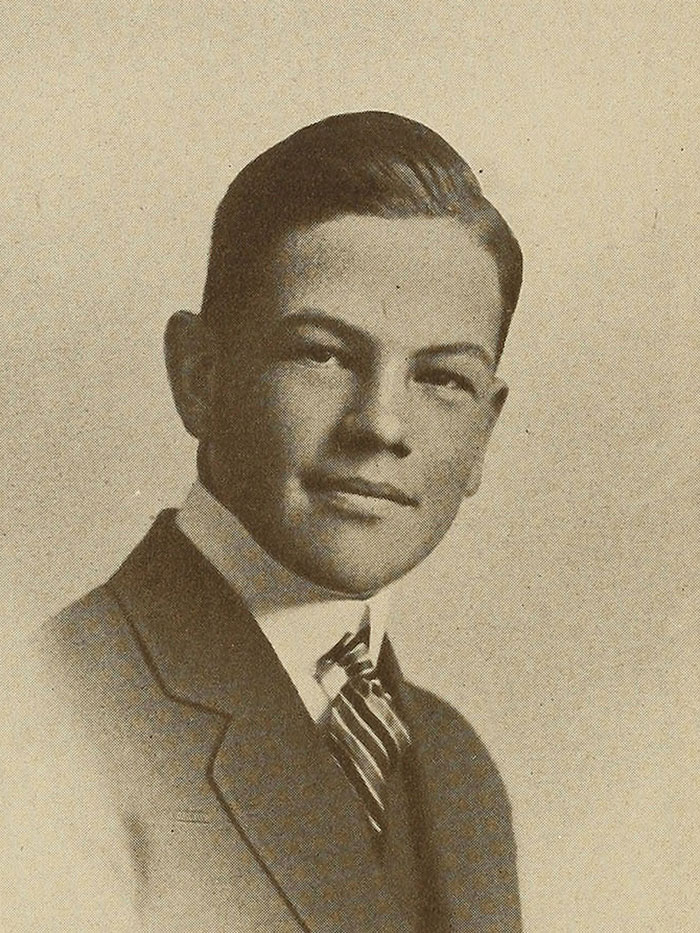
Born April 14, 1897, in Chicago, Illinois. Son of Samuel T. and Mabel Hitt Clover. Home, Richmond, Virginia, and Los Angeles, California. Educated Los Angeles and Pasadena schools, California; one year Leland Stanford University; Yale University, Class of 1919. Joined American Field Service, May 19, 1917; attached Transport Section 133 to November 19, 1917. Enlisted U. S. Aviation. Second Lieutenant. Killed in aeroplane accident August 30, 1918, training at Issoudun. Buried Issoudun, Indre.
OF all the qualities of character that distinguished Greayer Clover, perhaps the one that most fills the memory of his friends is his greatness of heart. He was as utterly incapable of thinking a mean or selfish thought as he was of "funking" in time of danger,---and courage, both moral and physical, was at the very foundation of his nature. His letters and his more formal sketches breathe loyalty ---loyalty to his ideals, his country and his friends. From his camion section he wrote, "There are forty of us in the section and each one has thirty-nine friends," and we know that he would have given his life for any of them because such was his plain understanding of friendship. "He had the kindest, tenderest and most generous heart that ever beat!" is the heart-broken cry of one of his closest friends. He loved children and they were quick to find in him a spirit as pure and fresh as their own. Of his generosity --- thoughtful, sacrificial generosity that took him often far out of his way to serve others---we have countless evidences. He "gave his own blankets and all of his sweaters and mufflers" to a family of Belgian refugees whom he discovered almost destitute in the winter of 1917-18, and he diverted every cent of his pay that he could spare, to their support." Many of us think of deeds such as that," a friend wrote, "but 'Grub' was one of the few who continually did them."
Greayer entered Yale in the fall of 1916 after a year at Leland Stanford Jr. University. As a schoolboy he had won the California interscholastic tennis cup and his athletic achievements continued at college. On April 17, 1917, he wrote to his father arguing for permission to join the American Field Service, closing with the cry, "And Oh! I want to make it France!" On May 19th, he sailed and in his father's words, "Never went a Crusader to the Holy Land with more zeal to serve." He served in the Camion Branch of the American Field Service until its absorption by the United States Army and then enlisted in aviation. On August 30, 1918, while flying across country over Romorantin, his plane skidded and crashed to the ground, killing him instantly.
"If so good a flyer as Greayer had to fall," Lieutenant J. R. Crowe, his "bunkie," killed two weeks later in the same way, wrote, "I know that it is all chance anyway."
His writings, which include a published volume of anecdotes under the title "A Stop At Suzanne's," betray a great deal of real literary ability, but more particularly they reveal the charm of his personality and the sincerity and fearlessness of his character. They indicate wide and intelligent reading, an intense love of music and a deep-seated admiration for France and the civilization that she represents, together with a quick and sympathetic appreciation of the humorous and the pathetic.
In the charming little sketch that gives the title to the book, Greayer tells of making his stop at "Suzanne's," --- that romantic inn where new-fledged aviators were welcomed in the brotherhood of the air. There he signed his name in the big book, below the names of Guynemer and Fonck and Bishop, with a boyish exalted thrill at the thought that those to come after might one day pause over his signature and remember him. That day has come and we cease turning the pages to bow silently over his name,---not because of the greatness of his achievements, but because of the beauty of his life. He did not have the good fortune to win his spurs in battle, but he leaves a record as imperishable as time itself,---that we may not forget.
- Tribute from Memorial Volume of the American Field Service, 1921
WWI File
- Months of service
- 6, 1917
- Section(s)
- T.M.U. 133
- Home at time of enlistment
- Richmond, Va., USA
- Subsequent Service
- 2nd Lt. U.S. Av.
