
Dix, Roger Sherman, Jr.
- Who
- WWI driver
- When
- WWI
- Where
- France
- Education
- Country Day; Harvard
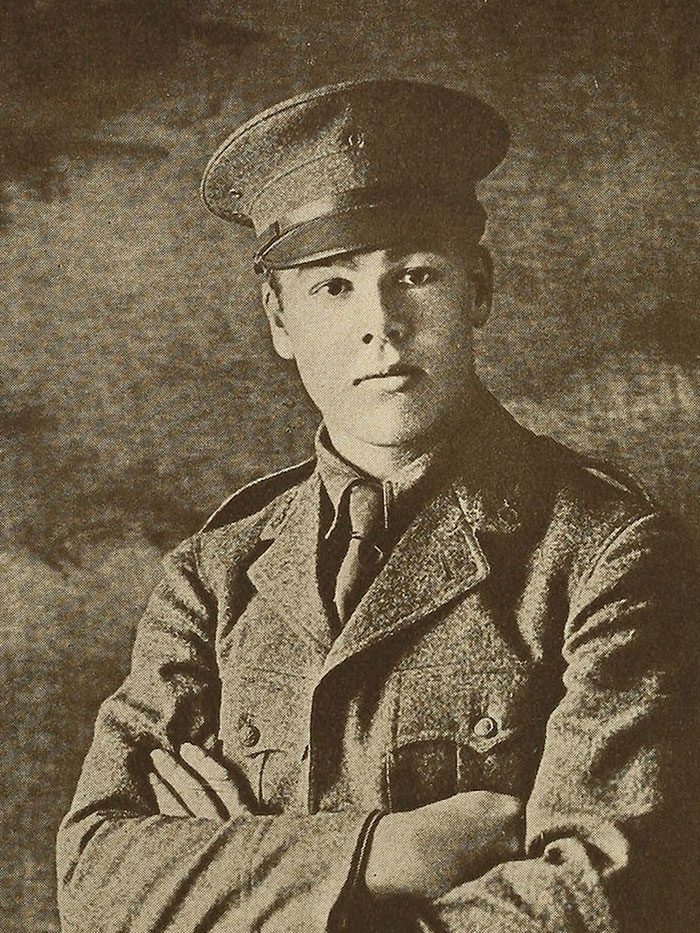
Born December 9, 1896, in Boston, Massachusetts. Son of Roger Sherman and Louise Parrish Dix. Educated Country Day School and Harvard University, Class of 1918. Attended two Plattsburgh Camps. Harvard Regiment. Joined American Field Service, July 23, 119 1917; attached Section One until October 21, 1917. Enlisted U. S. Aviation, November, 1917. Trained as bombing-observer at le Crotoy, Somme. Commissioned Second Lieutenant, May 112, 1918. Killed in aeroplane accident, le Crotoy, May 5, 1918. Buried le Crotoy, Somme.
IN the spring of 1918, upon his last training flight at the French school, Roger Sherman Dix, Jr., met his death. The plane in which he was acting as observer "collapsed at a height of about six-hundred feet" and Roger and his French pilot were killed. A French flyer at the École wrote: "Comme les autres fois, il était parti confiant, joyeux, et plein d'entrain. Hélas, le mort stupide s'est trouvé sur son chemin."
Roger Dix left Harvard at the end of his junior year to join the American Field Service, and in July, 1917, joined Section One near Verdun. With the veteran group he served through the very active summer of almost constant fighting, Section One receiving a citation for its work at this time. He added many friendships here, to those he had won in school and college, and earned the commendation of his Chef for his unflagging zeal and fidelity to duty. In October he left the Service, enlisted in the U. S. Air Force, and later went, as a cadet in American Aviation, to a French school at le Crotoy, near the mouth of the Somme. "He wished to be trained as a pilot, but this would have meant a long delay. He was promised that he would be sent at once to the front if he took the training as observer," and so Roger was one of twenty-five who volunteered as bombing-observers.
Having made his first flight in March, he completed his work with the best marks of any in his class, "was to have received the highest honors of any of my command," said his chief; and he was to leave for the front in a few days, when the accident happened. Subsequently his commission as Second Lieutenant arrived, dated May 12, 1918, two days before his death. Lieutenant Glover wrote, "He died while doing work in the air, and while holding the position of first in his class. More glory than this no man can claim for his son." He told, also, that in six weeks he came to know Roger as "a most excellent soldier both on the ground and in the air."
Nothing can better show Roger Dix as a man and a friend than does a memorial letter, sent to his father, signed by each of his cadet comrades: "None of the twenty-four flying cadets of his detachment has words to express to you how deeply we feel his loss --- to you, to us, and to the A. E. F. Easily the most popular member of this detachment, Cadet Dix was a loyal, gallant soldier, an assiduous student, an excellent airman, and a splendid companion. Every man counted him his friend, and he had never failed us. His fearlessness, his coolness, and his intrepidity had made it a foregone conclusion that his career in his chosen service would have been brilliantly distinguished and his tragic death is a double loss, to us and to the army, because he was the possessor of such splendid qualities."
Corporal Robert Philip, his French instructor, voiced the sympathy and understanding which marked Roger's friendship with those about him in a letter to his father: " Ce bon camarade --- il est mort en faisant son devoir de soldat américain, il est mort en brave! J'ai, moi-même en aéroplane suivi le cortège et lancé des drapeaux sur le corbillard, suprême hommage à notre cher disparu. Roger Sherman Dix repose maintenant en paix en terre française pour laquelle il est venu courageusement combattre à l'ombre des drapeaux américains et français. Nous avions tous pu apprécier ses qualités nombreuses --- excellent camarade, un coeur toujours compatissant, dévoué travailleur et modeste."
In the words of his fellows, written to Roger's father, "We have lost a splendid comrade, the Expeditionary Force a fine soldier, and yourself a noble son."
- Tribute from Memorial Volume of the American Field Service, 1921
WWI File
- Months of service
- 3, 1917
- Section(s)
- S.S.U. 1
- Home at time of enlistment
- Greenbush, Mass., USA
- Subsequent Service
- Cadet U.S. Av.