
Edwards, George Lane. Jr.
- Who
- WWI driver
- When
- WWI
- Where
- France
- Education
- Taft; Yale
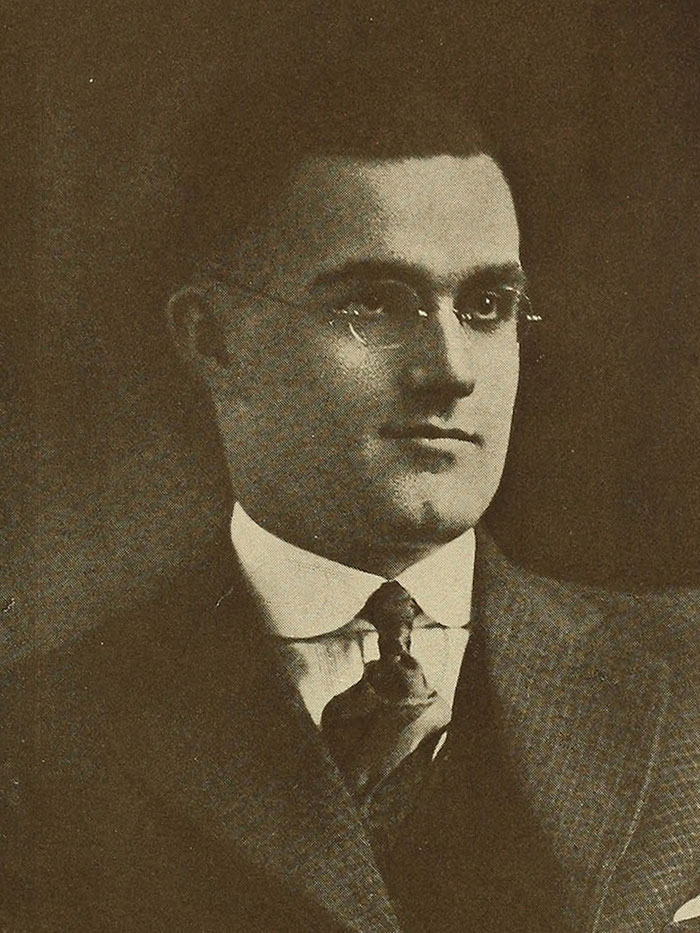
Born October 8, 1895, in Kirkwood, Missouri. Son of George Lane and Florence Noble Evans Edwards. Home, Kirkwood, Missouri. Educated Taft School, Watertown, Connecticut, and Yale University, Class of 1918. Mexican Border, 1916. Joined American Field Service, May 26, 1917; attached Transport Section 133 to November 13, 1917. French Automobile School. Commandant Adjoint. Transferred U. S. Motor Transport Corps, First Lieutenant, Section 211. Croix de Guerre with palm. Died October 24, 1918, of wounds received night before between Lor and Neufchâtel. Buried French Military Cemetery, Guignicourt, Aisne.
LIEUTENANT George Lane Edwards, Jr., gave his life in the great war protecting his command. No finer tribute could be paid to any man. By this single act alone he has bequeathed to all who knew him the priceless legacy of an imperishable memory.
A general order from Captain Potter telling of Lieutenant Edwards' death states that he was killed by enemy shell fire while putting in safety the lives of his men. "Lieutenant Edwards has been in command since the company's inception. He always gave the best that was in him, and was appreciated, liked, and admired by all his comrades, of whatever rank."
A letter from Commandant Mallet of the French army tells the circumstances of his death. While unloading a transport near Lor, part of Lieutenant Edwards' company underwent a violent bombardment.
"After hastening to the point of danger," Commandant Mallet wrote, "Lieutenant Edwards directed the personnel and material to a place of safety. He wished to go over the bombarded road once more to make sure that none of his men remained there. It was in so doing that he was hit by a shell and was so badly wounded that he died in the hospital the next morning. His commanders lose in him a capable and conscientious officer, his comrades a true friend, his men an excellent commander."
Lieutenant Edwards, in fulfilling his duty as he saw it, reveals the finest qualities of the American soldier, a thorough conscientiousness and an absolute disregard of personal danger.
At the time of the outbreaks on the Mexican border Edwards was a student at Yale. He enlisted and served several months, then as soon as the troops were recalled he returned to college.
When the United States declared war against Germany he tried to re-enter the service, but was rejected because of defective eye-sight. He joined the Field Service and went to France with the Yale unit, entering the camion branch. He graduated from the French officers' school at Meaux, becoming Chef of a section, and later was transferred to the Motor Transport Corps of the American army, where, enlisting as a private, he was raised to the rank of First Lieutenant within a short time. He had been serving in France for more than seventeen months at the time of his death.
Lieutenant Lamade of the same reserve, sending word that Lieutenant Edwards had been awarded the Croix de Guerre with palm, added, "May I say just a word about Lane? When I took over the group and became his immediate commanding officer, there was not another as willing to work long hours, to give thought and energy, as he, in order to make the group run smoothly. To tell you that he was loved by his men seems trite --- but, oh, how true it is, and not only true of the men, but of us officers who have known him, and worked with him as we have. Lane died serving his country and fighting for the cause of France and humanity. His vision was greater than any of ours, and so we felt that it would be his desire to rest under the inscription we have put on the cross which marks his grave -'Mort pour la France.'"
Frank H. Kimber wrote to his father, "Company C is broken-hearted this morning, for we have just learned that our Lieutenant was killed on convois two nights ago. . . . . . He was one who was on the job till the last car was in camp, and even the men who thought he was too strict and over-conscientious, realize it will be impossible to get another Lieutenant who can handle the work and the company as well as he did . . . . . . He was one of the cleanest and whitest men I have ever known. In one sense the most fit to die, and in another, the most worthy of living."
- Tribute from Memorial Volume of the American Field Service, 1921
WWI File
- Rank
- Cdt. Adjt. / Section Commander
- Months of service
- 5, 1917
- Section(s)
- T.M.U. 133, T.M.U. 211
- Home at time of enlistment
- St. Louis, Mo., USA
- Subsequent Service
- 1st Lt. U.S.M.T.C.