
Gilmore, Albert Frank
- Who
- WWI driver
- When
- WWI
- Where
- France
- Education
- Univ. of Wisconsin
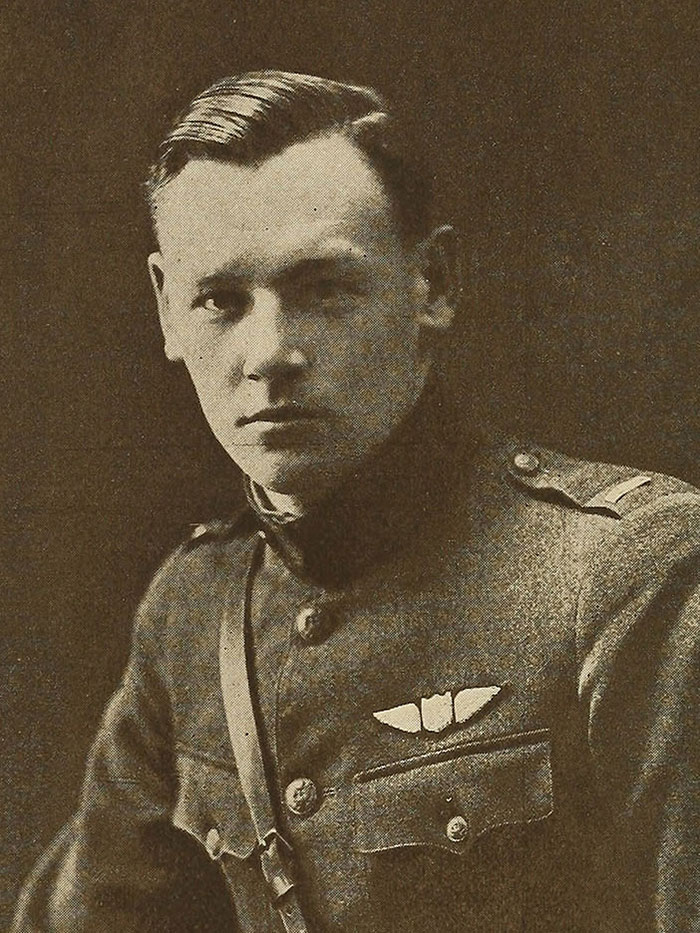
Born May 31, 1895, in Haverhill, Massachusetts. Son of Reverend Frank A. and Marion Gatchell Gilmore. Home, Madison Wisconsin, Educated Madison schools and University of Wisconsin, Class of 1919. Joined American Field Service March 12, 1917 attached Section Sixteen to November 1917. Enlisted as Cadet in U.S. Aviation. Trained Tours, St. Maixent, Voves, Avord, and Issoudun. Commissioned Second Lieutenant. Died October 3, 1918, of pneumonia, while training at Aviation Instruction Center, Issoudun. Buried Issoudun, Indre. Body transferred to Winthrop, Maine.
ALBERT FRANK GILMORE left the University of Wisconsin in the middle of his Sophomore year to enlist in the American Field Service. He reached Paris in March, 1917, and was attached to Section Sixteen, which left for the Verdun front about the middle of April. One of the members of the Section has said of its personnel: "The Section was composed entirely of men who had come to France before America had entered the war, and the bond that united them from the very outset was their love for France." It was this love of France which made Albert Gilmore quick to see and appreciate the sacrifices that the French were making. In one of his letters home he wrote: "Everywhere in this beautiful country one sees the black dress or the black arm band, and yet, every day there are hundreds more giving their lives gladly for France."
Endued with the same readiness to serve a cause and a nation which he esteemed so highly, he started work at the front and shared with his comrades the long summer of preparation for the final attack of August 20th at Verdun, where the Section made a name for itself at Avocourt. He remained with the Section until it was absorbed by the American Army in November, 1917. Even before leaving the Field Service he was impatient to render greater service, and a few days after he left Section Sixteen, he enlisted in American Aviation.
There followed the long delay with months of weary waiting at Tours and St. Maixent. Then at length came the eagerly awaited flying orders and training began. After Voves and Avord came Issoudun. Although he had had a bad cold for some weeks he refused to allow it to interrupt his training.
It was this fidelity to duty and this zealous preparation for active service that cost him his life. He died of pneumonia at the 3d Aviation Instruction Center Hospital on the morning of October 3, 1918. In a letter written to his Mother at the time of his death, his Commanding Officer said: "Lieutenant Gilmore had just fairly started his flying at this center and was progressing nicely when he contracted his fatal illness. He had an excellent record and was universally held in high esteem by his brother officers. His death was a sad blow to all of us. You may always have the satisfaction of knowing that your son was a good officer and a true gentleman, a higher tribute than which there is none. He was intent upon preparing himself to play an important part at the front when the unfortunate sickness overtook him. His life was dedicated to his country and he left with his fellow officers an example of earnestness and faithfulness which will live long."
It is from one of his own letters, however, that we glean the best evidence of that quiet, happy assurance and absolute fearlessness that characterized him at all times. It is a letter written to his parents in May, 1918, shortly after the death of his brother Bob at the Pelham Bay Naval Station, New York. ". . . . . This morning when I was up at 2,600 meters I felt as every fellow feels, that there is no one up there but himself and God. It's a queer sensation ---one doesn't dare even think a cuss word when something goes a trifle wrong with the motor. Before I came down at the end of my hour --- I had been thinking of Bob --- I could almost hear him calling from the edge of a big fluffy cloud just ahead of me: 'Hi! Al, you bum aviator, I got across all right.' I know he did, and I don't mind much where I pass out if I can get across to him all right too."
- Tribute from Memorial Volume of the American Field Service, 1921
WWI File
- Months of service
- 8, 1917
- Section(s)
- S.S.U. 16
- Home at time of enlistment
- Madison, Wisc., USA
- Subsequent Service
- 2nd Lt. U.S. Av.