
Graham, John Ralston
- Who
- WWI driver
- When
- WWI
- Where
- France
- Education
- Episcopal Acad; Univ. of Pennsylvania '14
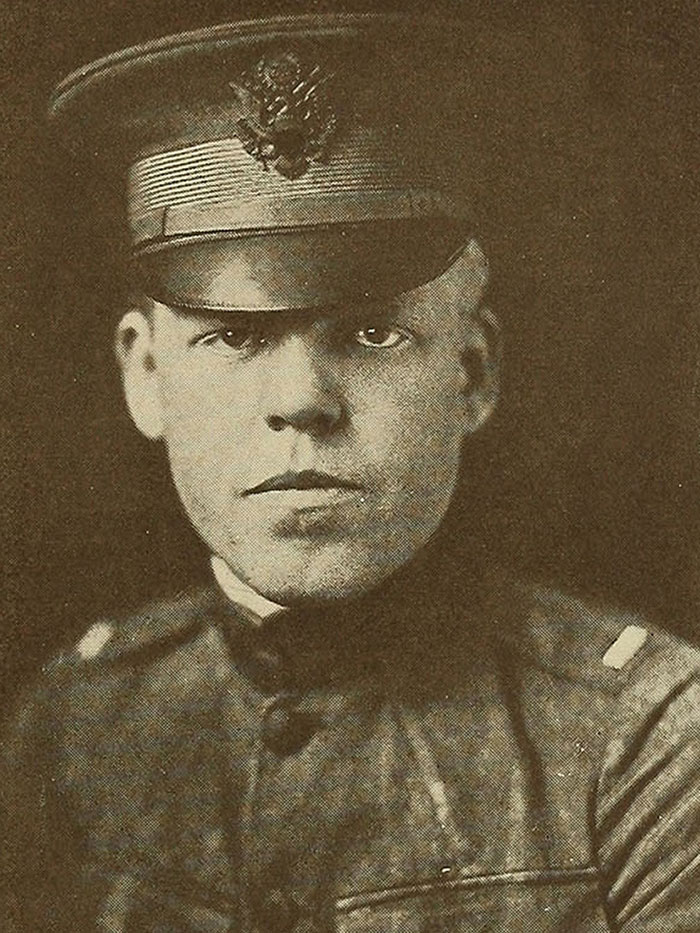
Born December 29, 1890, in Philadelphia. Son of John T. and Anne Ralston Graham. Educated Episcopal Academy, Philadelphia, and University of Pennsylvania, Class of 1914. Engineer on Panama Canal, 1913, later with Pennsylvania Railroad. Joined American Field Service, November 17, 1915; attached Section Two until May 17, 1916. Croix de Guerre. Returned to United States. Entered Fort Niagara Training Camp. Commissioned First Lieutenant. To France, September, 1917, with 18th Infantry. Recommended for Captaincy. Killed in action, July 18, 1918, between Cutry and St. Pierre-Aigle, south of Soissons. Buried there, later transferred to American Cemetery at Ploisy. Now buried in West Laurel Hill Cemetery, Philadelphia, Pennsylvania.
LOATHING the war intensely, frankly fatalistic about its outcome for him, Lieutenant John Ralston Graham was yet of the calibre which voluntarily precipitates itself into the most hazardous and hardworking branch of the service, wins a Croix de Guerre and special recognition for individual merit, and dies on the battlefield, leading his men in an attack. War held no glamour for him. As an ambulance driver in 1915-16, in Bois-le-Prêtre, and in the first battle of Verdun he saw much of its terror and sordidness. He won his Croix de Guerre for bravery in rescuing women and children at Bar-le-Duc, where he drove his ambulance through an especially venomous air raid during the battle of Verdun. Although he returned to the United States at the expiration of his eight months' service with Section Two of the American Field Service, as soon as America declared war, he entered the Fort Niagara officers' training camp, graduating as a Lieutenant, and returned to France early in September, 1917, as one of the first fifty of our men to reach the battlefront. From that time on until his death he was in almost constant action and participated in nearly all the great battles preceding the Soisson's offensive.
As a Lieutenant of Infantry with the Eighteenth Regiment he experienced all of the hardships and horrors that only can fall to the infantryman's lot. His letters tell with marvelous vividness of twenty-one day stretches in the front line trenches, short relief, then immediate return to the fighting. They tell, too, of combat patrols planned and executed by, him, and of attacks in which there were "intervals, minutes mostly, which I don't want ever to recall, when I have been at my lowest, nothing but a, beast, yelling, cursing, crying, alternately --- consumed with but one thought --- to kill, kill, kill."
Though he revolted from it all, he worked untiringly, and his record shows steady advancement. Shortly before his death he was appointed Intelligence Officer, and already he had been recommended for the rank of captain.
He died in the Soissons offensive, which marked the beginning of the end of the War, being killed in the turmoil of battle on July 18, 1918, by a fragment of flying shell. Of his death Reverend Murray Bartlett, Chaplain of the Eighteenth Infantry, wrote, "Indeed you have the consolation that the sacrifice of his splendid young manhood was part of the price paid for one of the critical victories of all history . . . . "
In the same strain a companion wrote, "This war takes the bravest and the best . . . . . Yet, speaking for myself, it seems to me that if my time to go had arrived I should ask nothing better than to fall at the high tide of a charge, leading men on to a victory which has proved to be the turning point of the whole war . . . . . Your son was respected universally as a courageous, capable, and promising officer. He lived up to the confidence reposed in him."
How great is the respect and pride which his memory commands, appears from the letters of his friends, all of whom, without a single exception, express the privilege and honor they felt in sharing his friendship. One writes, " It does n't seem possible that great, big, carefree 'Joe,' whom we all depended on, and looked up to, has been killed. My pride in him is the only thing which could possibly cheer me up. I have lost one of the best friends a fellow could have --- but how proud I am to have had such a wonderful friend."
Another adds, "I am proud and honored to have known Ralston all these years, and to have been one of his best and dearest friends. We all loved him. A brave man, a true gentleman, and a never-failing friend will be our memory of him always."
- Tribute from Memorial Volume of the American Field Service, 1921
WWI File
- Months of service
- 6, 1915-16
- Section(s)
- S.S.U. 2
- Home at time of enlistment
- Philadelphia, Pa., USA
- Subsequent Service
- 1st Lt. U.S. Inf.