
Kendall, Charles Benjamin
- Who
- WWI driver
- When
- WWI
- Where
- France
- Education
- Cambridge High & Latin School; Huntington School
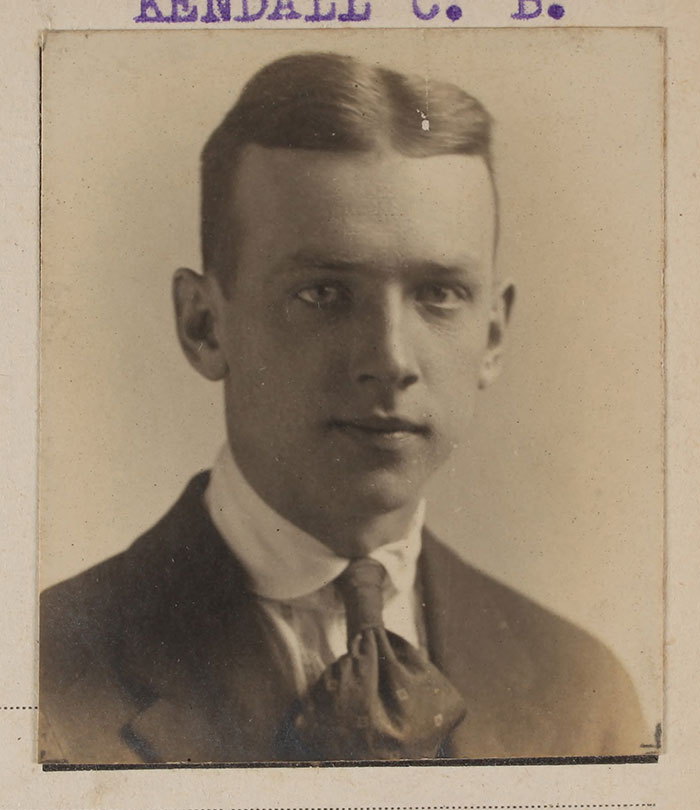
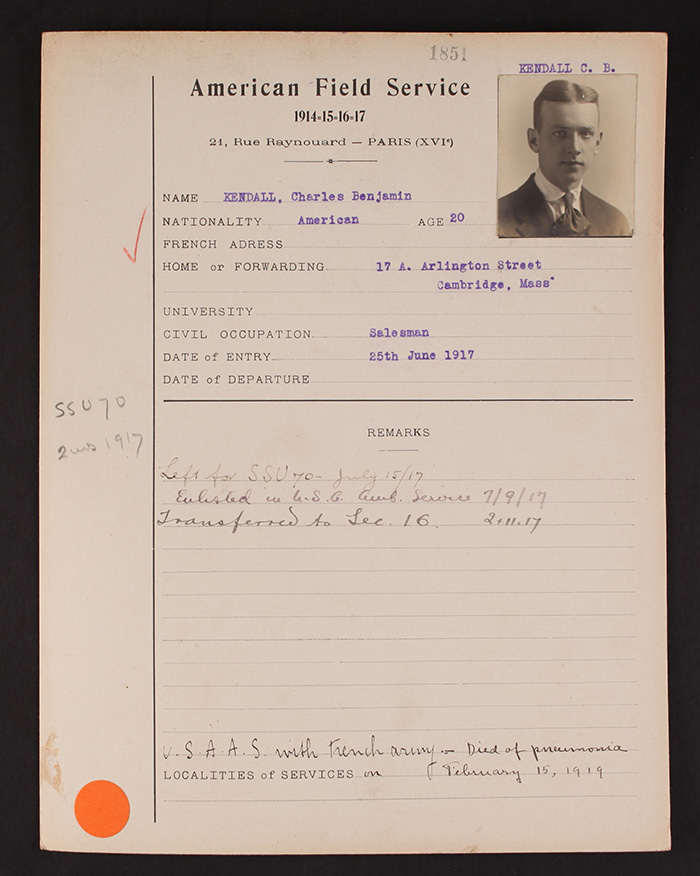
Born August 11, 1897, in Cambridge, Massachusetts. Son of John B. and Mabel Slade Kendall. Educated Cambridge High and Latin, and Huntington Schools. Joined American Field Service, June 25, 1917; attached Section Seventy to September 7, 1917. Enlisted U. S. A. Ambulance Service, Section 16/634. Wounded and received Croix de Guerre, December, 1917. Transferred October 24, 1918, to 104th U. S. Infantry. Gassed, November, 1918. Died of bronchial- pneumonia, February 15, 1919, at American Hospital, Langres. Buried Langres, Haute-Marne. Body transferred to Mount Auburn Cemetery, Cambridge, Massachusetts.
EXCEPT in the eyes of the biographer modesty is a virtue. For when a man is as self-effacing as was Charles Benjamin Kendall, it is unfortunately easy to overlook the depths of character, the steadfastness of spirit, the energetic devotion which inspired him and led him to do, so quietly as to attract little notice, his duties of service. His mother says "his letters were good," but vague because of "his modesty in regard to anything pertaining to himself." "I think he was about the coolest and bravest man under, fire in the Section," wrote J. Frank Brown, one of "Charlie's" comrades, "He was the best man to be with in a tight place. He received a magnificent citation which he fully deserved, but he was always very modest about his honors." He would not be downed, and his letters, even when things were going badly, showed only a fine optimism and forgetfulness of personal troubles in doing his work. Just before the offensive of August, 1917, he fell ill with a severe cold, but "got out of his bed to take part in the fun. He was always full of life and kept everyone in good humor." This trait of helping others and smiling at misfortune was apparent in his early days for even as a boy he was poised and considerate.
His schooling was all had in Cambridge, the city of his birth, where his home was. Much interested in chemistry, he made an excellent record at school, although always constitutionally frail. While still a mere lad his attitude toward his mother was that of a protector. Charles was always thoughtful of her, trying to guard her from troubles and worries, and to her as to everyone else his presence seemed to bring courage and confidence. This quality of easing the cares of others he carried through all his life. He was, in the words of his mother, "So big for a little fellow."
Joining Section Seventy of the Field Service in France on Independence Day, "Charlie" served through the battles along the Chemin des Dames during the summer of 1917, writing jocularly of the Malmaison attack: "My machine was hit several times by éclats . . . . . There were several times that I would not have given three cents for my hide or chances." Again he said:
"It is terrible. I wish you could see and hear . . . . . or rather I thank God that you cannot." Always he was full of fun and good-humored. He was a favorite with the French --- officers and privates alike. He spoke their argot and made a point of learning the patois of the country. After each offensive he was the first to be given souvenirs by poilu friends. He entered into the work, reckless of himself but fastidiously careful of his wounded, volunteering for extra duties. Yet through it all he kept his characteristic dry humor, and jested most when situations looked blackest. A quip was ever quick on his tongue, but it was always a kindly one. Considerate, loyal, conscientious, he never thought of himself save as one more pair of needed hands in a great work.
After the Armistice, weakened by the gassing he had received and his constant labors, Charles fell sick with influenza, entering a hospital on January 20, 1919. Bronchial-pneumonia developed and despite every effort of doctors and nurses he died quietly on February 15th. His nurses mentioned especially what a splendid patient he was. He wrote "I can't come home quick enough," and on the eleventh, that a nurse would write his mother so "that you won't worry because you haven't heard from me." "I've been very sick --- now I'm feeling much better." Patient, thoughtful of others, uncomplaining, until the end, he lay and waited for his going home.
- Tribute from Memorial Volume of the American Field Service, 1921
WWI File
- Months of service
- 2, 1917
- Section(s)
- S.S.U. 16, S.S.U. 70
- Home at time of enlistment
- Cambridge, Mass., USA
- Subsequent Service
- U.S.A.A.S. - U.S. Inf.