
Kurtz, Paul Borda
- Who
- WWI driver
- When
- WWI
- Where
- France
- Education
- De Lancey; Harvard '16
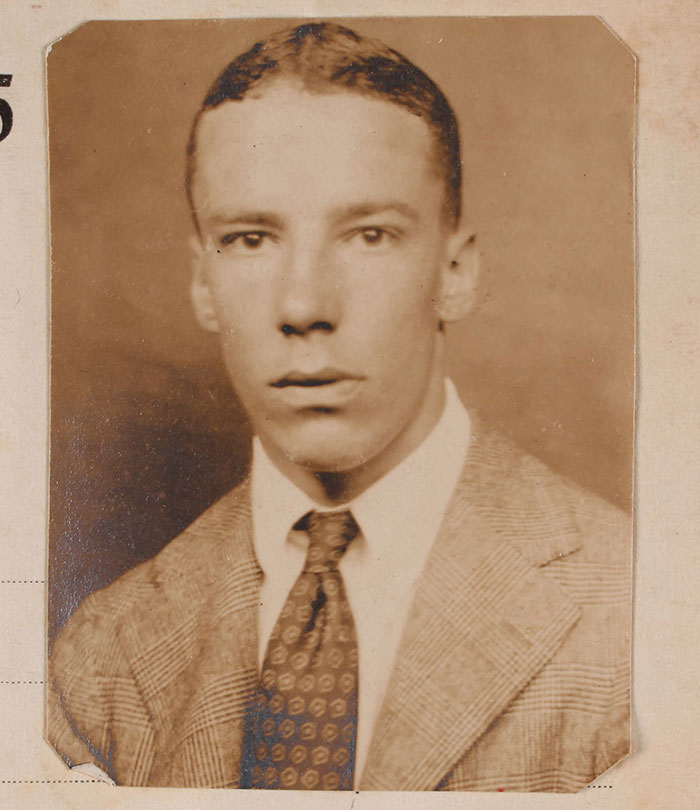
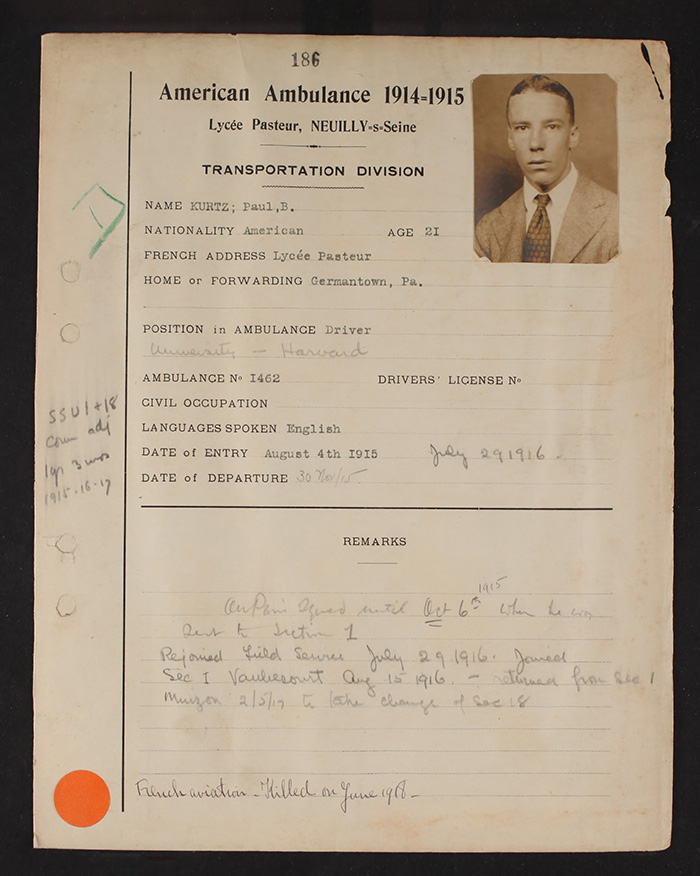
Born September 20, 1893, in Germantown, Pennsylvania. Son of William B. and Madge Fulton Kurtz. Educated De Lancey School, Philadelphia, and Harvard University, Class of 1916. Joined American Field Service, August 4, 1915; attached Section One to November 30th. Returned to America and secured college degree. Rejoined Field Service, July 29, 1916, and Section One. Commandant Adjoint, Section Eighteen, April, 1917, to July 25, 1917. Croix de Guerre. Enlisted U. S. Aviation. Trained Pau, France, and Scotland, especially in gunnery. First Lieutenant, attached 94th Aero Squadron. Killed near Toul, returning from first patrol between Pont-à-Mousson and St. Mihiel, May 22, 1918. Buried at Ménil-la-Tour, north of Tout. Body transferred to American Cemetery, Thiaucourt, Meurthe-et-Moselle.
WHEN he resigned his commission as commander of Section Eighteen to enter the aviation service, Paul Kurtz wrote to his parents in Philadelphia: "I feel that we owe a debt of gratitude to France which mere 'unlimited credit' can never pay. I have done a lot of thinking and have resolved that if the chance should ever come I would show her that there are Americans who could give their lives, if necessary, as long as they knew they were doing what was right."
" Doing right," to Paul Kurtz, was fighting in the air. Doing that, he gave his life near Toul, France, serving as a volunteer chasse pilot in the famous Ninety-Fourth Squadron.
Kurtz's intimate friends say that few men among the thousands who flocked to the aid of France loved that land and its people as did this Philadelphia youth who went from Harvard in the summer of 1915 to become one of the early volunteers in the ambulance service.
He served his first enlistment in Section One and returned home in the winter of 1915 to complete his work at Harvard. July of the next year saw him back in old Section One again. When the United States entered the war, Kurtz had served through a dozen battles scattered along the ragged line from Dunkirk to Alsace with the famous pioneer unit.
In April of 1917, Kurtz sought to resign from the ambulance service to enter aviation, but was prevailed upon to curb his ambition for combat work that he might assume command of Section Eighteen, a fresh unit in the field.
Three months later, feeling that these new volunteers had become veteran ambulanciers, he resigned to offer himself to the air service. He trained in the French schools and with the Royal Flying Squadron in England and Scotland to become head instructor of a new American aviation school, but while it was being built, Paul, eager for service at the front, asked that he might go there. He was finally assigned temporarily to the Ninety-Fourth for front-line experience.
Captain Rickenbacker, who led the patrol on which Kurtz lost his life, tells how the new recruit labored to master control of an aeroplane unfamiliar to him that he might participate in battle. It was on the first critical patrol over the lines that Kurtz lost his life. Returning home after his first fight, his machine suddenly dived groundward and burst into flames.
In his book Rickenbacker writes: "A few hours later the mystery of that crash was revealed. As has already been mentioned, I had noticed before starting that Lieutenant Kurtz appeared nervous, but had not given the matter any great consideration.
"The explanation was given by a brother officer who had come with Kurtz to the squadron. Before starting on his last flight, Lieutenant Kurtz had confided to him that he was subject to fainting spells when exposed to high altitudes, and the only thing he was afraid of was that he might be seized with such an attack while in the air. Alas, his fear had been only too well founded. But what a pity it was he had not confided this fear to me. I had lost a friend, and he had perished in the manner most dreaded by aviators."
For fear of losing his opportunity to fight, Kurtz had kept his secret. Under stress of bitter attack by experienced opponents on his first patrol, he had withstood their fire like the soldier that he was. The following day, when he was laid to rest in the little American cemetery near Toul, comrades of the Ninety-Fourth showered the grave, from planes overhead, with wreaths of flowers, their last tribute to a chum who had given his best, his life, for France.
- Tribute from Memorial Volume of the American Field Service, 1921
WWI File
- Rank
- Cdt. Adjt. / Section Commander
- Months of service
- 15, 1915-16 & 17
- Section(s)
- S.S.U. 1, S.S.U. 18
- Home at time of enlistment
- Germantown, Pa., USA
- Subsequent Service
- French Aviation - 1st Lt. U.S. Aviation
Decoration(s) received while a volunteer with the Field Service
- Croix de Guerre (1914-1918)