
McLarty, William Keith
- Who
- WWII driver
- When
- WWII
- Where
- North Africa
- Education
- Sacramento Jr. Coll.; Univ. of California '43
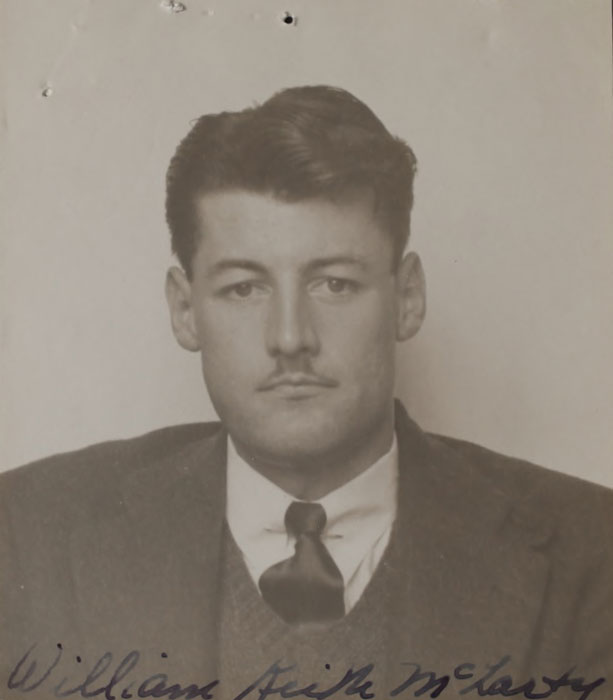
The name of William Keith McLarty, twenty-two-year-old California boy, has been added to the Honor Roll of the American Field Service. It was with a feeling of profound regret we learned of his death, as a result of wounds suffered when a bomb fragment struck him. He faced death---as he lived---fearlessly and bravely, doing the job he had chosen. Night and day he had driven his ambulance over the desert wastes with no thought to the dangers or the hardships which he might meed on the way. His loss is felt keenly by his companions, with whom he served, and by all those who had the good fortune to know him.
__ AFS Letters No. 10
"At about 4 o'clock we saw a Stuka raid that had left a string of bombs across the wadi at about the location, we thought, of McLarty and Grieb. . . . We went over to the ADS for supper and learned that McLarty had been hit. A fragment had scraped the end of his spine and broken part of his pelvis, but there was a tingling sensation in his legs, so the MO said be would probably be all right.
"His ambulance had been hit, too, though he was not in it at the time. John Nettleton bustled me through supper so that we could get to the car and salvage as much as possible before miscellaneous other Dodge drivers should strip it of everything useful. We found it with its rear tires still burning and the interior of the body gutted by flames from the gas tank. But the front tires, engine, chassis, and body had been saved by throwing sand on the fire. John piled into it and had it fit to tow by 7 o'clock. We hitched it to the back of my truck and dragged it to the MDS before dark. There, McLarty had just gone under the anaesthetic, and at 8:30 we were told by the doctor who performed the operation that be expected a full recovery. I saw and talked with Mac the next morning. He was uncomfortable, but his voice and spirits were strong and be had no worry about his legs. Later in the day, I saw him again, when he felt much better and seemed to be getting some rest. As far as I could tell, he was never worried about his wound. Shortly thereafter he was evacuated to base . . . "
William Keith McLarty had died of his wounds on 21 July at the 8th General Hospital in Alexandria. He was buried in the Military Cemetery the next afternoon with full military honors. Wreathes were sent by the units McLarty had served with in Syria and the desert, and all members of the AFS who were able to do so attended the service.
__ George Rock. Chapter 3. "Middle East 1. Tobruk to El Alamein (November 1941 to September 1942)" History of the American Field Service, 1920-1955. New York 1956.
On July 14 Keith McLarty was wounded in a Stuka raid and his ambulance destroyed. The attack came about four o'clock in the afternoon while he was in the vicinity of the advanced dressing station. McLarty had driven in with wounded from a regimental aid post and after off-loading at the advanced dressing station dispersed his vehicle and walked a hundred yards or so to the YMCA canteen truck that was touring the area with cigarettes and candy. He was at the side of the canteen when the attack began. The first bomb of a string of three exploded harmlessly in the desert; the second landed near his ambulance and set it afire. The third bomb landed in the vicinity of the canteen truck. There were no slit trenches in the immediate area, and Keith threw himself onto the sand. Fragments from the third bomb hit him. He was removed at once to the advanced dressing station, where it was found that his sacrum was damaged and his pelvis broken. Later that afternoon he was removed to the medical dressing station, where he was operated on. The doctors gave him a better than fifty-fifty chance to live. He retained some feeling in his feet, indicating that his spine was not so severely damaged as to cause paralysis.
When Chan Ives's signal reached me at Ikingi (Captain King was on leave in Syria), I bent every effort to have McLarty evacuated by air, for I knew what a frightful thirty-five miles the trip back was. But two hospital planes had been shot down in the past ten days, one near the medical dressing station where Mac was waiting, and it was hopeless to send another up. Mac had to come out over the desert tracks, and he never recovered from that trip.
The day Mac reached Alexandria I went to see him. Because of the nature of his wounds he was lying face down, and it was difficult for him to talk. He moved a bit to see me better.
__ Andrew Geer. Mercy in Hell. An American Ambulance Driver with the Eighth Army. McGraw Hill, New York 1943.
WWII File
- Unit(s)
- ME 1
- Home at time of enlistment
- Berkeley, Calif., USA
- KIA
- died or killed