
Meacham, Robert Douglas
- Who
- WWI driver
- When
- WWI
- Where
- France
- Education
- Asheville; Yale '07
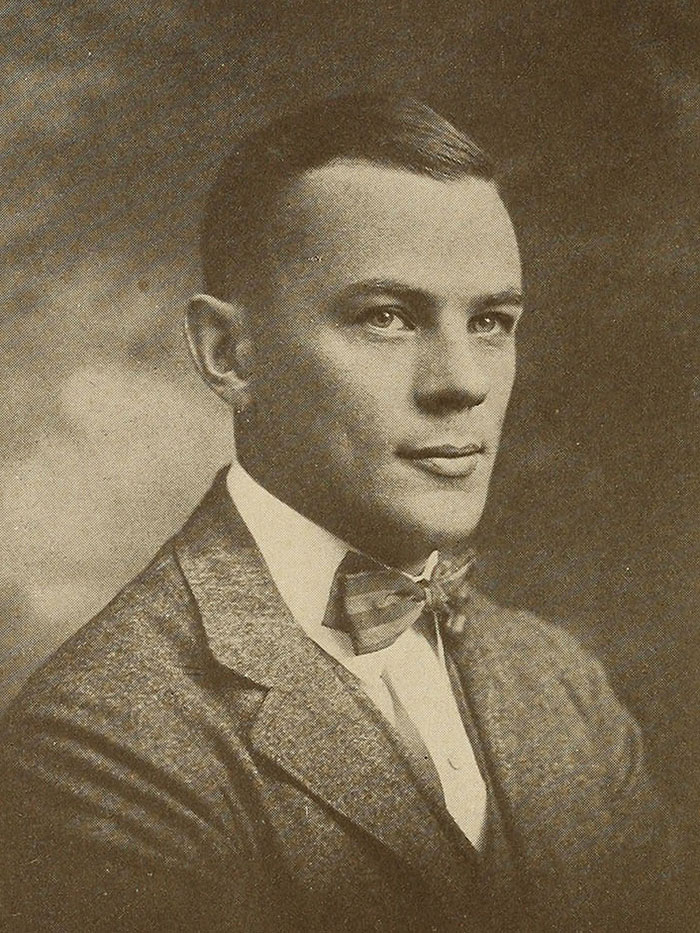
Born September 15, 1883, in Ashland, Kentucky. Son of Daniel B. and Lida Douglas Meacham. Home, Cincinnati, Ohio. Educated Asheville School, North Carolina, Hobart College one year, and one year Sheffield Scientific School, Yale, Class of 1907. From 1906 with Rogers, Brown Company, Cincinnati. Joined American Field Service, March 12, 1917; attached Section Sixteen to September 13, 1917. Died of appendicitis, December 14, 1917, at Louisville, Kentucky. Buried Spring Grove Cemetery, Cincinnati, Ohio.
IT'S strange the way things workout in this war," Robert Douglas Meacham wrote home, "one of our Frenchmen had been in the army since the beginning, but being rather old was taken out of the trenches and sent back here, a comparatively safe place, as a cook. He had been here only two days before he was killed." "Bob" did not guess that for him, too, things were to work out thus strangely and with as seeming little justice. He returned from ambulance work at the front to enter a more hazardous service, and, having passed his examinations for aviation, was on his way home from Washington to await his commission when he fell ill with appendicitis and died as a civilian --- yet no less a warrior. He had been often under fire. "Believe me," he had written, "it is some sensation to be flat on your stomach wondering if the next one is going to 'get' you" ; but no shells "got" him. He had served six months with Section Sixteen suffering more than most because always in his mind was a vision of what a shell might bring --- of being struck and mangled. Fear stood ever at his side vainly trying to influence him. He heard its urging but unmindful, went forward into all dangers. Yet the trail of his adventurous life ended far from the cannon and drums and banners of warfare in a city hospital and the silence of unsung heroism. Those who know fear are the bravest.
"Bob," after his schooling in the South, spent a year at Hobart and one at Yale. He was an athlete, for love of the sport, and, as a freshman at Hobart, played on the varsity baseball team . ". . . . As plucky a fellow as ever played a game, never losing his head," they said of him. "Never an exceptional student," wrote his brother, and perhaps, in his belief that in friendships was one of the biggest gains from college, "'Bob" overstressed that side of undergraduate life. But he made some very real and lasting friends. He was "one of the most lovable fellows to be with I ever knew" writes one, "liked by everybody" says another, and "I know very few who are so much worth while." He was the object of hero-worship, too, on straight manliness as the words of a younger man show : "I was just a green youngster . . . . . Bob's kindly nature and his clean-cut ways made me secretly idolize him." It means much to have a mother write, as one did who knew him well, "I wish my boy had known him."
"With sufficient income he would never have entered business but spent his time with expeditions exploring buried cities of the old world," said his brother, and before the war "Bob" had already traveled in Europe, circled the globe, and made trips to Central America. He had gathered quite a library on Egypt and India, and an unusual collection of arms from various nations and ages. Imitations never interested him, and also in his contact with men "he had no respect for the sham, admiring only the true and genuine." Yet he was lenient to the faults of others, though never toward his own. He not only did his duty whenever called upon, but did it cheerfully, and at all times was to be relied upon to keep up the spirits of those about him. "Bob" had a delightful sense of humor, declaring the most serious poilu he knew was "going to be married when he goes on permission. Suppose that is what's worrying him!' And with it he had a rare delicacy of perception and sympathy. "If I can only help save the lives of some of those poor fellows . . . . . I shall feel that my own life has been worth while," he wrote. He never realized how much worth while his fineness had made that life of his for others.
- Tribute from Memorial Volume of the American Field Service, 1921
WWI File
- Months of service
- 6, 1917
- Section(s)
- S.S.U. 16
- Home at time of enlistment
- Cincinnati, Ohio, USA
- Subsequent Service
- U.S. Av.