
Potter, William Clarkson
- Who
- WWI driver
- When
- WWI
- Where
- France
- Education
- Wixenford Prep (England); Harrow (England); Princeton
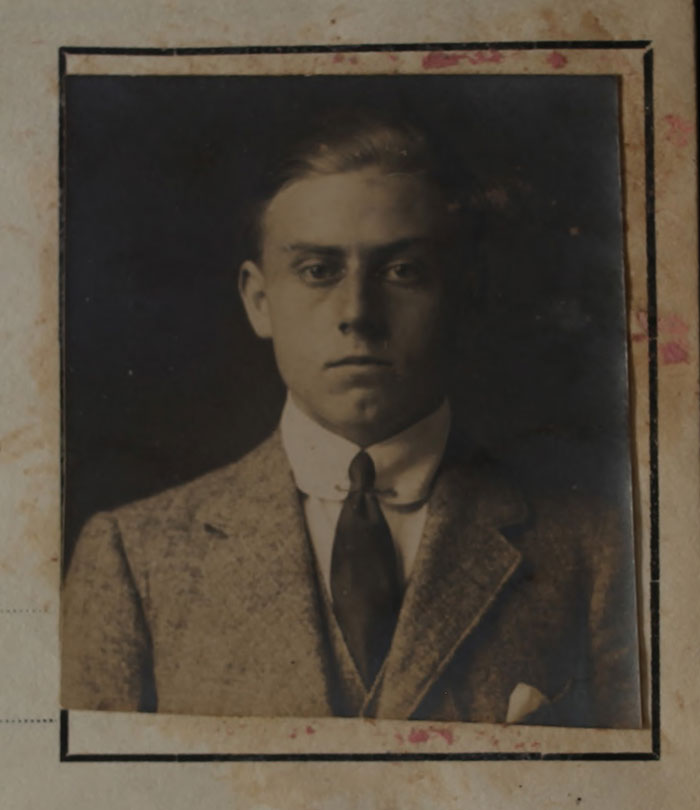
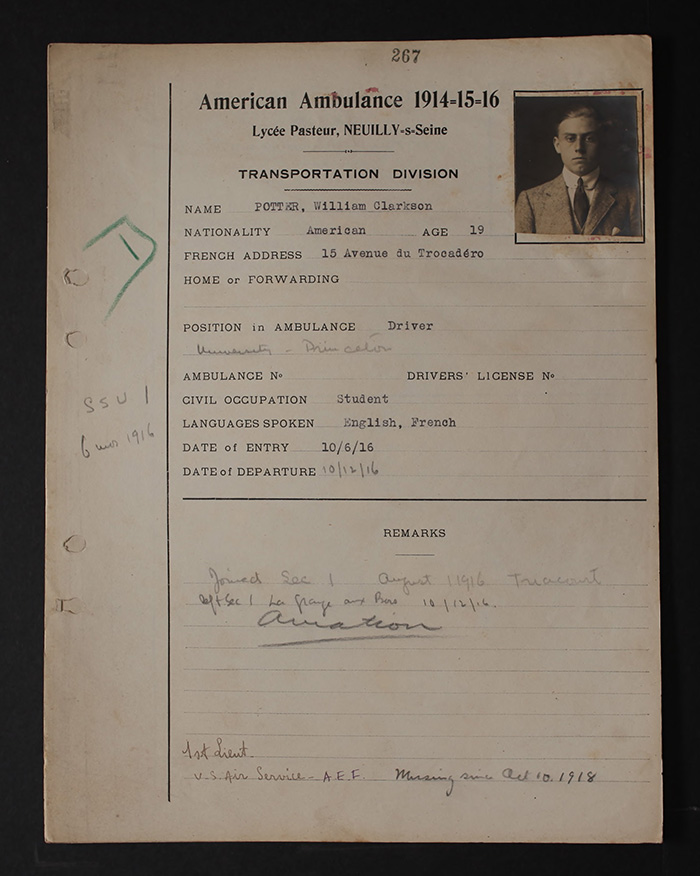
Born July 31, 1896, in Dinard, France. Son of Clarkson and Mathilde Allien Potter. Home, Paris, France. Educated Wixenford Preparatory and Harrow Schools, England, and Princeton University, Class of 1919. Joined American Field Service, June 10, 1916; attached Section One until December 10, 1916. joined Norton-Harjes Ambulance Corps. Croix de Guerre. Enlisted U. S. Aviation, August, 1917. Trained Tours, Issoudun, and Clermont-Ferrand. Commissioned First Lieutenant, November, 1917. September, 1918, attached 20th Day Bombing Squadron. D. S. C. Killed in action over lines, near Dun-sur-Meuse, October 10th, 1918. Buried by Germans at Barricourt, Ardennes, near Stenay. Body transferred to Suresnes, Seine.
IT seems only yesterday that Clarkson Potter came to Headquarters in Paris and asked if he could not get to the front a little more quickly than any new Field Service man had ever gotten there before. He explained that he had just finished his Freshman year at Princeton, that he had spent about half his life in France, that he had his parents' permission, and that, in short, "the war had been going on long enough without him."
So he was sent to Section One, where almost immediately he became known as "young Potter." Small, slender, with frank eyes and a boyish laugh, he looked hardly a match for the grim work of war. But appearances were misleading. He was ready to drive "anything on wheels"; he was keen to tackle any sort of road, and he seemed to consider skirting shell craters on a black night the best game he had ever played.
He remained with Section One, doing good work through several attacks, until December, 1916, when, in order to be with some close friends, he asked to be transferred to the Norton-Harjes Ambulance Corps. By this time he was a seasoned as well as a daring driver. "Permanently at an advanced post," read his citation for the Croix de Guerre, "Clarkson Potter made eighteen consecutive trips without a rest in thirty hours and, in spite of the bombardment of the road by the German artillery, he enabled a great number of wounded to reap the benefits of rapid transport."
In August, 1917, he enlisted in the American Air Service as a cadet and was sent to Tours for his preliminary training. Upon finishing his course and receiving a First Lieutenant's commission, he went to Clermont-Ferrand, where he was given advanced instruction as a bombing pilot, and in September, 1918, he was assigned to the 20th Day Bombing Squadron.
His first mission was to take part in a daylight raid over Dun-sur-Meuse on September 26th, the first day of the great Argonne offensive. Only three of the fourteen men who that day crossed the lines with him returned. The remaining eleven, including "Phil" Rhinelander, a former Field Service man and Potter's best friend, were killed or brought down wounded and captured. Lieutenant Howard, the Flight Leader, and also a former Field Service man, has said that he owed his escape to Potter.
"We were jumped," he wrote in the North American Review for November, 1919, "just after the bombing. Fokkers, five or six, came from behind, a second group from above, and a third from in front and below. They came out of peace and nothingness and were on us in an instant, diving through and flying as part of our formation. Bullets hit my plane as though somebody had been peppering me with a handful of gravel. I believe I should have given up and tried a landing, had not Potter stuck. And how he stuck! And in the end, when we did get back, three out of fourteen, one team and a half out of seven, Potter was as cool as --- I have no simile."
For his work that day Potter was given the D. S. C. "By his courage and disregard of danger," read the citation in General Orders, "Lieutenant Potter saved the life of his leader and brought his machine safely back to our lines."
But he did not live to receive this honor. He was struck, October 10th, by an "Archie" while over the German lines at a height of eleven thousand feet. He was seen to turn and start gliding towards the American trenches, but, at about six hundred feet, he apparently encountered a strong German barrage which riddled his plane with bullets and killed both him and Lieutenant Wilmer, his observer.
- Tribute from Memorial Volume of the American Field Service, 1921
WWI File
- Months of service
- 6, 1916
- Section(s)
- S.S.U. 1
- Home at time of enlistment
- Paris, France, France
- Subsequent Service
- 1st Lt. U.S. Av.