
Robertson, Malcolm Troop
- Who
- WWI driver
- When
- WWI
- Where
- France
- Education
- Prospect heights; Polytechnic Prep; Princeton '15
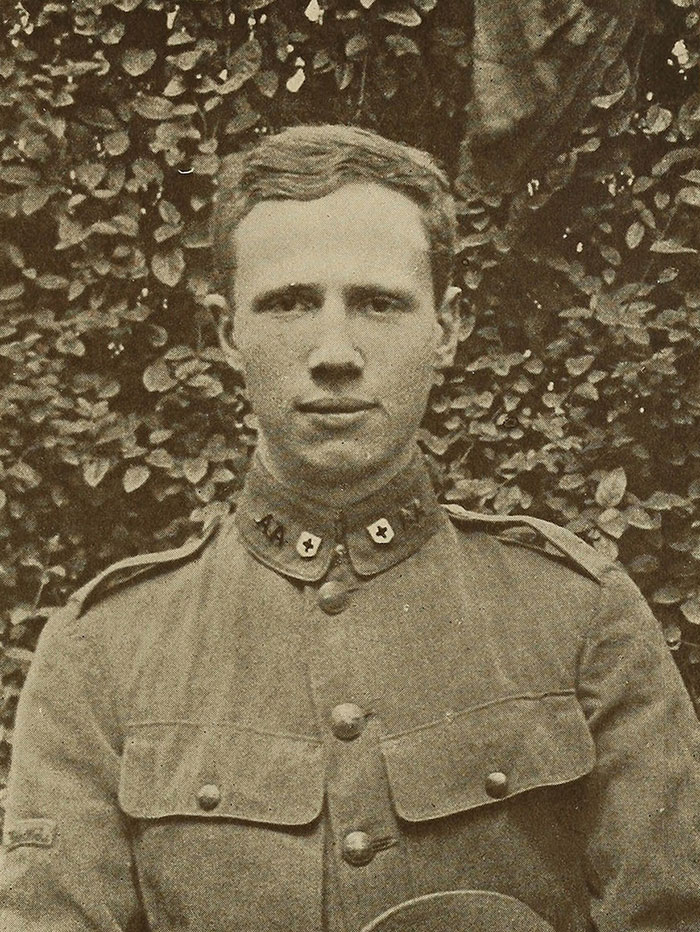
Born August 2, 1894, in Brooklyn, New York. Son of Doctor Victor A. and Maria Cochran Robertson. Educated Prospect Heights and Polytechnic Preparatory Schools, and Princeton University, Class of 1915. Joined American Field Service, April 28, 1915; attached Section One to July 18, 19115. Returned to America. Enlisted 7th Regiment, N. Y. N. G., June 27, 1917 ; voluntarily transferred to 165th Infantry for overseas service. Killed in action at the Ourcq River, July 30, 1918, near Villeneuve-sur-Fère. Recommended for Croix de Guerre and D. S. C. Buried American Cemetery, Seringes-et-Nesles, Aisne. Body to be transferred to American Cemetery, Belleau Wood.
"WHEN I needed someone with plenty of grit and bulldog courage, I always picked Malcolm, and he never failed me." Malcolm Troop Robertson earned this voluntary commendation from his platoon commander after ten months of devoted service as a first class private in the "Stokes Mortar" platoon, of the Headquarters Company, 165th Infantry. Sergeant Fitzsimmons writes that, when the regiment first "went in," near Luneville, "Private Robertson, on account of his knowledge of the language, volunteered to stand guard 'with the French sentry' every night during the regiment's stay in the trenches, which was four times his required duty, 'to warn more understandingly and quickly of gas-alarms or attack.'" In Champagne, two weeks before his death, with two "non-coms," Malcolm stood by his gun, when ordered to seek shelter, during a fierce bombardment, and by sending over a perfect barrage of Stokes Mortar shells drove the enemy from our wire." It was for such acts that "his coolness under fire became a byword in the company, and behind his back the boys remarked on his nerve." "The most courageous man in my platoon . . . . at times I took advantage of it .And used him in many a trying situation," Lieutenant McNamara wrote, "and at the Ourcq when I gave him a chance to volunteer, he was right there with his plea of 'take me with you, Lieutenant' . . . . . . and he gave his fine young life to his country."
On that 30th of July, 1918, the 165th, advancing rapidly and out of touch with its artillery supports, was "hung-up" by a strong machine gun nest in the Meurcy farmhouse at the Ourcq River. This had to be silenced before the regiment could move on. A volunteer squad of six men, including Robertson went forward into the open with two mortars to blast away the obstruction. With no time to "dig in," the order to open fire found them in an exposed position. Immediately they were answered by a concentrated shelling from a battery behind the farm. The officer had gone ahead to make observations, the sergeant had retired, wounded, and when there was a suggestion of wavering under the wilting bombardment it was "Robbie" who took charge, as his citation reads, holding the men by the strength and inspiration of his example. They "stuck" and their fire broke up a developing counter-attack, but when the shelling ceased Malcolm was found dead beside his gun, killed by a shell.
At Princeton, too, he had been "on the job," earning his class numerals and a degree although he left to join the Field Service before his graduation. In those dark hours following the battles of the Yser, he served with Section One in the north --- driving among the dunes of Coxyde, under the long-range shells in Dunkirk, and beneath avion bombs at Nieuport. In the autumn he returned to complete his studies, and enlisted in the 7th Regiment of New York when America entered the war. He transferred, as a private, to the 165th Infantry and went again to France with the 42d Division in October, 1917.
His constant eagerness to do the hardest things included no thought of recognition, although he was cited by French and Americans. His almost reckless courage and cool disregard of danger expressed his spirit of patriotism and gave evidence of his desire to give himself completely to the cause for which he was at the last to die. His lieutenant wrote, "I buried Malcolm that evening, and while the Boche were shelling I knelt in prayer at his grave . . . . ... And his next words might almost be Malcolm's own last brave message to his, people, for Lieutenant McNamara said, "What a glorious death! To die for one's country, for right and justice."
- Tribute from Memorial Volume of the American Field Service, 1921
WWI File
- Months of service
- 3, 1915
- Section(s)
- S.S.U. 1
- Home at time of enlistment
- Brooklyn, N.Y., USA
- Subsequent Service
- U.S. Inf.