
McConnell, James Rogers
- Who
- WWI driver
- When
- WWI
- Where
- France
- Education
- Univ. of Virginia '10
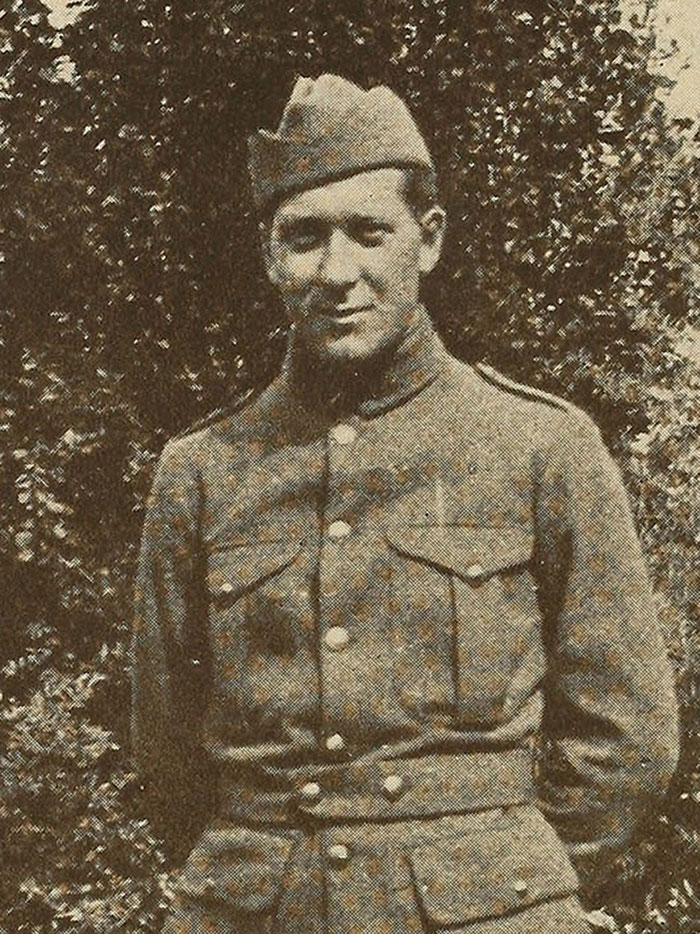
CITATION SERVICE DE SANTÉ,
73ème DIVISION
McCONNELL, James R., Conducteur à la Section Sanitaire Automobile Américaine N° 2
Conducteur engagé dès la première heure; animé d'un excellent esprit; a toujours fait preuve d'un courage et d'une hardiesse dignes des plus grands éloges.
* * *
Born March 14, 1887, in Chicago, Illinois. Son of Judge Samuel P. and Sarah Rogers McConnell. Home, Carthage, North Carolina. Educated Morristown School, New Jersey; Haverford School, Pennsylvania, and University of Virginia, Class of 1910. In business, New York City. From 1912, Industrial Agent, Randolph and Cumberland Railroad, North Carolina. Secretary, Carthage Board of Trade. Joined American Field Service, February 11, 1915; attached Section Two until December 12, 1915. Croix de Guerre. Enlisted French Aviation, October 1, 1915. Trained Pau and Plessis-Belleville. Breveted February 6, 1916. Attached as Sergeant, Lafayette Escadrille, N. 124, April 20, 1916. Killed in combat over the German lines, March 19, 1917, near Petit-Détroit, southeast of Ham. Croix de Guerre with palm. Buried Petit-Détroit, Aisne.
IN the long list of those who gave their lives in the War, there is one small group of names which must ever rank above the rest. These were the men who, before America entered the struggle, fought and died for the cause which they had made their own, side by side with the blue coated soldiers of France. Of these James R. McConnell was one.
When war broke out in Europe he was employed in Carthage, North Carolina, as the land and industrial agent of a railroad company. He soon came to the conclusion, as he is quoted in the introduction to his book, "Flying for France," that: "These sand hills will be here forever, but the war won't, so I'm going." From February to December, 1915, he served with the American Field Service, first as one of a group of drivers attached to a hospital at Beauvais, and, from April on, as one of the original members of Section Two at Pont-à-Mousson, where he had the reputation of being the most fearless member of the section.
It was undoubtedly in no small part his love of danger and adventure which first drew McConnell to France, but by the fall of 1915, these motives had given way entirely, before the keen realization of what the war meant, to a desire to give his utmost to the cause of France. He left the Field Service and enlisted in the French Army with the idea of training for aviation and in April, 1916, was sent to the front in the newly formed Lafayette Escadrille, with such comrades as Rockwell, Lufbery, Prince, and Chapman.
At the front he seemed destined to have bad luck from the start. Twice he was left without a machine, once after an accident at Luxeuil, and again at the time of his first trip over the Verdun sector. In the latter instance he boldly attacked six German planes and in the unequal combat had his machine riddled with bullets. In August he and Lufbery brought down a two-seated German machine and each was officially credited with half a share in the victory. Soon afterward, however, while making a landing in the dark, he so badly wrenched his back that the resulting rheumatism confined him to the hospital until the following spring. Then, despite the fact that he was still unfit for service, he insisted upon returning to the squadron on March 10, 1917.
Nine days later he fell at the little village of Petit-Détroit, southwest of St. Quentin. One of his comrades, C. C. Johnson, wrote: "Like old Kiffin, Mac died gloriously and in full action. It was in a fight with three Germans in their lines. Genet took one Hun and was wounded. The last he saw was a Hun on Mac's back. Later we learned from the cavalry that there were two on Mac and after a desperate fight he crashed to the ground. Three days later we took that territory . . . . . and Mac was buried where he fell, in a coffin made from the door of a pillaged house." In his lifetime "Jim" had said were he killed he desired to be buried where he fell, and so it is. The French 165th Infantry used stones from a nearby ruined village to erect there a beautiful monument. The grave is decorated with flowers by the peasants, and in the words of one of them, "It will always be covered with flowers; you know he was a volunteer."
No words can add to the record of his achievements, nor can any one who knew him ever forget the impression of his manly nature, whimsical humor, fearlessness, and above all his love for France. One phrase from his posthumous citation for the Croix de Guerre with palm, is sufficient proof that these qualities were not unknown or unappreciated by the army he so nobly served: "Pilote modeste, autant que courageux, disait souvent à ses camarades: 'Tant mieux si je dois être tué, puisque c'est pour la France.' "
- Tribute from Memorial Volume of the American Field Service, 1921
Author of Flying for France.
WWI File
- Months of service
- 10, 1915
- Section(s)
- S.S.U. 2
- Home at time of enlistment
- Carthage, N.C., USA
- Subsequent Service
- French Aviation
Decoration(s) received while a volunteer with the Field Service
- Croix de Guerre (1914-1918)
Related Content
Flying for France
With the American Escadrille at Verdun
- Creator
- McConnell, James R., 1887-1917

Letter from McConnell to A. Piatt Andrew
- Creator
- McConnell, James R., 1887-1917

Letter from McConnell to A. Piatt Andrew
- Creator
- McConnell, James R., 1887-1917

Letter from McConnell to A. Piatt Andrew
- Creator
- McConnell, James R., 1887-1917

Letter from McConnell to A. Piatt Andrew
- Creator
- McConnell, James R., 1887-1917

Section Two (SSU 2) – Part I
Section 2 left Paris April, 1915; it became Section 626 in September,1917.